- Known for
- The legendary 1324 hajj that revealed Mali's staggering wealth to the world
- Fatal flaw
- An empire built entirely on one man's brilliance, with no succession plan to outlast him
The Story
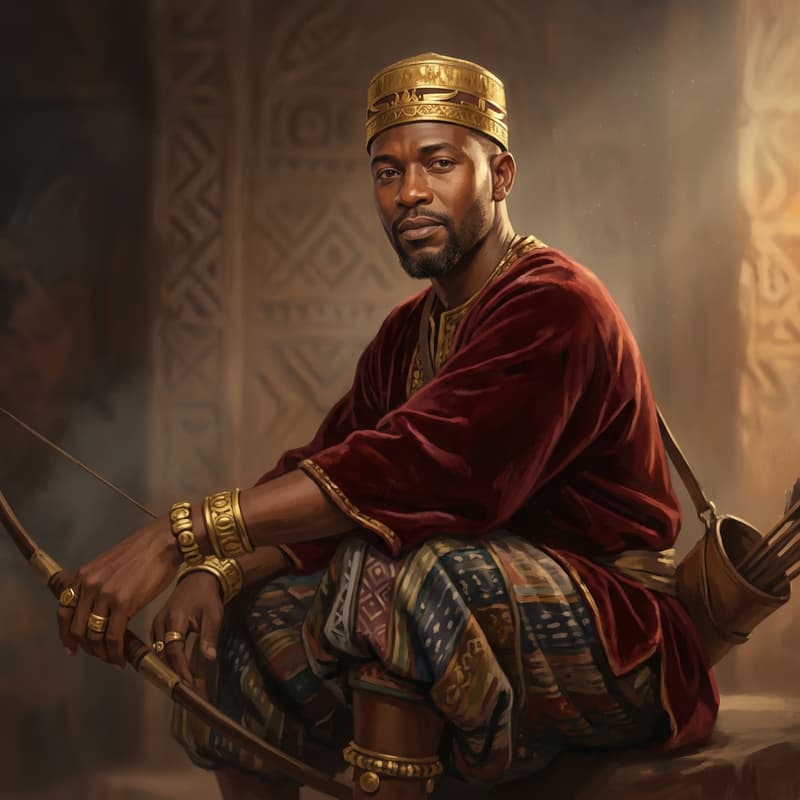
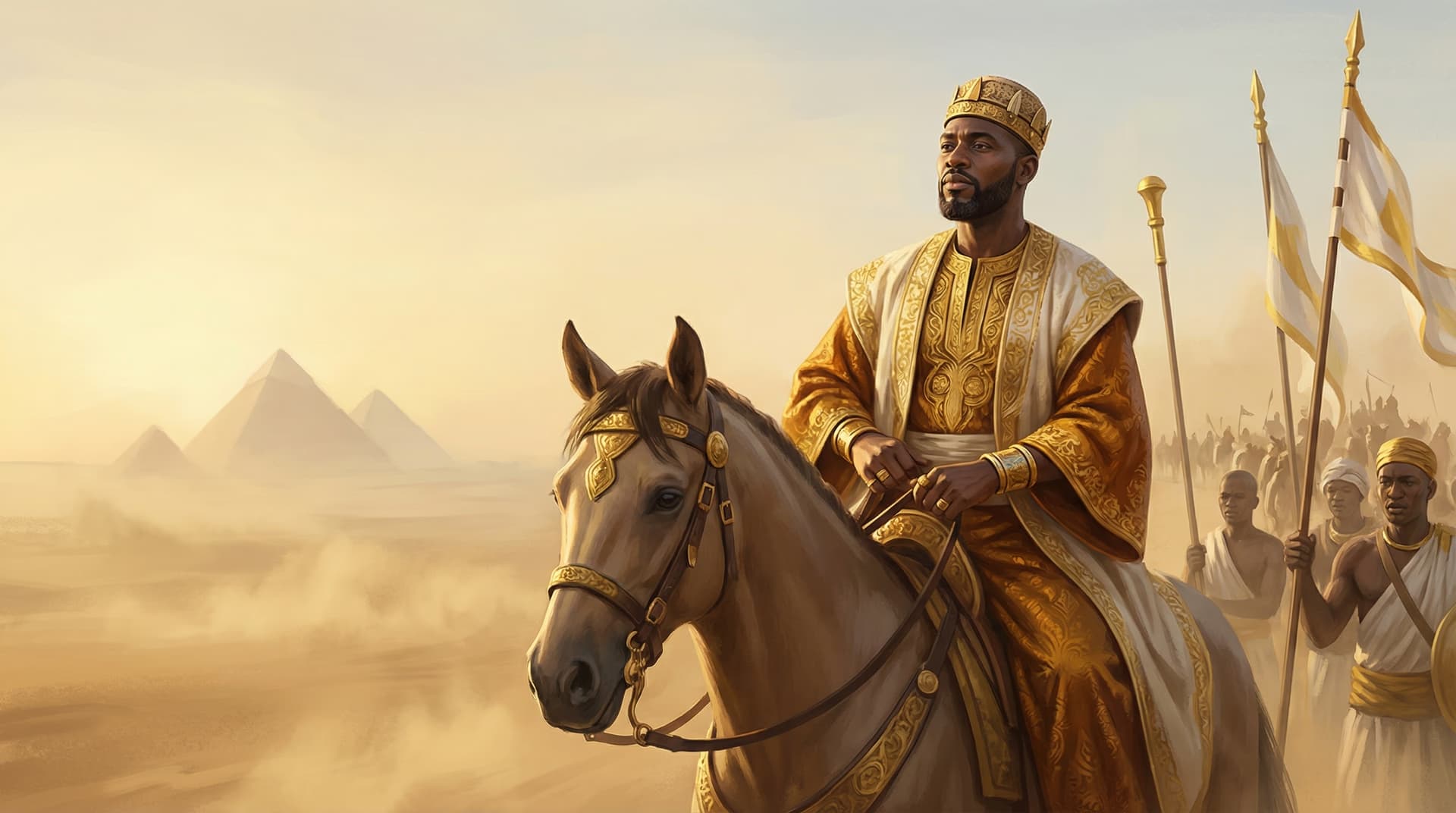
July 1324. Cairo, the largest city in the Islamic world, has seen its share of foreign delegations. But nothing like this. A caravan stretches across the horizon, 60,000 people strong. Twelve thousand slaves walk in rows, each wearing brocade and Persian silk, each carrying four pounds of gold. Eighty camels lumber under loads of gold dust, some hauling up to 300 pounds apiece. At the center of it all rides a man the Egyptians have never heard of, from a kingdom most of them could not find on a map.
His name is Musa, Mansa of Mali. Within weeks, he will give away so much gold that he will crash Egypt's precious metals market for over a decade. He is not trying to cause an economic crisis. He is trying to get to Mecca.
Musa came to power around 1312 under circumstances that read like fiction. His predecessor, Muhammad ibn Qu, became obsessed with the idea of sailing across the Atlantic Ocean. He equipped 200 ships filled with men and another 200 loaded with gold, water, and provisions. He sailed west. One ship returned. The others, including the mansa himself, were never seen again. Musa, serving as deputy, took the throne.
He inherited an empire already rich. Mali controlled the trans-Saharan trade routes that funneled gold from the mines of Bambuk and Bure northward to the Mediterranean world. It controlled the salt trade from the Saharan deposits, the commodity that was, pound for pound, as valuable as gold in West Africa. Under Musa's 25-year reign, Mali expanded to its greatest territorial extent, stretching from the Atlantic coast to the bend of the Niger River, encompassing parts of modern-day Mali, Senegal, Gambia, Guinea, Mauritania, and Niger.
But territory and gold were not enough for Musa. He wanted something that could not be mined or conquered. He wanted knowledge, legitimacy, and a place in the wider Islamic world. The hajj was his announcement.
Personality & Motivations
Musa was devout, strategic, and spectacularly generous, sometimes all at once. Arab chroniclers who encountered him or recorded testimony from those who did consistently noted his piety, his fine manners, and the discipline of his enormous entourage. The Egyptian official Abu'l-Hasan Ali ibn Amir Hajib, who met Musa during the Cairo visit, described a man who was knowledgeable in Arabic and deeply committed to Islamic law and tradition.
But the piety served a purpose beyond the spiritual. Islam was Musa's diplomatic language, the framework through which he connected Mali to the broader network of Islamic states, scholars, and trade routes. He did not merely practice the faith. He invested in it, building mosques, funding universities, and importing scholars. When he returned from Mecca, he brought back the Andalusi poet and architect Abu Ishaq al-Sahili, paying him 200 kg of gold for his services. The knowledge economy was not an afterthought. It was central to his vision.
He also understood the power of reputation. Musa reportedly spread rumors that gold grew like a plant in his kingdom, a piece of strategic disinformation designed to inflate the mystique surrounding Mali. He wanted the world to know his name, and the 1324 hajj was the most expensive marketing campaign in medieval history.
What Most People Get Wrong
The internet loves to call Mansa Musa "the richest person in history," with net worth estimates ranging from $400 billion to "incalculable." It makes a great headline. It is also impossible to verify and probably misleading.
The historian Hadrien Collet has argued that Musa's personal wealth cannot be meaningfully separated from the wealth of the Malian state, and that comparisons across centuries and economic systems are essentially meaningless. A medieval West African emperor's relationship to gold was nothing like a modern billionaire's relationship to stock valuations. Musa controlled gold-producing regions, taxed trade routes, and could command labor on a massive scale, but none of that translates neatly into a dollar figure.
What is not in dispute is the impact. Musa's spending in Cairo depressed the value of gold for more than a decade. Even the historian Warren Schultz, who argues the gold fluctuation was within normal parameters for Mamluk Egypt, acknowledges the sheer volume Musa distributed. The man may or may not have been "the richest ever," but he was certainly rich enough to destabilize an entire regional economy by accident.
Key Moments
The Atlantic Expedition, c. 1311. Musa's predecessor, Muhammad ibn Qu, launches a fleet of 200 ships into the Atlantic Ocean to find out what lies beyond the horizon. He equips another 200 ships with gold, water, and provisions. A single vessel returns. The pilot reports that the other ships were pulled into a "river in the sea," likely the Canary Current, and vanished. Muhammad is among the lost. Musa, serving as regent, ascends to the throne.
Cairo, July 1324. Musa arrives at the outskirts of Cairo with his caravan of 60,000 people, 80 camels laden with gold, and 12,000 slaves in silk. He camps for three days near the Pyramids before crossing the Nile. The Mamluk sultan al-Nasir Muhammad invites him to court. Musa initially refuses to kiss the ground before the sultan, saying he bows only to God, before a compromise is reached. He then distributes so much gold in gifts, tips, and purchases that he single-handedly crashes the Egyptian gold market. The exchange rate does not recover for twelve years.
Mecca, 1324-1325. Musa completes the hajj, fulfilling the fifth pillar of Islam. The 2,700-mile journey from Mali to Mecca and back takes over a year. Along the way, he builds a mosque every Friday, the Muslim holy day. The hajj transforms Mali's reputation. For the first time, sub-Saharan Africa appears on European maps, most famously the 1375 Catalan Atlas, which depicts Musa seated on a golden throne, holding a gold nugget, with the caption: "This Black lord is called Musse Melly, lord of the Blacks of Guinea. So abundant is the gold which is found in his country that he is the richest and most noble king in all the land."
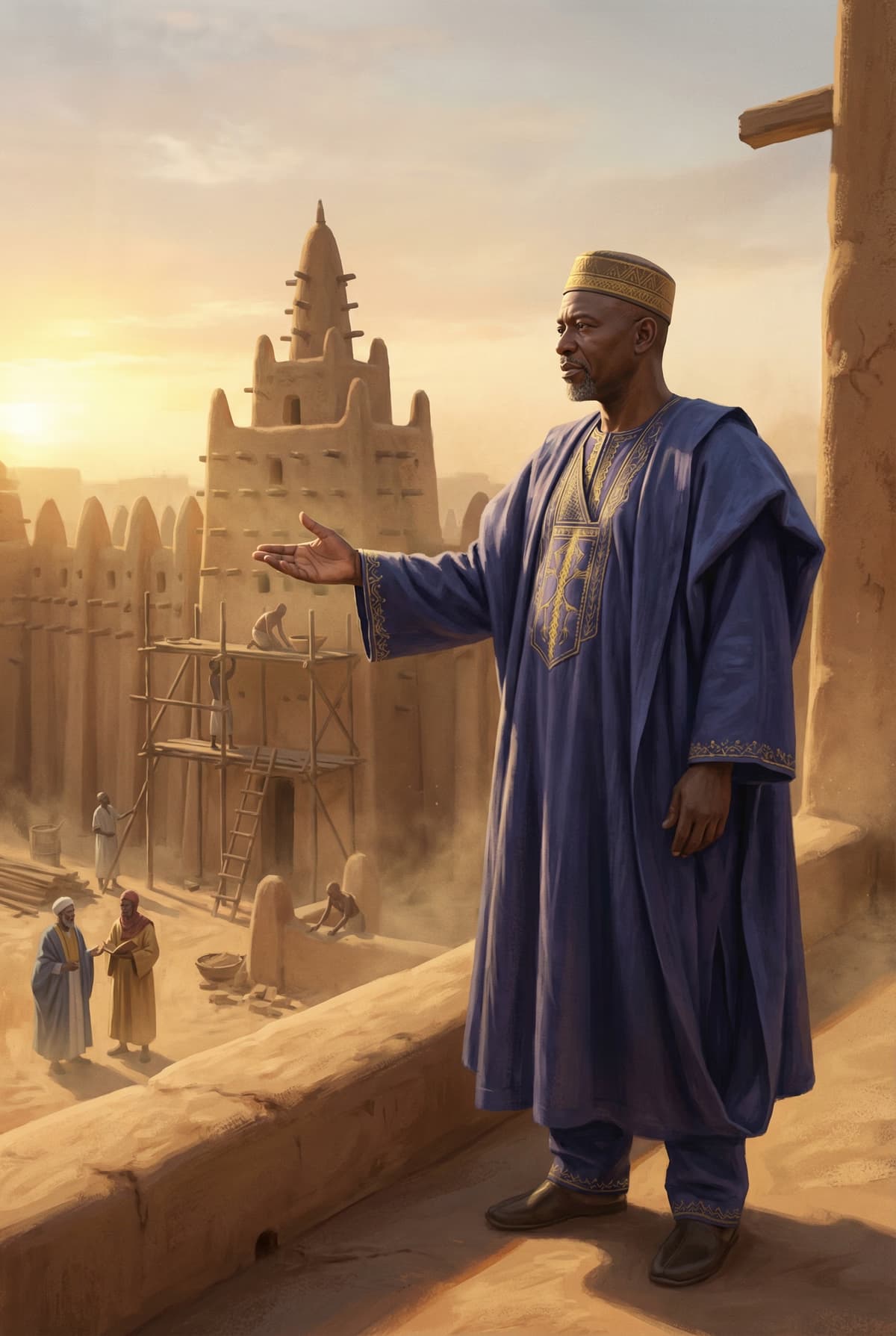
Timbuktu, c. 1327. Returning from Mecca with scholars, books, and the architect Abu Ishaq al-Sahili, Musa begins transforming Timbuktu from a trading outpost into an intellectual capital. He commissions the Djinguereber Mosque and expands the Sankore Madrasah, which will grow into one of the Islamic world's great centers of learning, housing tens of thousands of manuscripts and attracting scholars from across North Africa and the Middle East.
Gao, c. 1325. On his return from hajj, Musa receives the submission of the city of Gao, extending Mali's eastern frontier. He builds another grand mosque there. The annexation of Gao and its surrounding territory represents the peak of Mali's territorial expansion, an empire now spanning roughly 439,000 square miles.
The Detail History Forgot
When Musa ran out of gold to give away in Cairo (or realized he had given away too much), he did something remarkable: he borrowed it back. He took out high-interest loans from Cairo's money-lenders to fund the return journey, using the gold he had already distributed as collateral for the credit. The same man who had crashed the gold market by flooding it with gifts now had to borrow against his own generosity to get home.
This detail, recorded by the historian al-Umari, reveals something about Musa that the "richest man ever" headlines miss. He was not a careful steward of wealth. He was a man who understood that spending lavishly in Cairo bought something more valuable than the gold itself: a reputation that would echo across continents. The loans were repaid, the debts settled, but the story of the African king who gave away more gold than Egypt had ever seen traveled from Cairo to Genoa to Barcelona, permanently altering European understanding of Africa.
The Downfall
Musa died around 1337, after roughly 25 years on the throne. The cause of death is unrecorded. What happened next is not.
His son Maghan I inherited the throne and lost control almost immediately. Within four years of Musa's death, Timbuktu was raided and burned by warriors from the east, demonstrating to every rival and vassal state just how vulnerable Mali had become without its great mansa. Maghan was deposed by his uncle Suleyman in 1341. Suleyman managed to stabilize the empire for a time, but his death in 1360 triggered another succession crisis.
The pattern repeated for decades. Mali had no institutional mechanism for orderly succession, no bureaucratic structures robust enough to survive a change of leadership. Musa had governed through personal brilliance, religious authority, and the sheer weight of gold. He had built mosques, universities, and trade networks, but he had not built a system that could operate without an exceptional individual at the top. Every successor was measured against Musa and found wanting. The provinces began to break away. The Songhai Kingdom to the east, once a vassal, grew powerful enough to swallow what remained.
By the 15th century, Mali was a shadow of what Musa had built. The empire that had appeared on European maps as the seat of the richest king in the world gradually vanished from those same maps. Timbuktu endured, but under Songhai rule. The gold still flowed, but through other hands. Musa's legacy was not an empire. It was a memory, recorded in the chronicles of Arab historians and the illuminated maps of European cartographers, of a king so wealthy that he broke an economy by being generous.