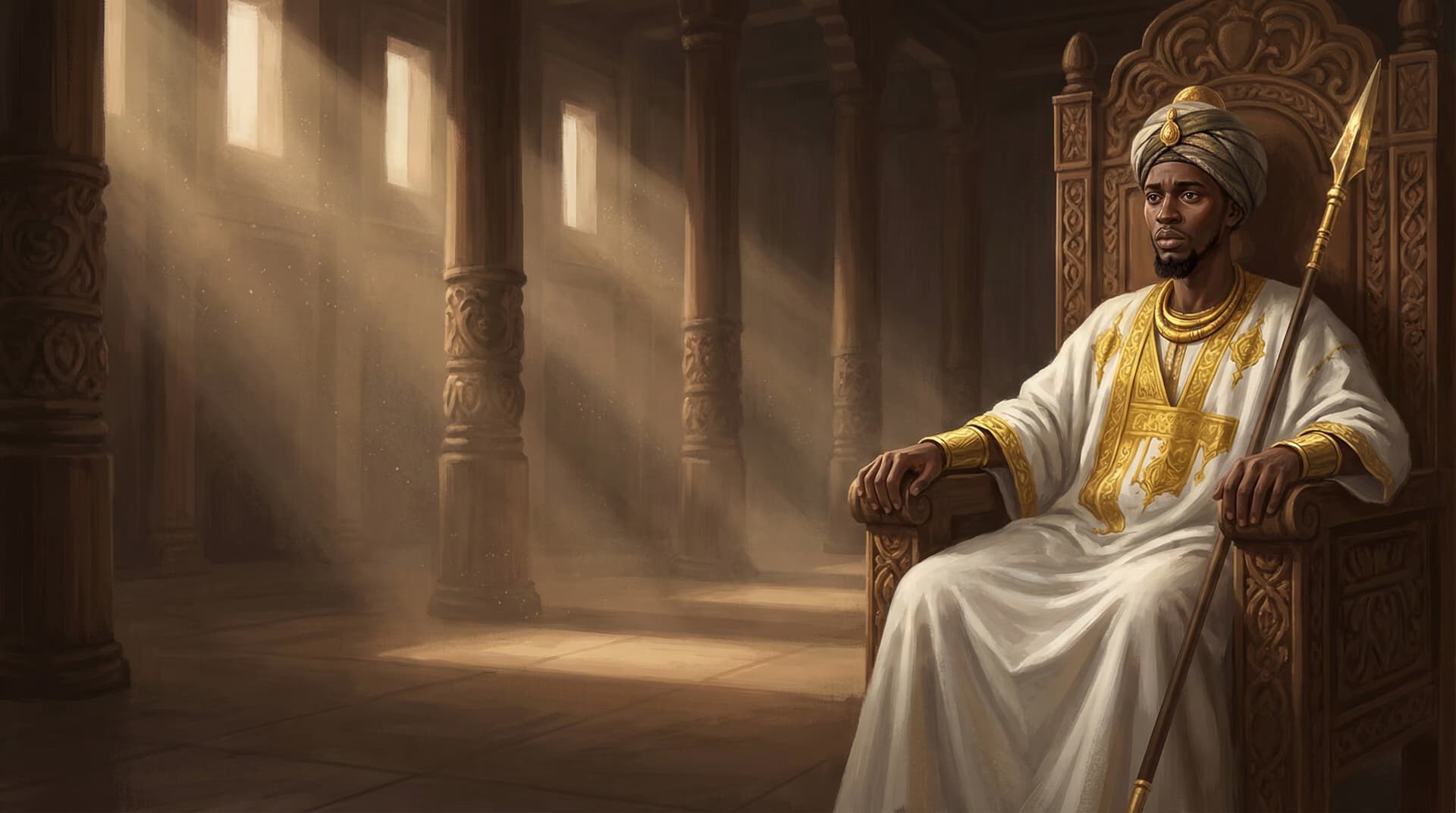
- Known for
- Presiding over the beginning of the Mali Empire's decline as Mansa Musa's immediate successor
- Fatal flaw
- An inability to command loyalty or respect in a system that demanded both, compounded by reckless spending that squandered his father's treasury
The Story
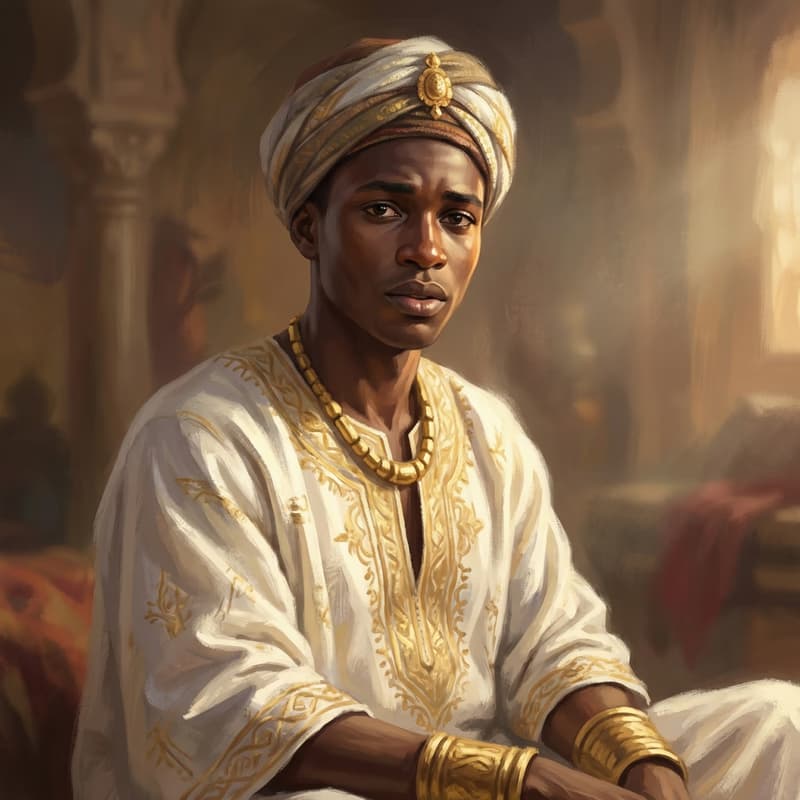
Maghan I became mansa of the Mali Empire around 1337, upon the death of his father, the legendary Mansa Musa. He inherited the largest empire in West Africa, stretching from the Atlantic coast to the bend of the Niger River. He inherited Timbuktu, with its mosques and madrasas. He inherited the trans-Saharan gold trade, the salt routes, and a diplomatic network that extended from Cairo to Fez. He inherited everything his father had built, and he could not hold any of it.
His reign lasted approximately four years. The sources are sparse, but what survives is consistent: Maghan was weak where his father had been strong. He spent lavishly without the strategic purpose that had characterized Musa's generosity. He failed to command the loyalty of Mali's provincial governors and military commanders. Timbuktu, the city Musa had transformed into a center of learning, was raided and burned by warriors from the east during Maghan's reign. The attack was not just a military setback. It was a signal to every vassal state and rival power that the new mansa could not protect the empire's most important city.
In 1341, Maghan was deposed by his uncle Sulayman, Musa's brother. The removal was not violent in the way of Mamluk palace coups, but it was decisive. Maghan disappears from the historical record after his deposition. No source records his death, his exile, or his subsequent fate. He simply ceases to exist in the chronicles, which is perhaps the most damning verdict a medieval historian could deliver: not worth recording.
Personality & Motivations
The historical sources give Maghan I almost no personality. He is defined entirely by contrast with his father, a literary device that may reflect reality or may reflect the tendency of medieval chroniclers to simplify complex successions into parables of decline. What seems clear is that Maghan lacked the political instincts that had allowed Musa to hold a vast, decentralized empire together.
Musa governed through a combination of religious authority, strategic generosity, personal charisma, and the sheer intimidating weight of gold. These are not qualities that transfer automatically from father to son. Maghan appears to have understood the generosity part without grasping the strategy behind it. Reports of wasteful expenditure suggest a ruler who threw money at problems without building the relationships that made his father's spending effective.
He may also have been undermined from the start. Sulayman, who deposed him, was Musa's brother, an experienced member of the royal family with his own networks and loyalties. Maghan may have faced internal opposition from the moment he took the throne, opposition that a more skilled politician might have neutralized but that overwhelmed a young and inexperienced ruler.
What Most People Get Wrong
Maghan I is usually treated as a cautionary footnote, the incompetent son who ruined everything his brilliant father built. The narrative is neat, satisfying, and probably too simple. Mali's decline was not the fault of one man.
The empire Musa built had no formal succession mechanism. Power passed through a combination of bloodline, political maneuvering, and brute force. There was no bureaucracy capable of functioning independently of the mansa's personal authority, no standing constitution, no council of regency. When Musa died, the empire's stability died with him. Maghan was not uniquely incompetent. He was simply the first person to try running a system that had been designed for a genius.
Key Moments
Mali, c. 1324. Maghan is left in at least nominal charge of the empire while his father undertakes the hajj to Mecca. This is the only indication that Musa saw his son as a potential successor. The empire functions during Musa's absence, but this likely reflects the strength of existing administrative structures rather than Maghan's leadership.
Mali, c. 1337. Musa dies after approximately 25 years of rule. Maghan inherits the throne. He is the tenth mansa of the Mali Empire, inheriting a kingdom at its territorial and economic peak. The transition appears smooth initially, but cracks begin to appear almost immediately.
Timbuktu, c. 1338-1340. Warriors from the east, possibly from the Mossi or another neighboring people, raid and burn Timbuktu. The city that Musa had built into an intellectual capital is attacked and damaged. The raid demonstrates that Mali's military deterrent has weakened. Provincial governors and vassal states take note.
Mali, 1341. Sulayman, Musa's brother and Maghan's uncle, deposes Maghan and takes the throne. The deposition is framed in the sources as a response to Maghan's wasteful spending and administrative failures. Maghan disappears from the historical record entirely.
The Detail History Forgot
Maghan I is one of the few Malian mansae whose removal from power did not result in recorded violence. In many succession disputes in the Mali Empire and across the medieval Islamic world, deposed rulers were killed, blinded, or imprisoned. Maghan simply vanished from the record. This silence might indicate that Sulayman allowed his nephew to live, perhaps in internal exile, or it might indicate that chroniclers simply did not care enough about Maghan to record his fate. Either way, the silence is its own kind of verdict. Maghan's entire reign occupies less space in the historical record than a single day of his father's hajj.
The Downfall
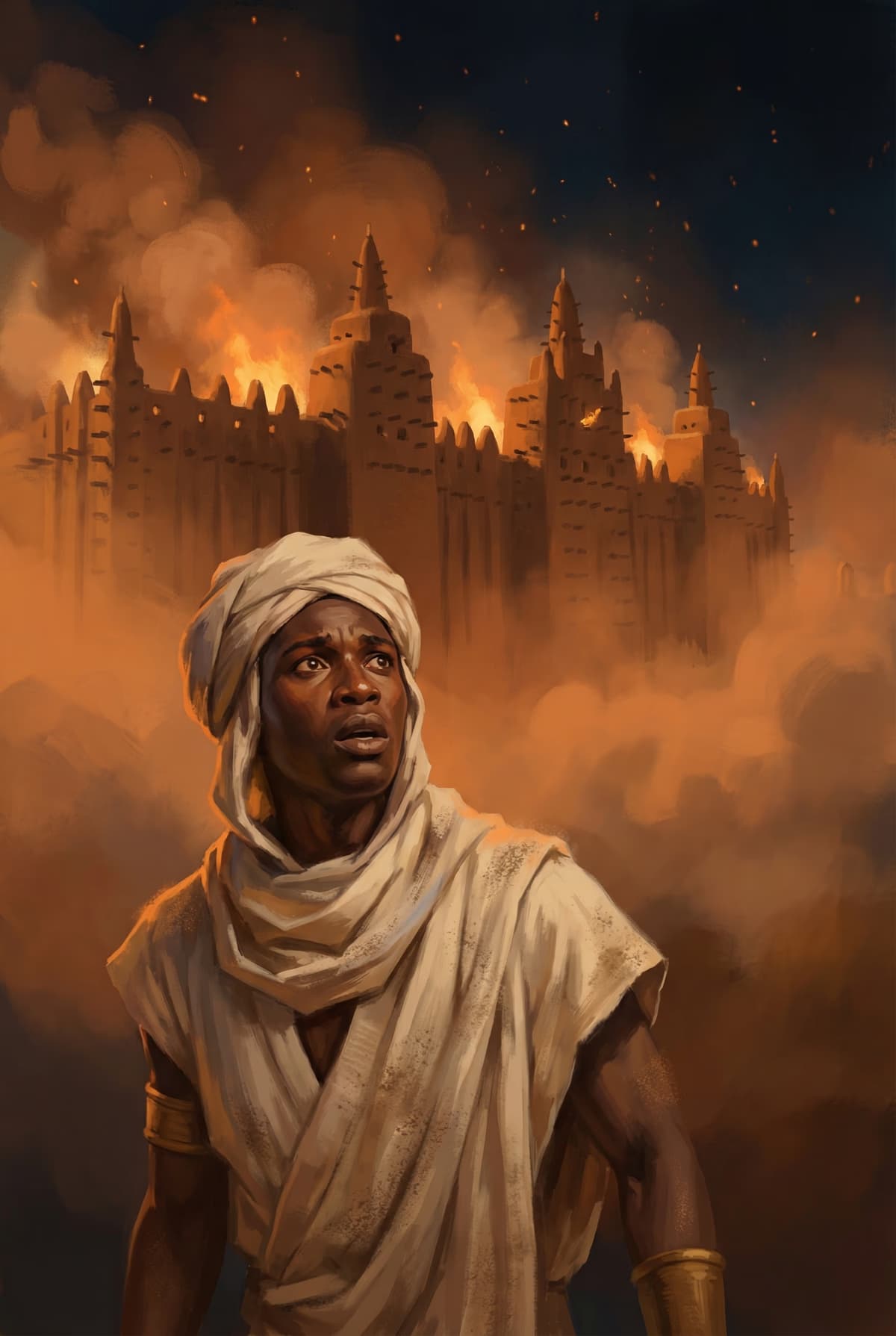
Maghan's downfall was not a single moment but a slow-motion collapse that lasted his entire brief reign. He could not prevent Timbuktu from being raided. He could not stop the hemorrhaging of the treasury. He could not maintain the loyalty of the provincial power brokers who had served his father. And he could not prevent his own uncle from concluding that the empire would be better off with a different mansa.
The deeper problem was structural. Musa had governed through force of personality, backed by seemingly inexhaustible wealth. The personality was gone. The wealth was diminished. What remained was an empire that covered hundreds of thousands of square miles, connected by trade routes that required constant military protection and diplomatic management. Running it demanded exactly the qualities Maghan lacked: decisiveness, authority, and the ability to make powerful men believe they were better off obeying than rebelling.
Sulayman, who replaced him, managed to stabilize the empire for nearly two decades and was regarded as the last great mansa of Mali. But the pattern Maghan's deposition established, of successions determined by palace coups rather than orderly inheritance, would repeat for the rest of the empire's history. Every mansa after Musa was measured against his impossible standard. Maghan was merely the first to be found wanting.