- Known for
- Launching a massive fleet into the Atlantic Ocean and vanishing, clearing the way for Mansa Musa
- Fatal flaw
- An obsession with the unknown that cost him an empire he could have ruled for decades
The Story
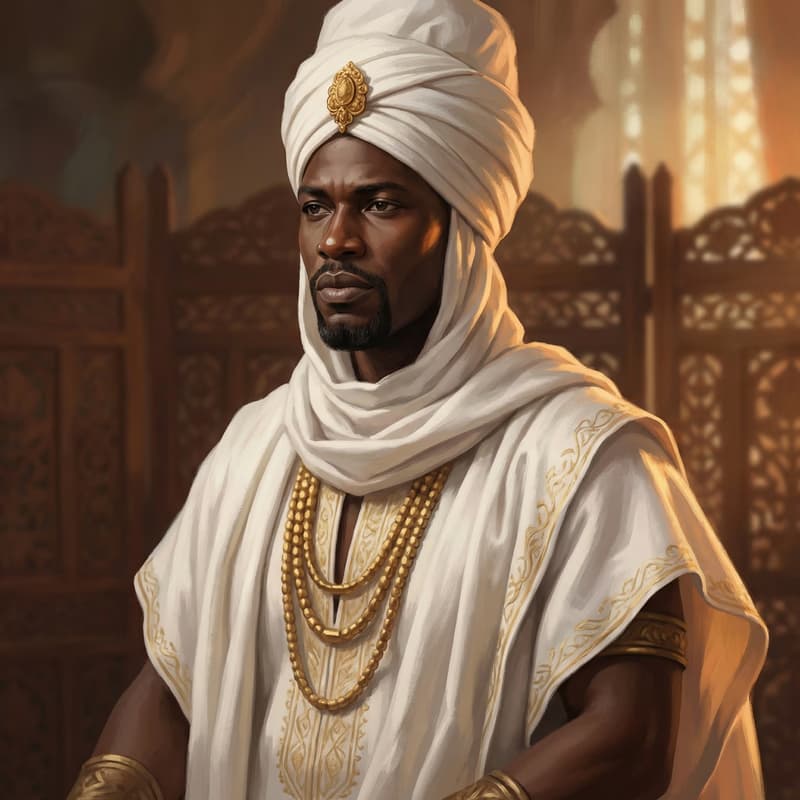
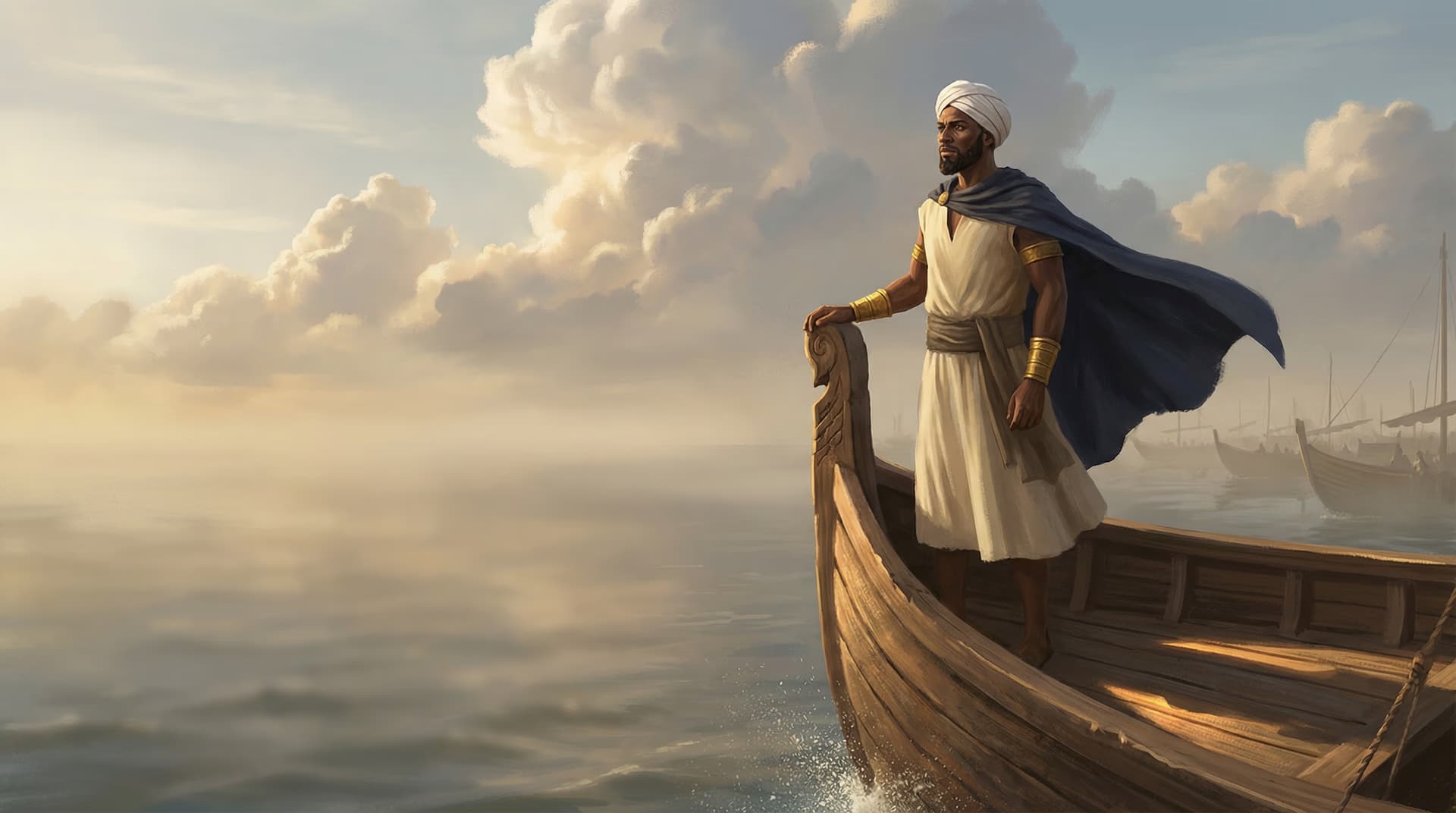
Sometime around 1311, the mansa of the Mali Empire stood on the Atlantic coast of West Africa and stared at the horizon. Behind him lay the richest kingdom on the continent, an empire that controlled the gold and salt trades feeding half the known world. Ahead lay nothing anyone had ever mapped. He chose the horizon.
His name has been debated for centuries. Arab chroniclers and modern historians have called him Abu Bakr II, Muhammad ibn Qu, Mansa Muhammad, and half a dozen other variations, each name trailing its own chain of mistranslations and scholarly disputes. What is not disputed is what he did. He equipped a fleet, sailed west into the Atlantic Ocean, and never came back.
The story survives because of the man who replaced him. In 1324, when Mansa Musa arrived in Cairo on his legendary hajj, Egyptian officials asked how he had come to power. Musa told them his predecessor had become consumed by a single question: what lay on the other side of the ocean? The mansa had first sent an exploratory fleet of 200 ships. A single vessel returned. Its pilot reported that the others had been caught in a "river in the middle of the sea," almost certainly the Canary Current, and swept away. The mansa was not discouraged. He was inflamed. He assembled a second fleet, this one numbering 2,000 vessels, 1,000 filled with men and 1,000 loaded with gold, water, and provisions. He appointed Musa as his deputy, stepped aboard, and sailed into the Atlantic. No ship returned. No message arrived. The mansa of Mali had vanished.
Musa took the throne. The rest is history. The man who left is a mystery.
Personality & Motivations
Everything we know about Abu Bakr II's personality comes filtered through a single source: Mansa Musa's account to Egyptian officials, later recorded by the historian al-Umari. The portrait that emerges is of a man driven by curiosity to the point of recklessness. He did not merely wonder about the Atlantic. He tested it, lost 200 ships, and responded by building ten times as many.
This was not the behavior of a cautious administrator. The Mali Empire in the early 14th century was at or near its peak, controlling the trans-Saharan gold trade, commanding tens of thousands of subjects, and enjoying diplomatic relationships across the Islamic world. A conventional ruler would have consolidated, expanded overland, or focused on internal governance. Abu Bakr II looked past all of it. The Malian historian Gaoussou Diawara has argued that the mansa should be admired as a ruler who valued science and discovery over holding onto power. Others have noted that Malian oral tradition is conspicuously silent about the voyage, which may reflect a view that the mansa's expedition was a shameful abdication of duty.
Both interpretations may be true. A man can be visionary and irresponsible at the same time.
What Most People Get Wrong
The internet is full of articles about "Abu Bakr II," but that name is almost certainly wrong. The inclusion of a Mansa Abu Bakr II in the list of Malian rulers originated in a mistranslation of Ibn Khaldun's text by the 19th-century European historian Baron de Slane. De Slane translated Ibn Khaldun as saying that the kingship passed from Muhammad to Abu Bakr, then to Musa. In the original Arabic, Abu Bakr is mentioned only as the progenitor of Musa's lineage, not as a separate ruler.
According to Ibn Khaldun, Musa's actual predecessor was Muhammad ibn Qu (Mansa Muhammad). The voyage should be attributed to him. But "Abu Bakr II" has taken on a life of its own, appearing in documentaries, articles, and Afrocentric histories as a bold explorer-king. The real man behind the legend had a different name. The story, however, remains the same.
Key Moments
The First Fleet, c. 1310. The mansa equips 200 ships and sends them west into the Atlantic Ocean to discover what lies beyond the horizon. The fleet departs from the West African coast, likely from the Senegambian region. Days pass. Weeks. Months. Eventually, a single ship returns. The pilot tells the mansa that the other vessels were pulled into a powerful current, "a river in the middle of the sea," and dragged away. The ships that entered the current never emerged. One hundred and ninety-nine vessels and their crews are lost.
The Decision, c. 1311. A rational ruler would have absorbed the loss and moved on. The mansa does the opposite. He orders the construction of a second fleet, this one ten times larger: 2,000 vessels. One thousand are filled with men. One thousand are loaded with gold, water, and enough provisions to last years. The scale of the undertaking suggests not impulse but planning, months or years of preparation, shipbuilding, and resource allocation. This was not a whim. It was a project.
The Departure, c. 1311-1312. The mansa appoints his deputy, Musa, to govern in his absence. He boards one of the 2,000 ships. The fleet sails west from the Atlantic coast. No ship returns. No message is sent. No wreckage washes ashore in any account that survives. The mansa, his fleet, his men, and a kingdom's worth of gold disappear into the ocean.
Cairo, 1324. Twelve years later, Musa tells the story to stunned Egyptian officials during his hajj. The historian al-Umari records it. The tale of the vanished fleet enters the historical record, where it will be debated, embellished, and mythologized for the next seven centuries.
The Detail History Forgot
The "river in the middle of the sea" that swallowed the first fleet was almost certainly the Canary Current, a powerful oceanic flow that runs southwest from the coast of West Africa toward the Caribbean. The Canary Current was later used by European sailors, including Columbus, as a natural highway to the Americas. The surviving pilot had, without knowing it, described the same force that would carry Spanish caravels to the New World nearly two centuries later.
This means the Malian fleet was not simply lost at sea. It was caught in a current that flows directly toward the Americas. Whether any of the ships completed the crossing is unknown. No uncontroversial archaeological evidence of pre-Columbian African contact with the Americas has been found. But Columbus himself noted in his journal that Native Americans told him of "black-skinned people" who had come from the southeast in boats, trading gold-tipped spears. The natives called the spearheads "guanin," a word strikingly similar to the Mande word for gold.
The Downfall
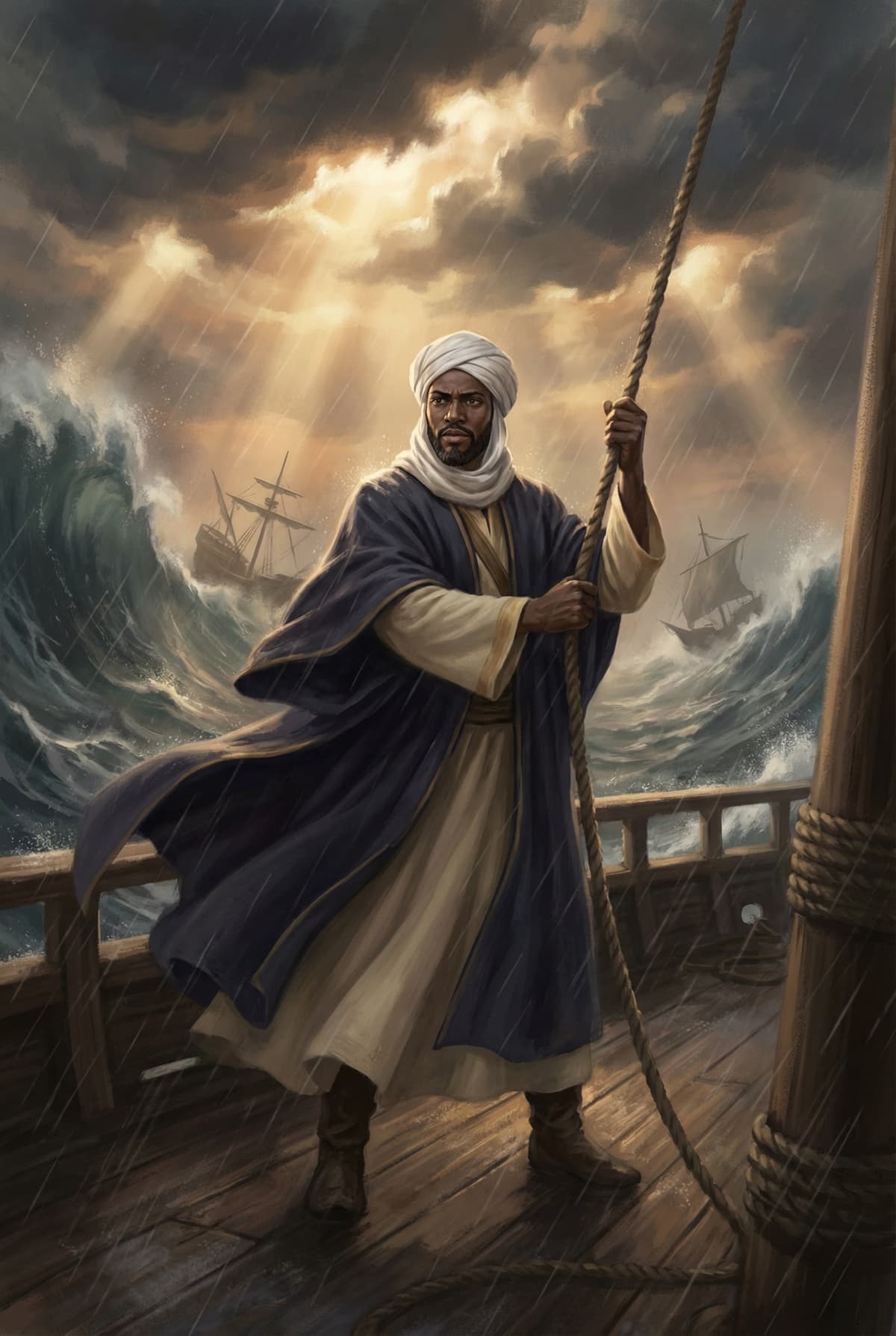
Abu Bakr II's downfall is inseparable from his defining act. He did not lose a battle, suffer a coup, or die of disease. He walked away from an empire to chase a question, and the ocean swallowed the answer.
The scale of the loss was staggering. Two thousand ships represented an enormous investment of resources, manpower, and state capacity. The men aboard those vessels were not expendable. They were soldiers, sailors, navigators, and craftsmen, the kind of skilled population that an empire needs to function. The gold loaded onto the provision ships was wealth that could have funded decades of building, trade, and diplomacy. Abu Bakr II did not just risk his own life. He gambled a significant portion of Mali's human and material capital on a voyage with no precedent and no guarantee.
And yet the empire survived. Musa proved to be not merely a competent placeholder but one of the most remarkable rulers in African history. The throne Abu Bakr II abandoned became the platform for Musa's legendary reign, his world-altering hajj, his transformation of Timbuktu into a center of learning. There is an irony the chronicles do not acknowledge: Abu Bakr II's greatest contribution to history may have been leaving. By vanishing into the Atlantic, he cleared the path for a successor who would put Mali on the map of the world. The voyager king is remembered, when he is remembered at all, as the man who made room for Mansa Musa.