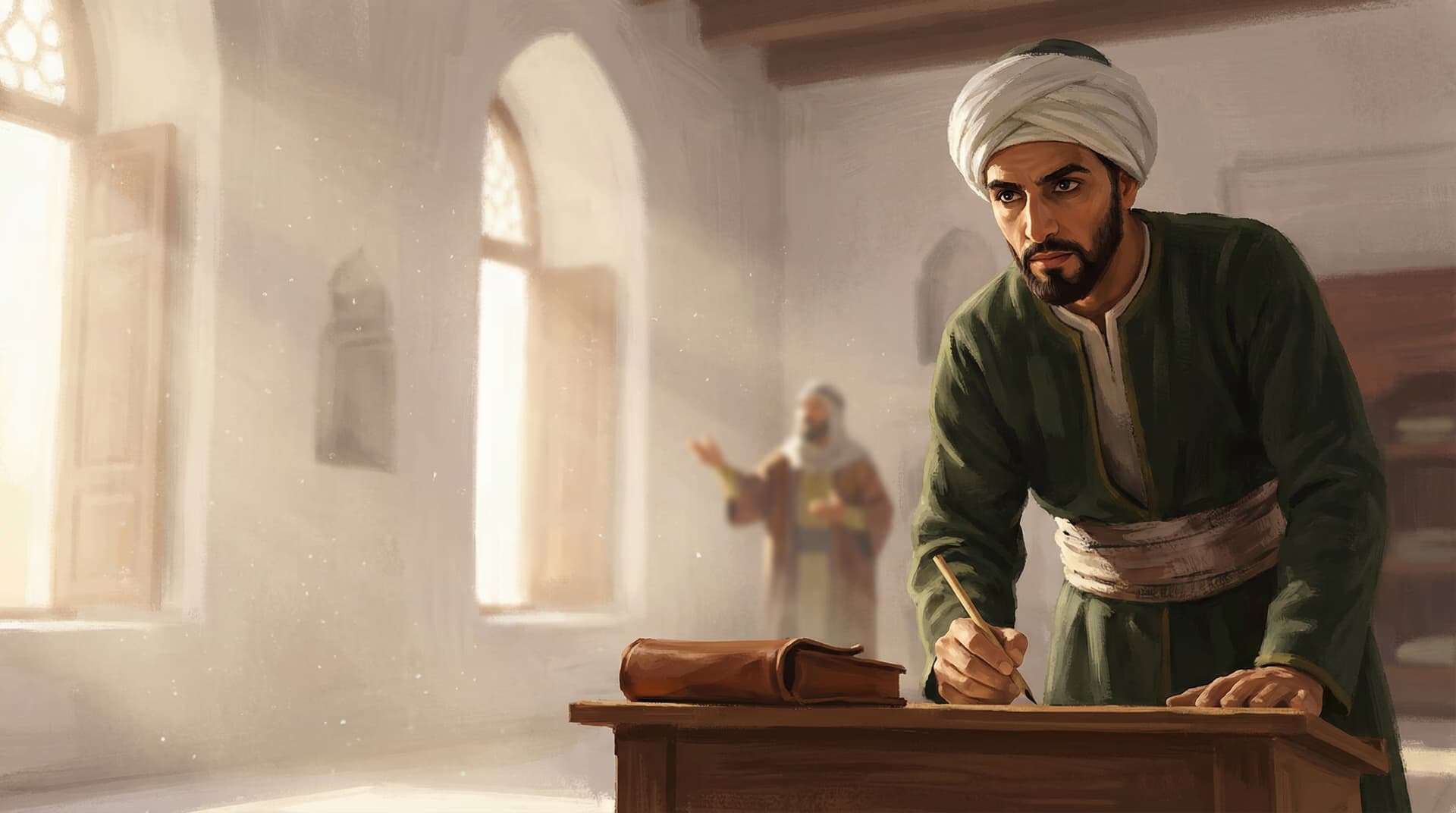
- Known for
- Writing the most important Arabic account of Mansa Musa's 1324 hajj and the Mali Empire
- Fatal flaw
- A temperament so combative that it landed him in prison and exile, cutting short a career that should have produced far more
The Story
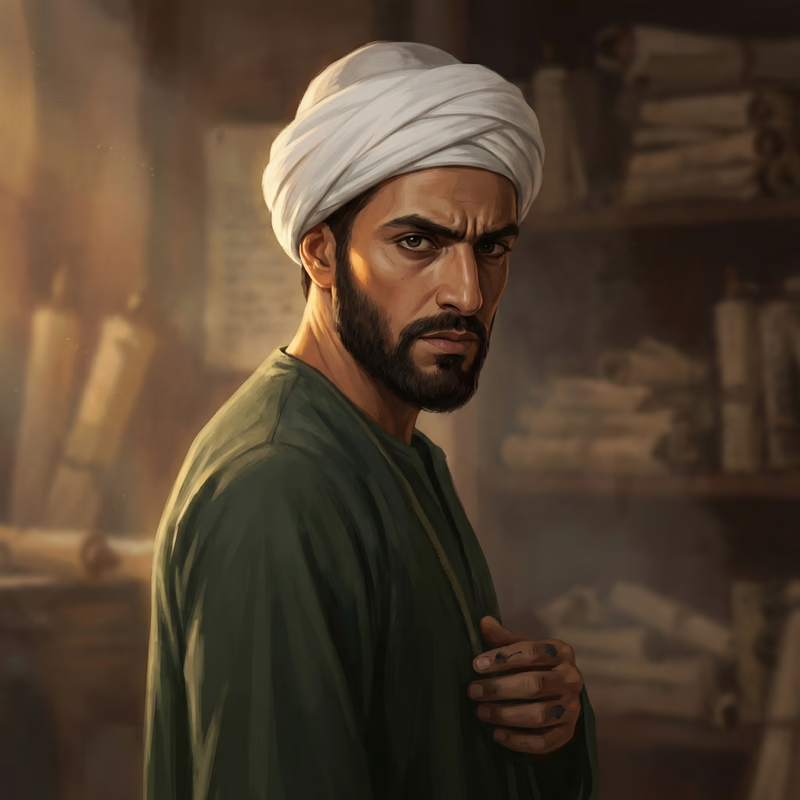
Shihab al-Din Abu al-Abbas Ahmad ibn Fadlallah al-Umari arrived in Cairo sometime after 1324 and found a city still talking about the African king who had broken its economy. Mansa Musa had already left, continuing his hajj to Mecca and then home to Mali. But the effects of his visit lingered in the gold markets, the stories of the merchants, and the memories of the officials who had received him. Al-Umari, trained to gather information the way other men gathered taxes, began interviewing everyone who had met the Malian emperor.
The result was the most detailed and reliable Arabic account of Mansa Musa's 1324 hajj, preserved in al-Umari's encyclopedic work, Masalik al-absar fi mamalik al-amsar ("Routes of Insight into the Realms of the Cities"). It is al-Umari who records that Musa brought 60,000 people, that his spending crashed the gold market, that the exchange rate took twelve years to recover. It is al-Umari who preserves Musa's account of his predecessor's Atlantic voyage. It is al-Umari who captures the detail that Musa, having given away too much gold, borrowed it back from Cairo's money-lenders at high interest.
Without al-Umari, Mansa Musa would be a footnote. The hajj might survive as a vague legend, a story of an African king who gave away gold. Al-Umari made it specific: names, numbers, dates, economic data, diplomatic protocols. He turned a spectacle into a historical record.
Al-Umari was born on June 12, 1301, in Damascus, the son of a powerful Mamluk bureaucrat. His father held the post of head of the chancery of the Mamluk Empire, the office that handled official correspondence and diplomatic dispatches. Al-Umari was born into the administrative elite of the most powerful state in the Islamic world, and he was trained to do what his family had done for generations: process, record, and organize information on a massive scale.
Personality & Motivations
Al-Umari was a man of formidable intellect and formidable temper. He was a student of Ibn Taymiyya, the controversial Islamic scholar whose writings would influence Islamic thought for centuries. He served as a chancery official, handling diplomatic correspondence in both Cairo and Damascus. He had the skills and connections to become one of the most powerful bureaucrats in the Mamluk state.
Instead, he kept getting arrested. In March 1339, al-Umari was detained following an altercation with the sultan. His father intervened and persuaded the sultan to commute the punishment to house arrest. He clashed with the sultan again and was imprisoned, then released in October. He subsequently relocated to Damascus, where he worked as a secretary from 1340 to 1343 before further conflicts ended even that position.
The pattern suggests a man who could not moderate his opinions or his tongue, brilliant at gathering and organizing knowledge but incapable of the political compromises that a career in Mamluk administration required. His consolation was scholarship. The same obsessive attention to detail that made him a valuable bureaucrat made him an extraordinary historian. If the Mamluk state would not let him run its correspondence, he would document its world.
What Most People Get Wrong
Al-Umari is often treated as a neutral recorder, a historical camera pointed at Mansa Musa's hajj. He was not. He was a Mamluk insider with a specific perspective, writing for a Mamluk audience. His account of Musa's visit is colored by the assumptions and interests of the Cairene elite: they are fascinated by the gold, bewildered by the scale of the caravan, and somewhat condescending toward the African emperor's unfamiliarity with Mamluk court protocol.
This does not make al-Umari's account unreliable. It makes it a document of two cultures encountering each other, each interpreting the other through its own framework. When al-Umari records that Musa initially refused to kiss the ground before the sultan, he is documenting both Musa's pride and the Mamluk expectation that all visitors should prostrate themselves. The history he wrote was not objective. It was the most detailed subjective account anyone produced.
Key Moments
Damascus, June 12, 1301. Al-Umari is born into one of the most powerful bureaucratic families in the Mamluk Empire. His father is head of the chancery, the office that processes the empire's diplomatic correspondence. The young al-Umari grows up surrounded by state documents, intelligence reports, and the administrative machinery of a superpower.
Cairo, c. 1325-1330s. Al-Umari visits Cairo and begins gathering testimony about Mansa Musa's 1324 visit. He interviews officials, merchants, and witnesses who met the Malian emperor. He records their accounts with the precision of a trained bureaucrat: the size of the caravan, the quantity of gold distributed, the diplomatic protocols observed and violated, the economic impact on Cairo's gold market. This research will form the core of his account of the Mali Empire.
Cairo, March 1339. Al-Umari is arrested following a confrontation with the sultan. His father intervenes to save him from severe punishment, and the sentence is commuted to house arrest. The incident reveals both al-Umari's inability to navigate court politics and his family's continued influence in the Mamluk administration.
Damascus, 1340-1343. Exiled from Cairo, al-Umari works as a secretary in Damascus and devotes increasing time to his scholarly projects. He compiles the Masalik al-absar fi mamalik al-amsar, an encyclopedic work covering the geography, peoples, and rulers of the known world. The section on the Mali Empire, drawn from his Cairo interviews, becomes one of the most important sources for medieval African history.
Damascus, March 1, 1349. Al-Umari dies at the age of forty-seven. His death at a relatively young age, possibly during the Black Death pandemic that devastated Damascus in 1348-1349, cuts short a career that had already produced an extraordinary body of work. The Masalik al-absar survives and circulates in the Arabic-speaking world, preserving his account of Musa's hajj for future centuries.
The Detail History Forgot
Al-Umari recorded a detail about Mansa Musa that most modern retellings omit. When Musa's gold flooding of the Cairo market caused a crash in the exchange rate, Musa did not simply leave the problem behind. He borrowed gold back from Cairo's money-lenders, at high interest, to fund his continuing journey to Mecca. The same man who had just crashed the gold market by giving too much away was now borrowing at unfavorable rates from the very merchants who had benefited from his generosity.
Al-Umari saw the irony clearly. The passage reveals something crucial about Musa: his generosity in Cairo was not a calculated investment. It was compulsive, or at least poorly planned. The richest man in the world ran out of money in someone else's city and had to take out loans to get home. Al-Umari preserved this detail because it complicated the narrative. A lesser historian would have left it out.
The Downfall
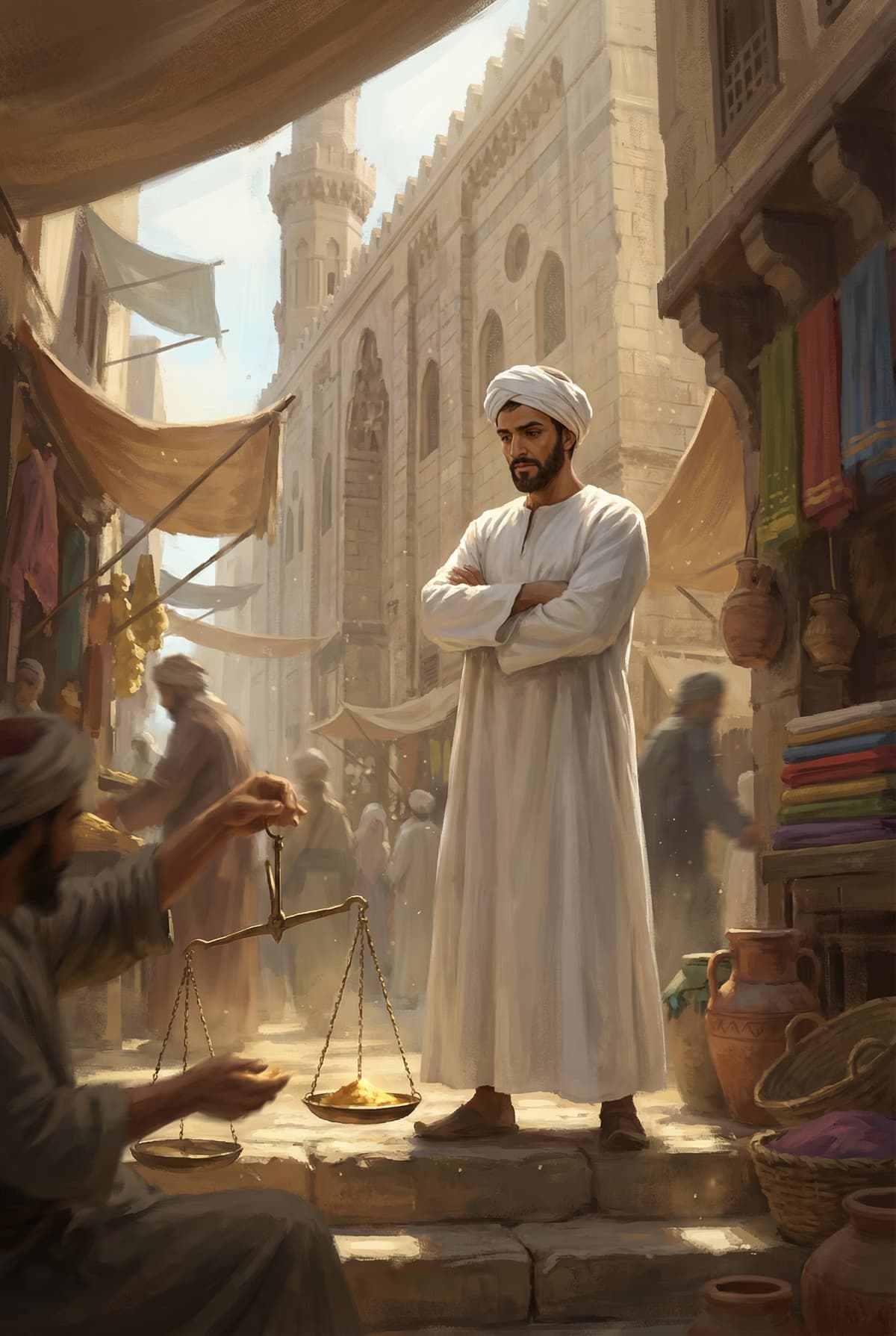
Al-Umari died on March 1, 1349, in Damascus. He was forty-seven years old. The timing coincides with the arrival of the Black Death in Syria, which killed roughly a third of Damascus's population between 1348 and 1349, though no source explicitly names plague as his cause of death.
His career had been marked by a frustrating gap between talent and temperament. He had the intellectual gifts to become one of the great administrators of the Mamluk state, inheriting his father's position and connections. Instead, his combative personality led to arrests, imprisonments, and exile. The bureaucratic career that should have been his birthright became a series of interrupted appointments.
But the exile produced the scholarship. Al-Umari's greatest work, the Masalik al-absar, was the product of a man with too much talent and too much time, channeled into the encyclopedic documentation of everything he knew. The section on the Mali Empire, built from interviews he conducted in Cairo, became the foundation for all subsequent historical understanding of Mansa Musa's hajj. Without al-Umari's temperament problem, without the arrests and the exile and the enforced leisure, the most famous episode in medieval African history might have gone unrecorded.
Al-Umari did not live to see the impact of his work. The Masalik al-absar circulated in manuscript form for centuries, read by other Arabic-language historians and geographers. It informed later accounts by Ibn Khaldun and others. It was not translated into European languages until the 20th century, when the French historian Maurice Gaudefroy-Demombynes published a French edition in 1927. The historian who made Mansa Musa famous had to wait nearly six hundred years for the wider world to notice.