- Known for
- Conquering Wales, reforming English law, and waging decades of war against Scotland
- Fatal flaw
- Could not stop. Every victory demanded another humiliation, every conquest another campaign, until his wars consumed his treasury, his health, and his legacy.
The Story
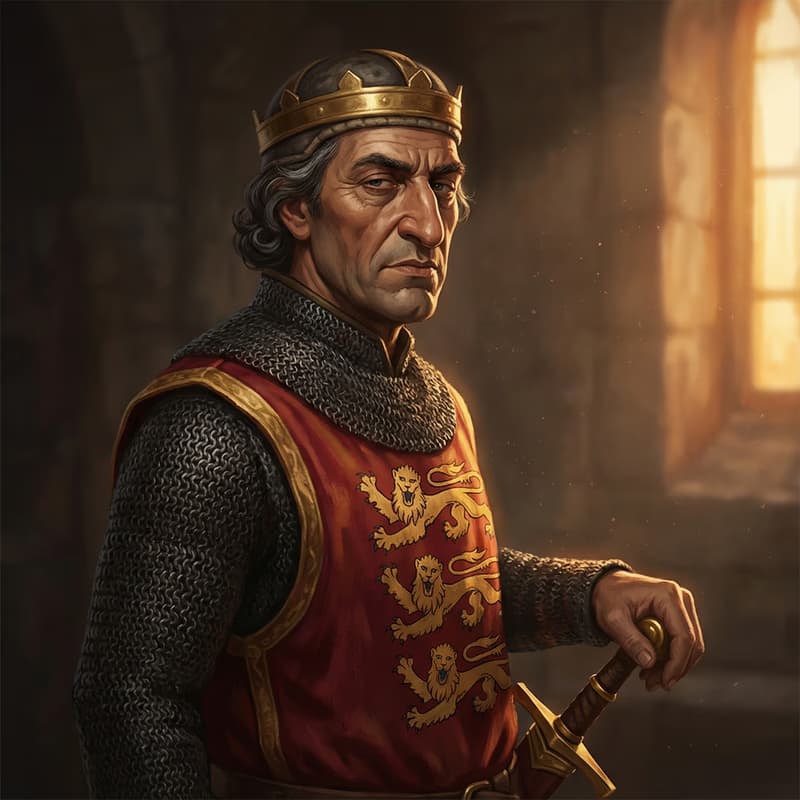
July 7, 1307. An old man is dying in a tent on the marshes of Burgh by Sands, just miles from the Scottish border. His servants come to lift him so he can eat. He dies in their arms. He is sixty-eight years old, riddled with dysentery, and still marching north. Still reaching for Scotland.
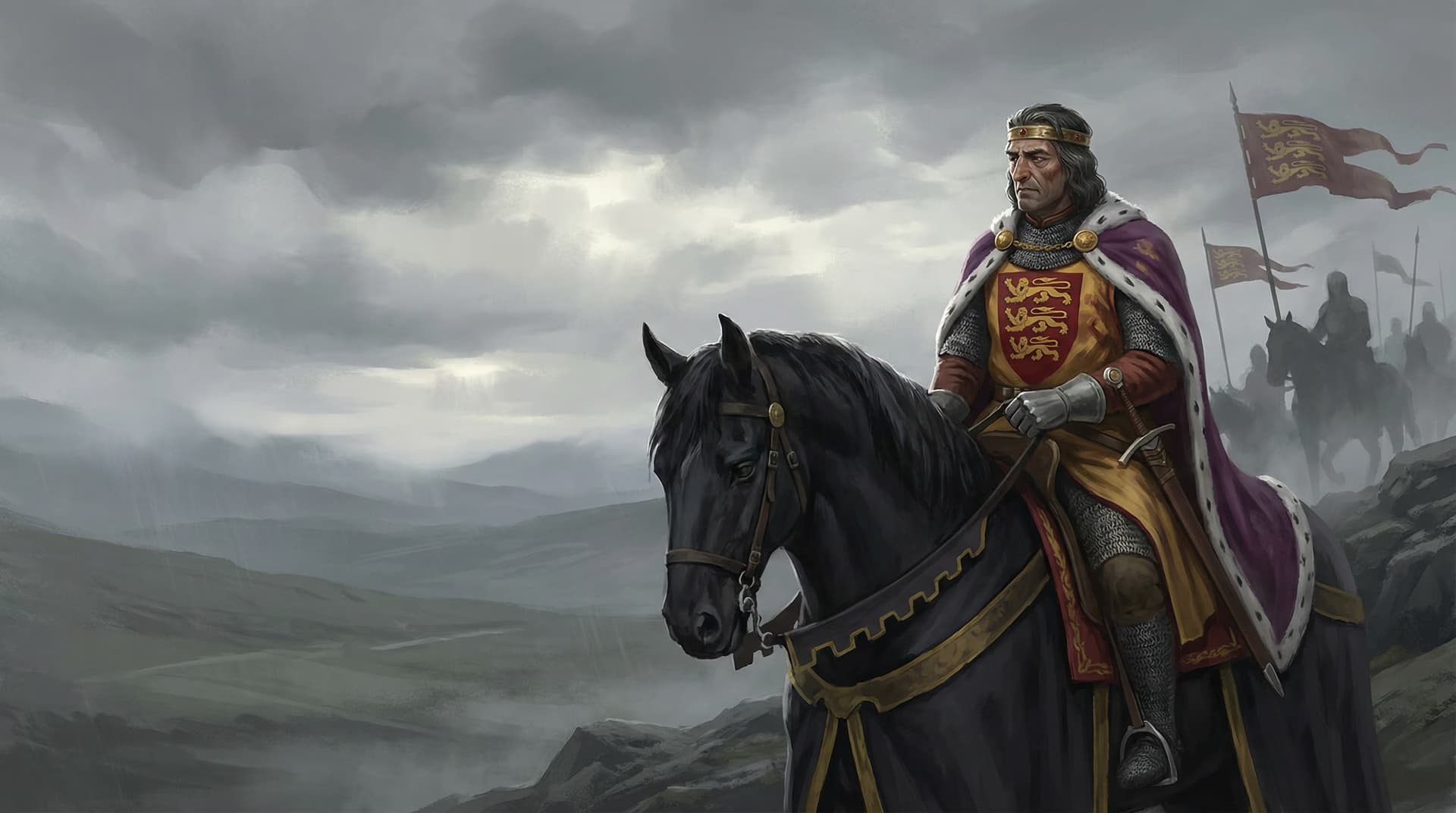
Edward I was the tallest king England ever produced, a man who stood six foot two in an era when the average man barely cleared five foot seven. They called him Longshanks for his impossibly long legs, and the nickname stuck because it captured something true about him: he was always striding toward the next conquest, the next law, the next war, faster than anyone could keep up.
He was also the most dangerous king of his century. He crushed Wales so completely that he built a ring of castles around Snowdonia that still stand today. He rewrote English common law so thoroughly that historians compared him to the Roman Emperor Justinian. He created the Model Parliament, established the Prince of Wales title, and expelled every Jew from England for the next 365 years. He was a crusader, a lawmaker, a castle builder, and a man who skinned his enemies' reputations the way Wallace skinned Hugh Cressingham.
But Scotland broke him. Not in battle, where he won nearly every engagement, but in the grinding, decades-long reality that a country cannot be held by a king who rules through humiliation. He stole the Stone of Scone, executed William Wallace with spectacular cruelty, sacked Berwick with a massacre that shocked even medieval chroniclers, and none of it worked. Scotland kept fighting. And Edward kept marching north, year after year, until his body gave out on a muddy road to nowhere.
Seven years after his death, his son lost at Bannockburn everything Edward had spent two decades trying to take.
Personality & Motivations
The Song of Lewes, a Latin poem written during the civil war of 1264, compared Edward to a leopard: "A lion by pride and fierceness, he is by inconstancy and changeableness a pard, changing his word and promise, cloaking himself by pleasant speech." The comparison stuck because it was precise. Edward was ferocious in war and slippery in politics. His eyes, according to one chronicler, "sparkled like fire" when he was angry. He spoke with a lisp that somehow made his words more persuasive, not less.
He was a man of stark duality. In his youth, he was arrogant, violent, treacherous. In maturity, he showed patience, generosity, and something close to idealism. The difference was his wife. As long as Eleanor of Castile lived, the better side of Edward dominated. She traveled with him everywhere, through Wales, Scotland, France, the Holy Land. She gave birth to their children on campaign. She was his moderating force. When she died in 1290, something in him broke. His chancellor Robert Burnell died two years later. Without Eleanor's steadying presence and Burnell's counsel, Edward's autocratic temper ran unchecked for the final fifteen years of his reign.
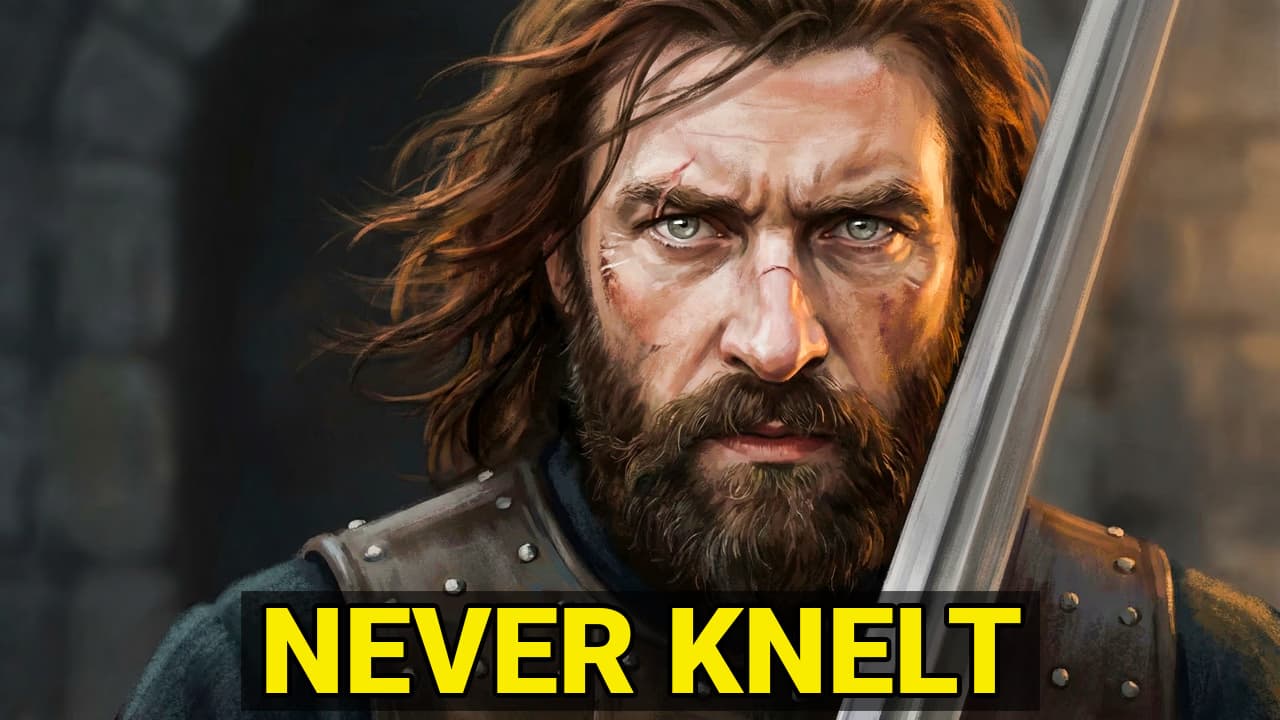
What drove him was an almost pathological need for order and dominion. He saw himself as the rightful overlord of all Britain, and he pursued that vision with the relentless energy of a man who could not distinguish between asserting legitimate authority and crushing everything in his path. Historian R.R. Davies called his "repeated and gratuitous belittling of his opponents" one of the most consistent and unattractive features of his character. He displayed Llywelyn's severed head at the Tower of London crowned with ivy, mocking a Welsh prophecy. He made Dafydd the first man in recorded history to be hanged, drawn, and quartered. He refused to accept the surrender of Stirling Castle until he had tested his new trebuchet on its walls. Every defeated enemy had to be not merely beaten but humiliated, and every humiliation bred more resistance than it suppressed.
What Most People Get Wrong
Most people picture Edward I as the snarling villain from Braveheart, a one-dimensional tyrant who threw his son's lover out a window and enacted the "right of the first night" over Scottish brides. Almost none of it is true.
The jus primae noctis, the film's central inciting incident, never existed as law anywhere in medieval Europe. Medieval scholars have never found trustworthy evidence for it. The window scene never happened. And the real Edward was far more interesting than a cartoon villain. His first major act as king was the most comprehensive survey of English land ownership in two hundred years, followed by legal reforms so sweeping that he earned the title "the English Justinian." He made trial by jury mandatory, restructured commercial law, and created the parliamentary framework that would eventually limit royal power for centuries. The man who destroyed Wallace also created the constitutional machinery that would one day destroy absolute monarchy. Braveheart erased the reformer and kept the tyrant, which is exactly backwards for the first twenty years of his reign.
Key Moments
Escape from captivity, May 1265. After the Battle of Lewes, Edward was held hostage by Simon de Montfort's forces. He convinced his captors to let him exercise their horses. Day after day, he rode them, racing his guards, testing which mounts were fastest. Then one afternoon, after exhausting every horse in the stable, he leapt onto a fresh mount he had arranged in advance and galloped to freedom. Three months later, he killed de Montfort at the Battle of Evesham in a fight so one-sided that a chronicler called it "the murder of Evesham, for battle it was none."
The assassination attempt, June 1272. In Acre, during the Ninth Crusade, a member of the Syrian Order of Assassins stabbed Edward with a poisoned dagger. Edward killed the man with his bare hands, then collapsed. A surgeon saved his life by cutting away the blackened, infected flesh around the wound. The popular story that Eleanor sucked the poison from the wound is almost certainly legend, but what is documented is that she had to be led from the room weeping. Edward spent months recovering. He left the Holy Land with a scar, a reputation, and the knowledge that he had survived something that should have killed him.
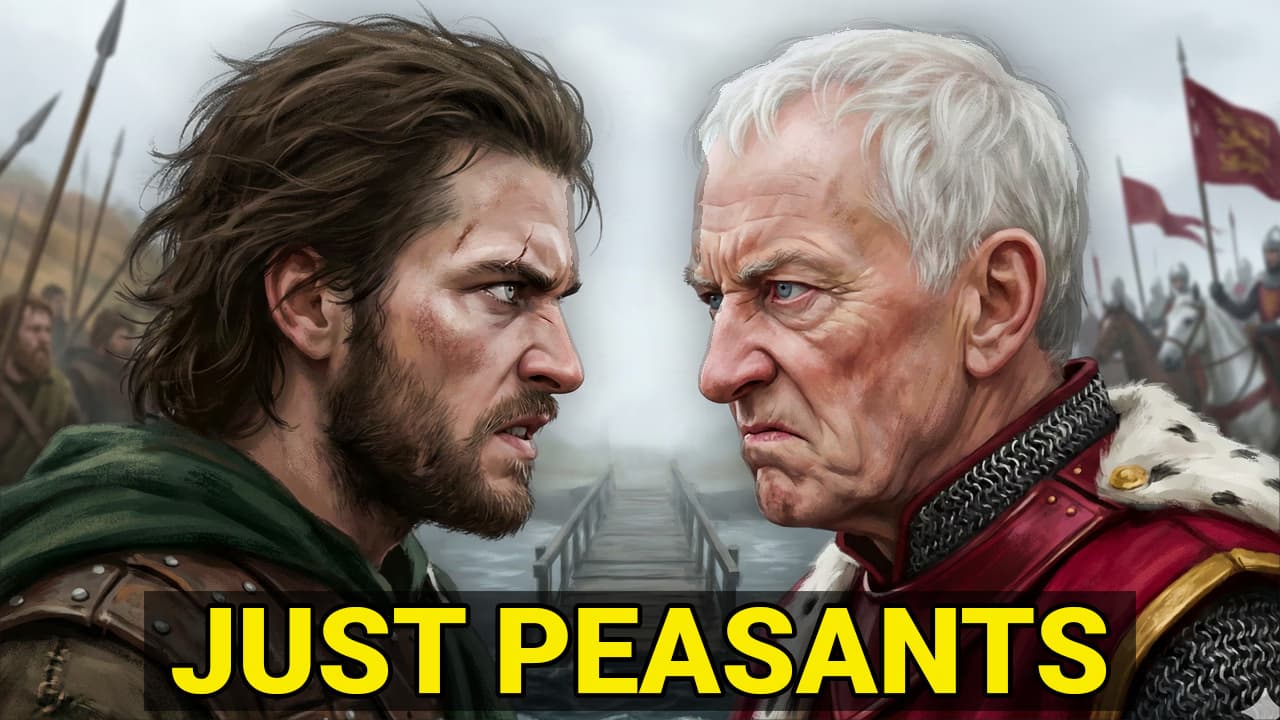
The conquest of Wales, 1277-1284. Edward invaded with three coordinated armies and naval support, starved Llywelyn into submission, then returned when Dafydd rebelled and finished the job. Llywelyn was killed at Orewin Bridge. Dafydd was hanged, drawn, and quartered at Shrewsbury. Edward spent 173,000 pounds building the greatest chain of castles in medieval Europe, including Caernarfon, whose walls deliberately echoed the Theodosian walls of Constantinople, a message carved in stone: this is imperial power. He ensured his son was born at Caernarfon in 1284, then granted him the title Prince of Wales, establishing a tradition that has lasted seven centuries.
The sack of Berwick, March 30, 1296. Edward brought 25,000 men to Scotland's most important trading port and unleashed a massacre that lasted three days. The chronicler Walter of Guisborough counted 11,060 dead. Churches were violated, then turned into stables. It was, as one historian wrote, "a coldly calculated act of inhumanity; the use of terror for political ends." Edward then seized the Stone of Scone, Scotland's ancient coronation stone, and had it fitted into a new Coronation Chair at Westminster. Twenty-six monarchs would be crowned sitting over it before Scotland got it back in 1996.
The execution of William Wallace, August 23, 1305. Captured near Glasgow, tried at Westminster Hall for treason, Wallace protested that he had never sworn allegiance to Edward and could not be a traitor. Edward made his death the most elaborate public execution in English history: dragged naked through London, hanged, cut down alive, castrated, disemboweled, beheaded, and quartered. His head was tarred and spiked on London Bridge. His limbs were sent to four cities. Edward designed it to end the rebellion. Instead, within six months, Robert Bruce crowned himself king and restarted the war.
The Detail History Forgot
Every Easter Monday, Edward allowed Eleanor's ladies-in-waiting to "trap" him in his bed. He would play along, pretending to be caught, then pay them a small ransom so they could release him to go to Eleanor's chambers, a playful ritual marking the first day after Lent.
The year after Eleanor died, Edward went through the same ritual. The ladies trapped him. He paid the ransom. But Eleanor was no longer waiting in her chambers. He did it anyway. This is the same king who sacked Berwick, expelled the Jews, and had Wallace's intestines burned before his eyes. He could not let go of a bedroom game because his wife was no longer alive to finish it. After her death, he commissioned twelve elaborate stone crosses marking every place her funeral procession had stopped between Nottinghamshire and Westminster. Three still stand. The man who wrote to the Abbot of Cluny that "she whom in life we dearly cherished, and whom in death we cannot cease to love" meant every word of it.
The Downfall
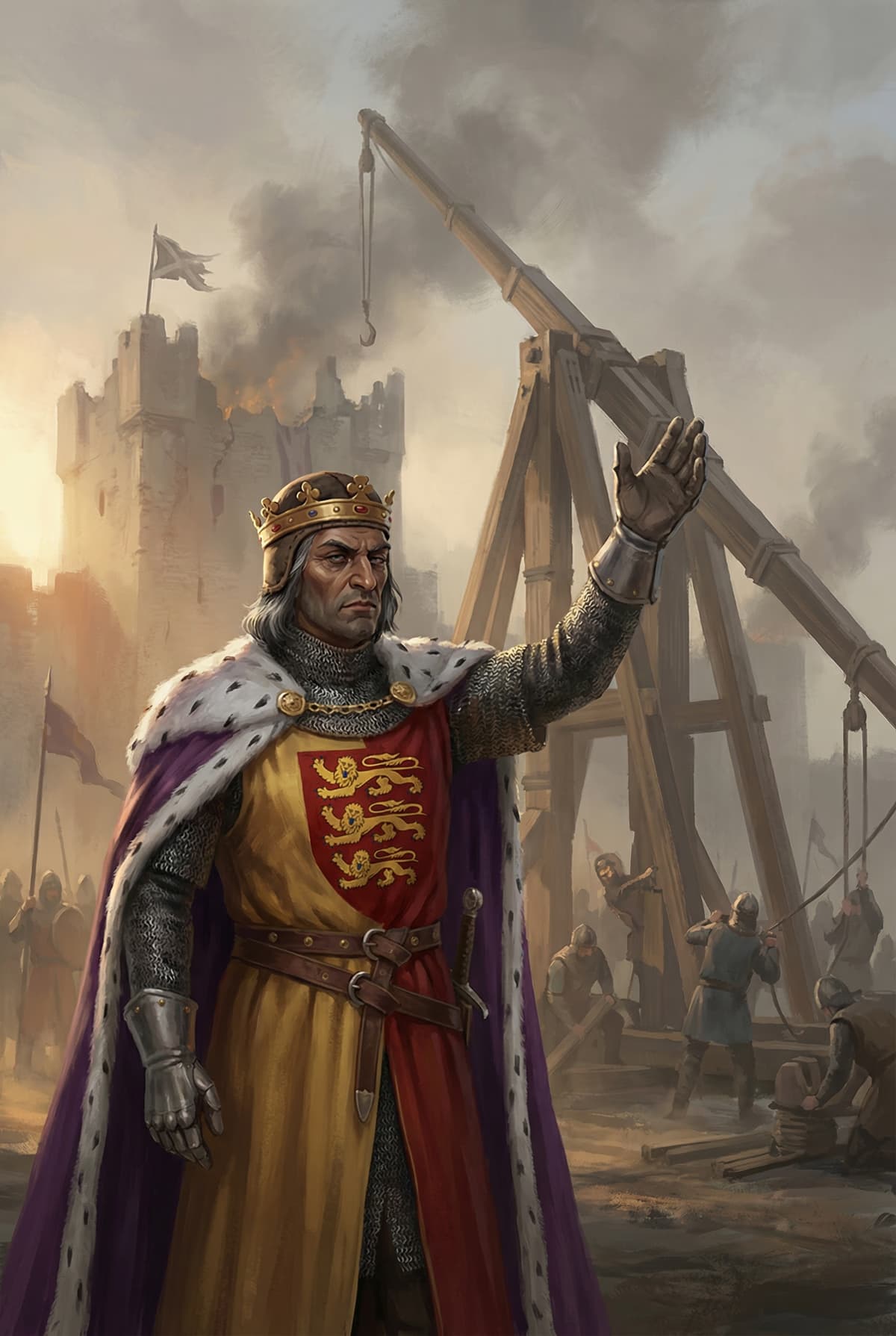
Edward's fatal flaw was not cruelty. Cruelty was a tool, and in the thirteenth century, every king used it. His fatal flaw was that he could not stop. Every conquered territory demanded another. Every defeated enemy required a more elaborate humiliation. Wales led to Scotland, Scotland led to France, France led back to Scotland, and each campaign drained the treasury further while generating exactly the resistance it was meant to crush.
The financial collapse was staggering. Wales alone cost 173,000 pounds when annual crown revenue was roughly 30,000. The Scottish wars broke what was left. By 1297, his barons and clergy revolted against the endless taxation. Edward was forced to reconfirm Magna Carta in the Confirmatio Cartarum, formally conceding that he could not levy taxes without parliamentary consent. He had built the parliamentary system to fund his wars, and his wars had given Parliament the leverage to restrain him. The machinery he created to serve his ambitions became the machinery that checked them.
After Eleanor and Burnell died, there was no one left to tell him when enough was enough. His character hardened into something brittle. He expelled the Jews on Tisha B'Av, a deliberate cruelty. He refused Stirling Castle's surrender so he could test his trebuchet. He tore out handfuls of his own son's hair when Edward II asked for a favor he disapproved of. By 1307, he was a sick old man carried northward on a litter, insisting on one more campaign against a country that had already proven it would never submit. He died on the march, in the mud, within sight of the Scottish border. The epitaph carved on his tomb, "Hammer of the Scots," was not added until the sixteenth century. By then, Scotland had been free for two hundred years. The hammer struck and struck, and the anvil endured.