The Pieces
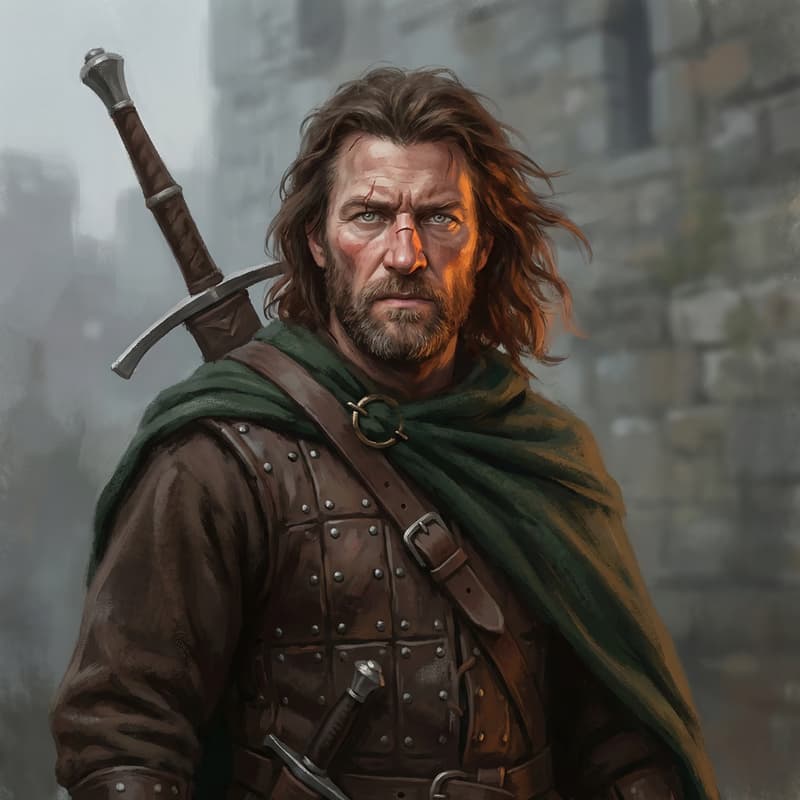
August 1305. Four pieces of William Wallace hang in four corners of Britain.
His head rots on a spike above London Bridge, dipped in tar to slow the decay. Ravens have taken the eyes. The lips have pulled back from the teeth in a permanent grimace. Travelers crossing the Thames look up and see what remains of the man who humiliated England at Stirling Bridge.
His right arm swings from a gibbet in Newcastle, creaking in the wind. His left arm hangs in Berwick, where Scottish merchants pass beneath it on their way to market. His right leg is displayed in Perth. His left leg hangs in Stirling--the very city where he won his greatest victory, where he watched five thousand Englishmen drown in the Forth.
Edward I has designed this display with precision. Every Scot who enters a major town will see the cost of resistance. Every potential rebel will understand: this is how England treats its enemies.
The message is clear. Scotland is conquered. Resistance is over. Wallace is dead.
Within six months, a man will murder his rival in a church and crown himself King of Scots. Within two years, Edward I will be dead. Within nine years, Scotland will crush the largest English army ever assembled.
The execution that was supposed to end Scottish resistance will create it.
The Murder
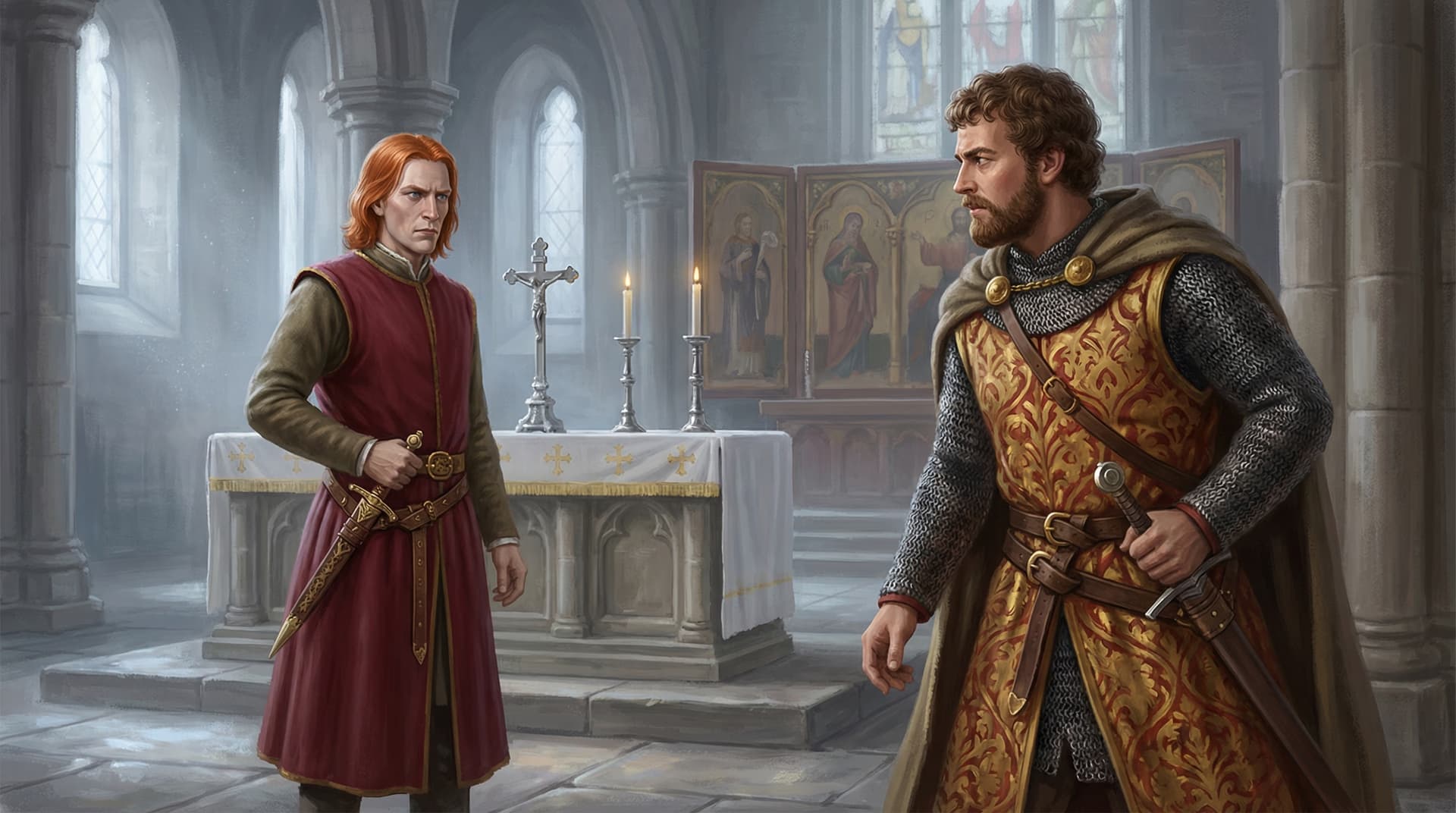
February 10th, 1306. Greyfriars Church, Dumfries. The winter light falls cold through the windows.
Robert Bruce has asked John Comyn to meet him here, before the high altar, where men are supposed to speak truth. The two men are rivals--both have claims to the Scottish throne, both have spent years maneuvering for position, both know that only one of them can wear the crown.
The chronicles disagree about what happened inside those stone walls. Some say Bruce proposed a deal: "Give me the throne, and I'll give you my lands. Or give me your lands, and take the throne yourself."
Others say Comyn had already betrayed Bruce to Edward--had shown the English king a secret agreement Bruce had signed, had sold him for English favor. They say Bruce came to Greyfriars not to negotiate, but to confront.
What the chronicles agree on is the result.
Bruce's hand went to his dagger. Comyn saw it coming--tried to step back, tried to raise his arms. Too slow. The blade went into his chest before the high altar, in full view of God and the attending priests.
Comyn fell. Blood spread across the flagstones. He was wounded, but alive.
Bruce stumbled out of the church, his hands shaking, his mind racing. His companions met him in the doorway. "What have you done?"
"I think I've killed Comyn."
Roger de Kirkpatrick pushed past him, drawing his own dagger. "You think? I'll mak siccar." I'll make sure.
He found Comyn trying to crawl toward the altar. He finished the work. Comyn's uncle died trying to help.
Bruce walked out of Greyfriars a murderer, a sacrilegist, excommunicated the moment the blade touched flesh. He was also the only man left with a credible claim to Scotland's throne.
The Crown
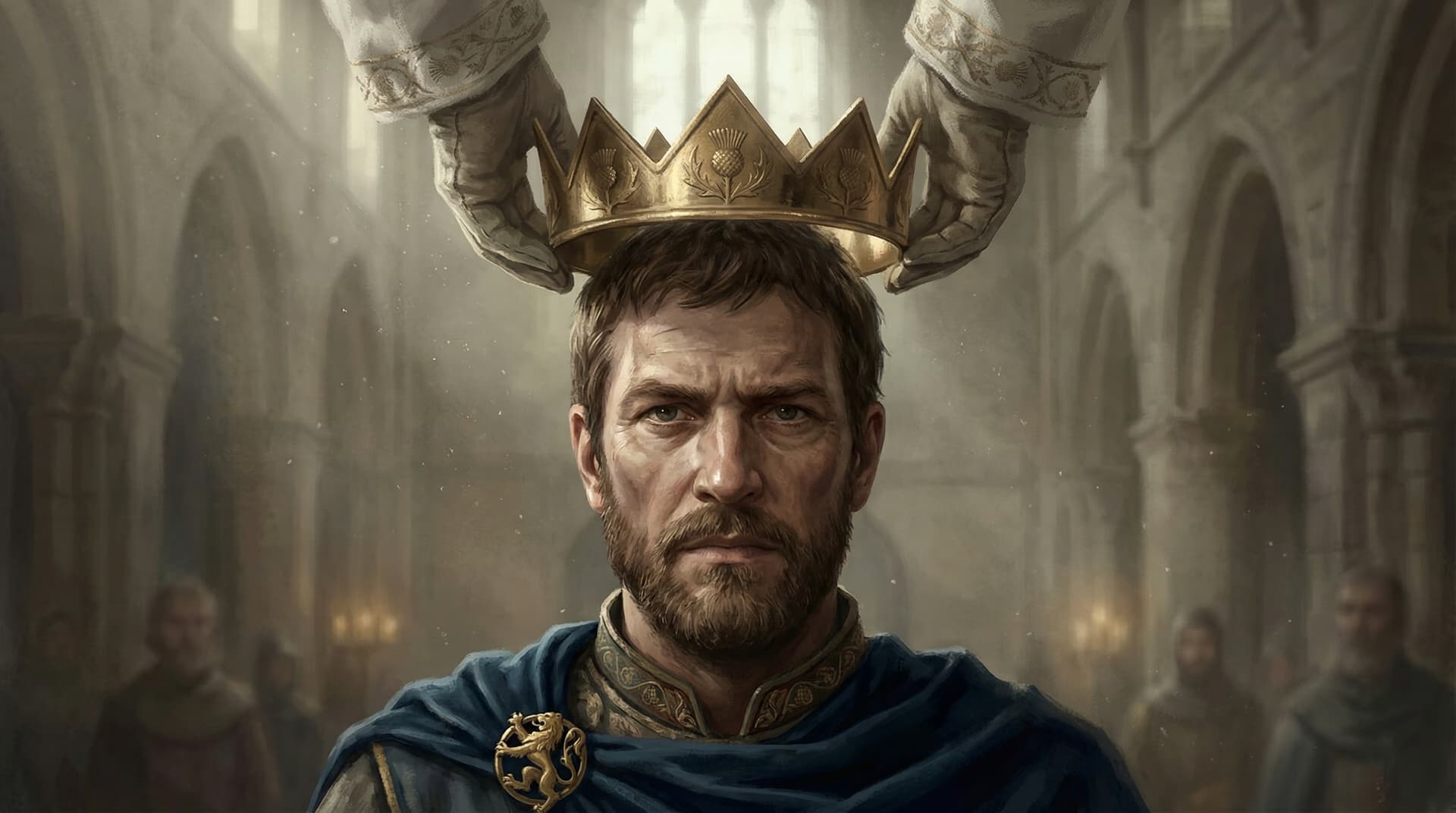
Six weeks later, on Palm Sunday, March 25th, 1306, Robert Bruce knelt at Scone.
The coronation was rushed, improvised, and almost certainly illegal. Bruce had murdered his rival in a church. Pope Clement V had excommunicated him. The English still held most of Scotland's castles, and Edward's army was already marching north to crush this new rebellion before it could begin.
None of it mattered.
The Bishop of Glasgow lifted royal robes that had been hidden from the English for exactly this moment--vestments that carried the weight of centuries, the authority of kings. He placed them on Bruce's shoulders. The bishops of Moray and Glasgow stood witness. The earls of Atholl, Menteith, Lennox, and Mar knelt in allegiance.
Behind the throne, the great banner of the kings of Scotland unfurled--the red lion on gold that Edward had tried to erase from history.
Scotland had a king again.
It would take eight more years to prove that the crown meant anything.
The Disasters
1306 was catastrophe.
In June, Bruce met the English at the Battle of Methven. He expected a formal engagement, a chance to prove himself in open combat. What he got was a night attack--the English falling on his camp before dawn, cutting down men still stumbling from their tents.
Bruce barely escaped. His army scattered into the Perthshire hills, a handful of survivors fleeing through the heather.
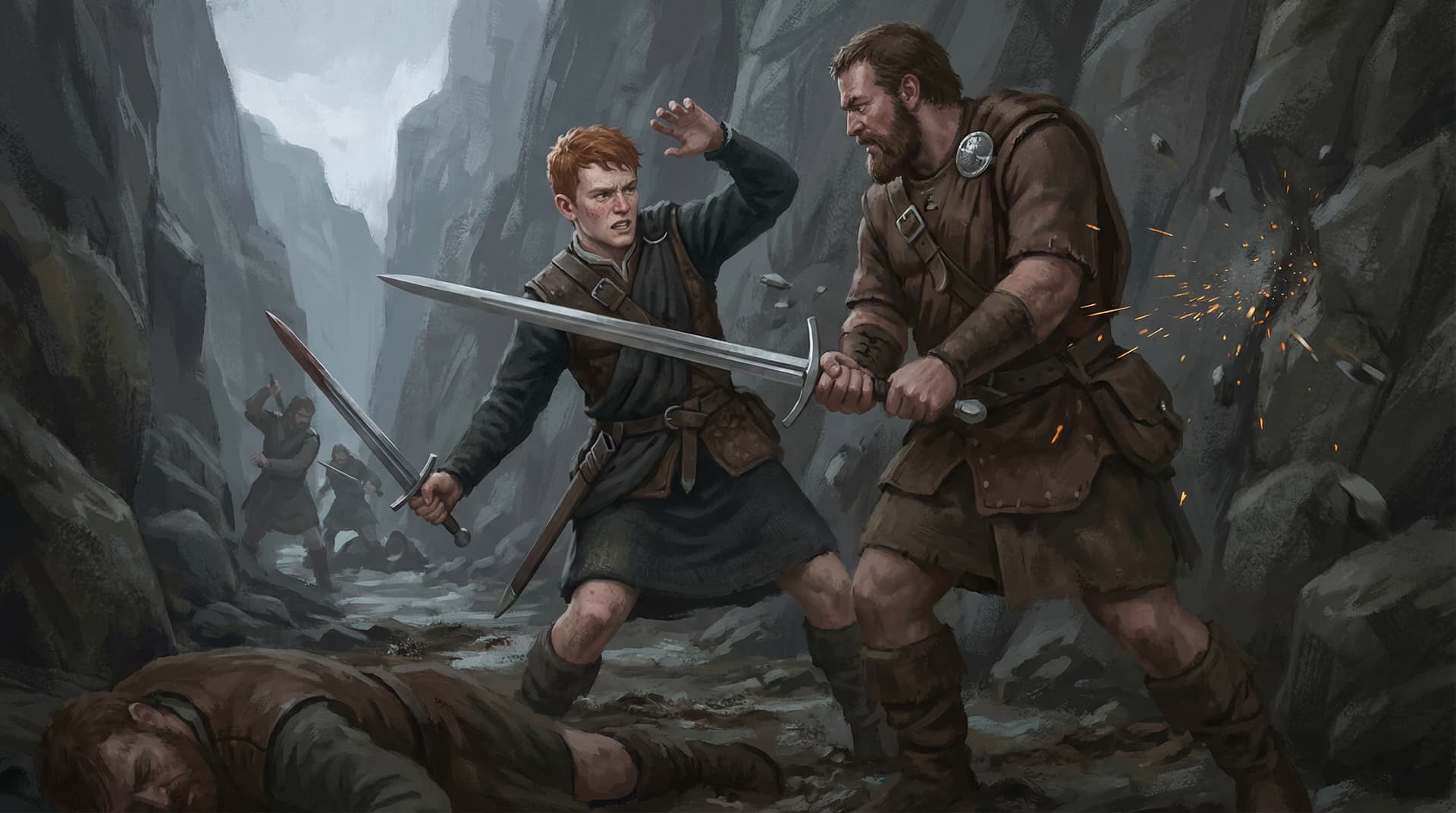
Days later, the remnants walked into an ambush at Dalrigh. The MacDougalls--allies of the murdered Comyn, burning for revenge--fell on Bruce's men in a narrow pass. Swords rang off rock walls. Men died in the mud. Bruce fought his way out with his brooch torn from his cloak, leaving dead companions behind.
His wife Elizabeth was captured. His daughter Marjorie, twelve years old, was imprisoned. His sisters were locked in cages and hung from castle walls like animals. Three of his brothers were captured and executed--hanged, drawn, and quartered, just as Wallace had been.
By December 1306, Robert Bruce was a fugitive king hiding in the Western Isles with a few dozen followers. He had no army. No treasury. No allies. The Pope had excommunicated him. The English hunted him. The Comyn faction wanted him dead.
He had nothing left but a crown that no one recognized.
Subscribe to Nightfall History on YouTube
Join our community on YouTube for more historical deep dives and visual storytelling
The Spider
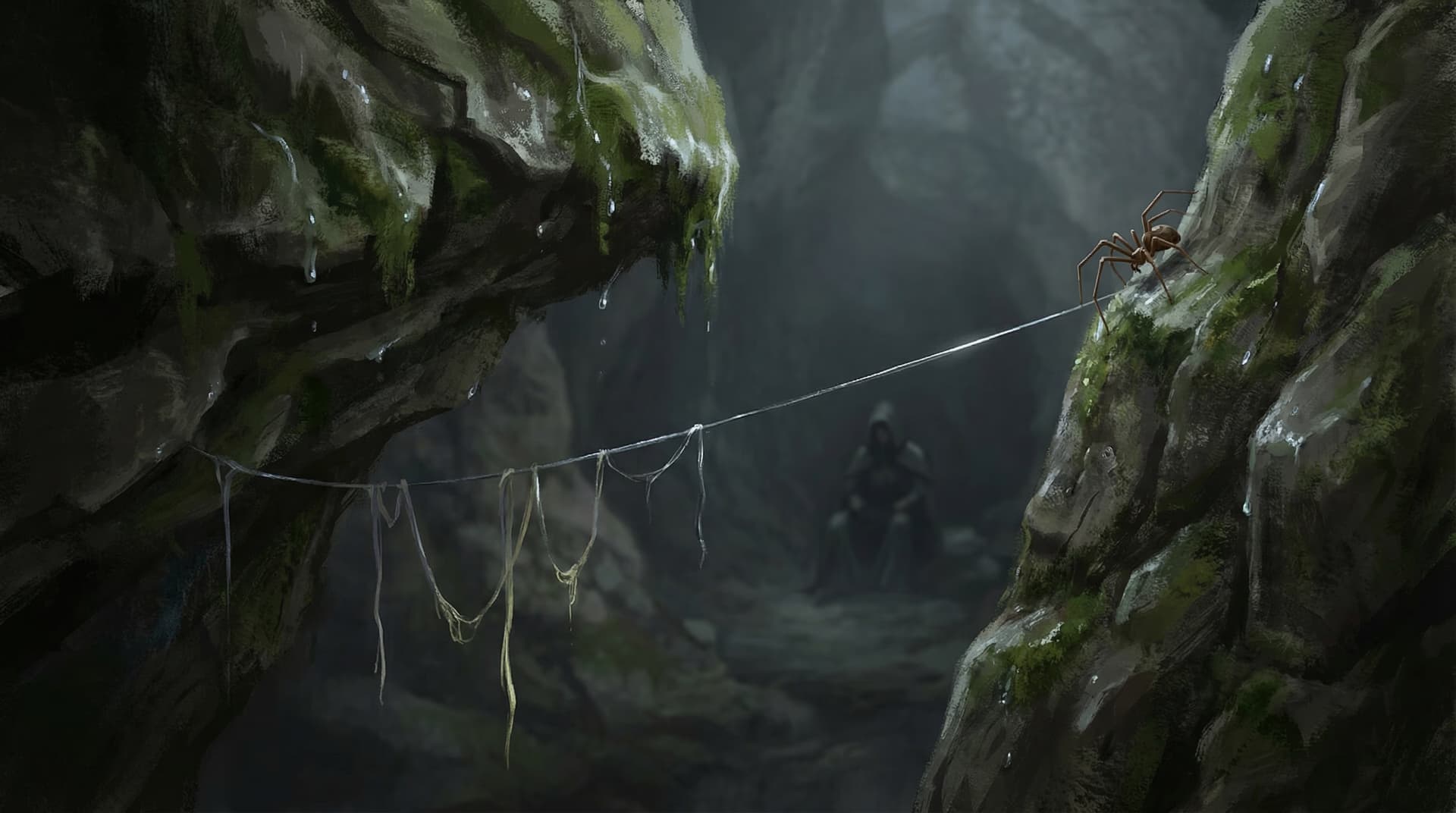
The legends say Bruce sheltered in a cave that winter--on Rathlin Island, or Arran, or somewhere in the mainland hills. The legends say he lay in the darkness, listening to the drip of water on stone, wondering if he should give up.
The legends say he watched a spider.
It was trying to spin its web between two rocks, stretching a single thread across the gap. The thread broke. The spider fell. It climbed back up and tried again. The thread broke again. Again the spider fell. Again it climbed.
Six times the spider failed. Six times it returned to the work.
On the seventh try, the thread held.
Bruce watched the web take shape in the dim light--strand by strand, patient and relentless, built from nothing but persistence and the refusal to stop.
Whether the spider was real or invented, the lesson was real. Wallace had taught it first: you do not stop fighting because you are losing. You stop fighting when you are dead.
Bruce was not dead yet.
The Death of Longshanks
On July 7th, 1307, Edward I died.
He was sixty-eight years old, in failing health, leading yet another army north to crush yet another Scottish rebellion. He died at Burgh by Sands, three miles from the Scottish border--close enough to see the hills of the country he had tried to destroy, not close enough to finish the work.
The man who had conquered Scotland. Who had executed Wallace. Who had scattered Bruce's family and hunted him like an animal. That man died in his tent, surrounded by physicians who could do nothing, staring at a ceiling instead of a battlefield.
He never saw the consequences of his cruelty.
His son, Edward II, inherited the war. But Edward II was not his father. He lacked the old king's military genius, his political ruthlessness, his obsessive determination. Within weeks of taking the throne, he withdrew the English army from Scotland.
Bruce had been given something he never expected: time.
The Comeback
For the next seven years, Bruce did exactly what Wallace had done a decade before.
Guerrilla warfare. Strike and withdraw. Burn what you cannot hold. Use the mountains, the forests, the bogs against enemies who do not know the ground.
He attacked English garrisons at night and vanished before dawn. He ambushed supply columns and disappeared into the heather. He took castles not by siege but by stealth--scaling walls in darkness, killing sentries in silence, opening gates from within.
One by one, the English strongholds fell. Dundee. Forfar. Brechin. Aberdeen. The network of fortifications that Edward I had built to control Scotland was dismantled stone by stone.
By 1314, only a handful of English castles remained. The most important was Stirling--the same fortress Wallace had isolated seventeen years before, the same ground where Scottish spears had drowned English knights in the Forth.
Bruce's brother Edward laid siege to Stirling. The English garrison agreed to surrender if not relieved by midsummer. Edward II, finally roused to action, assembled the largest army England had ever sent to Scotland: twenty-five thousand infantry and two thousand cavalry.
He marched north to save Stirling.
Bruce waited for him with six thousand men.
Bannockburn
June 23rd and 24th, 1314. The fields south of Stirling.
Bruce had chosen his ground with the care of a man who had learned from Wallace's mistakes. Wooded terrain where English cavalry could not charge. Boggy ground where armored knights would flounder. Prepared positions with pits dug to break horses' legs.
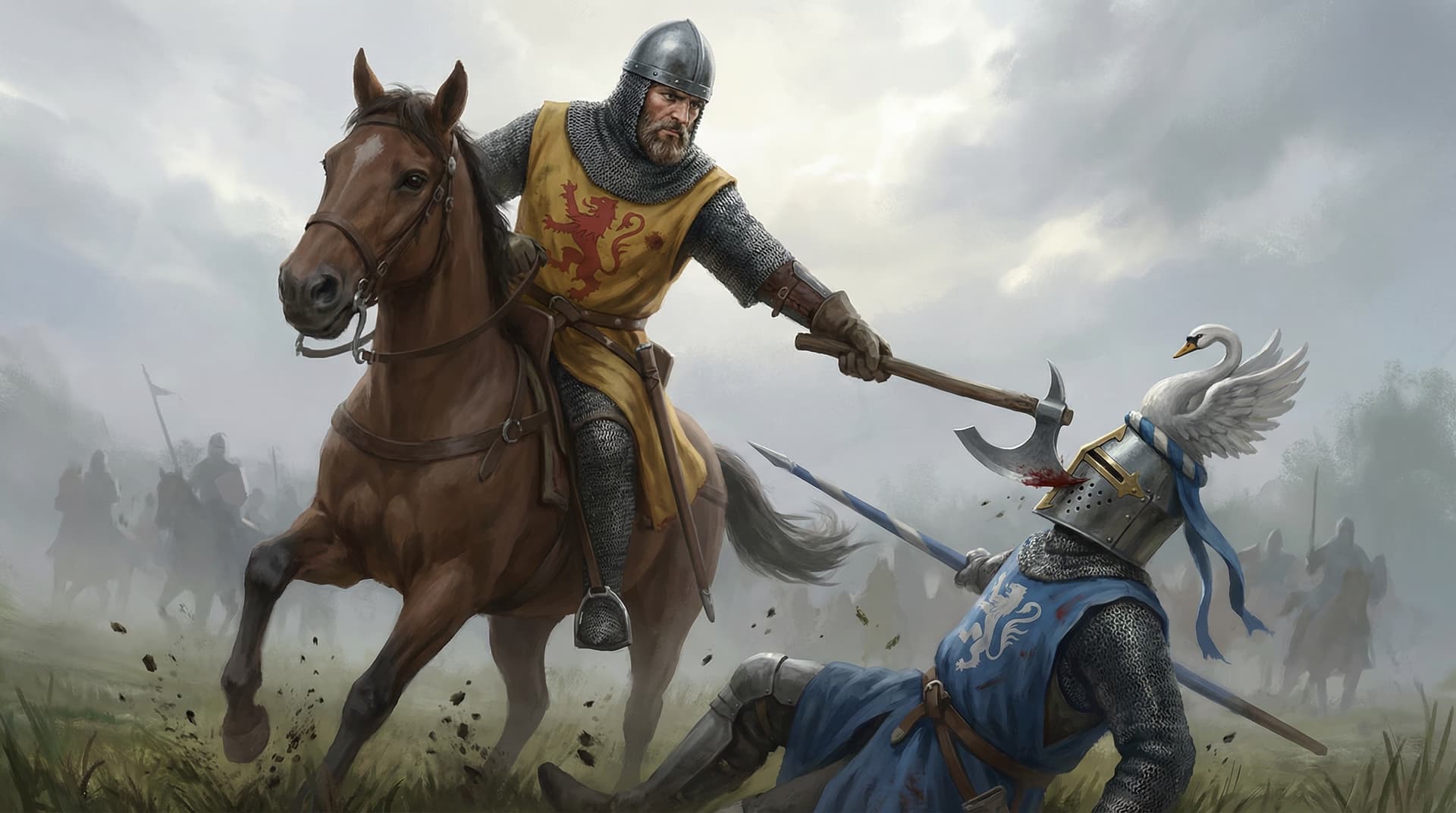
On the first day, an English knight named Henry de Bohun spotted Bruce riding ahead of his army. De Bohun saw glory--the chance to kill a king with a single lance thrust, to end the war in one moment of courage.
He spurred his warhorse forward. The lance came down. The distance closed.
Bruce waited. At the last instant, he turned his smaller horse, let the lance point slide past, and rose in his stirrups. His axe came down on de Bohun's helmet with the full force of his weight behind it.
The helmet split. The skull split. Henry de Bohun was dead before he hit the ground.
Six thousand Scots watched their king kill an English champion in single combat. They knew what it meant.
On the second day, the English tried to overwhelm the Scots with sheer numbers. Twenty-five thousand men pushing forward, cavalry and infantry mixed together, banners flying, drums beating.
But the numbers worked against them. The English army crammed into a narrow field between the Bannock Burn and the woods, unable to maneuver, unable to bring their full strength to bear. Ranks collided with ranks. Cavalry trampled infantry. Orders were lost in the chaos.
The Scottish schiltrons advanced--the same formations Wallace had used at Stirling Bridge and Falkirk, walls of spears moving forward in lockstep. They pushed into the English mass like knives into flesh.
The English broke.
The retreat became a rout. Knights drowned in the boggy ground, dragged down by their armor. Infantry trampled each other trying to escape. The Bannock Burn ran red with blood, then choked with bodies.
Edward II fled the field. Of his twenty-five thousand men, fewer than three thousand made it back to England.
Bannockburn did not end the war. But it proved that Scotland could win it.
Stay in the Loop
Get notified when new articles and videos drop. Unsubscribe anytime.
The Declaration
Six years later, on April 6th, 1320, the nobles of Scotland sent a letter to Pope John XXII.
The Declaration of Arbroath was Scotland's statement to the world--its claim to exist as a nation, its justification for rejecting English rule. Thirty-one barons and eight earls set their seals to the document, the ruling class of a country that England insisted did not exist.
The most famous passage captured something Wallace would have recognized:
"For as long as but a hundred of us remain alive, never will we on any conditions be brought under English rule. It is in truth not for glory, nor riches, nor honours that we are fighting, but for freedom--for that alone, which no honest man gives up but with life itself."
The Declaration did not mention Wallace by name. It did not need to.
He had fought not for glory, nor riches, nor honours. He had given up freedom only with his life itself.
The words could have been written for him.
The Return
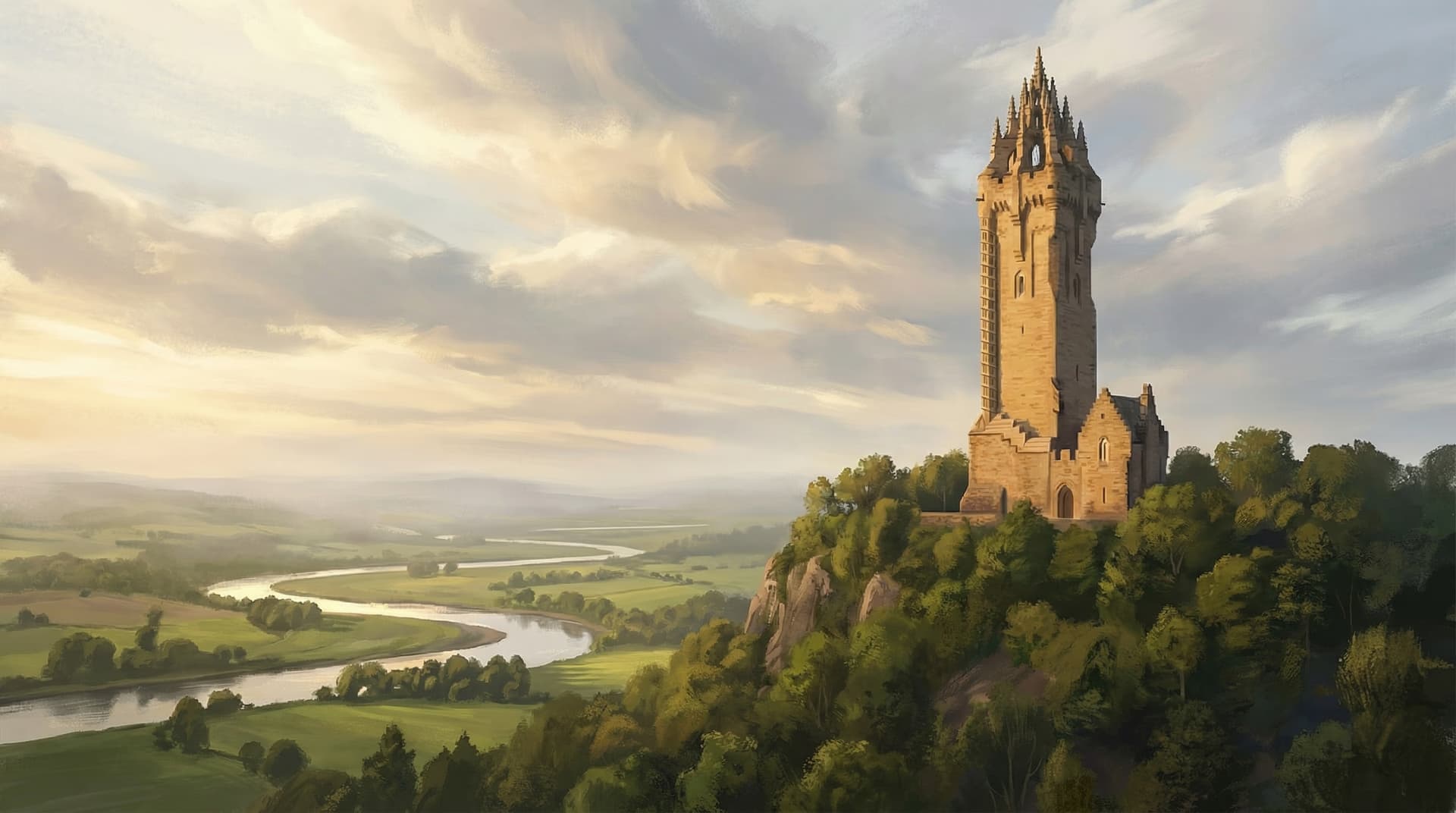
Today, on the rocky outcrop of Abbey Craig, a tower stands 220 feet above the Forth Valley.
The National Wallace Monument was built in 1869, funded by public subscription--donations from Scots around the world who had never forgotten what happened on this ground. The tower rises from the exact spot where, according to tradition, Wallace stood on September 11th, 1297, watching the English army begin its fatal crossing of Stirling Bridge.
Inside the monument, visitors climb 246 steps to a viewing gallery. From the top, they can see the landscape where a second son with no inheritance won an impossible victory. The River Forth winding through the valley. The site of the bridge that no longer exists. The fields where five thousand Englishmen died.
They can also see the Wallace Sword--the massive longsword, five feet four inches long, that tradition says Wallace carried from Lanark to Falkirk to Robroyston. The sword that was left behind in Dumbarton Castle when its owner was dragged to London in chains.
The sword came home. Wallace never did.
The Execution That Created Scotland
Edward I designed Wallace's execution to break Scottish resistance forever.
He wanted the brutality of Wallace's death to teach a lesson: this is what happens to rebels. This is the price of defiance. Bend the knee, or end like him.
Instead, he created a martyr.
Wallace's execution didn't end the war. It intensified it. The brutality of his death convinced Scots that submission to England meant submission to an enemy that would never show mercy.
When Robert Bruce killed John Comyn and seized the throne six months later, he wasn't starting a new rebellion. He was continuing the one Wallace had begun.
The tactics Bruce used--guerrilla warfare, scorched earth, striking and withdrawing--were Wallace's tactics. The schiltrons that won at Bannockburn were Wallace's formations. The refusal to accept conquest, even when conquest seemed total--that was Wallace's legacy.
Edward had thought that killing Wallace would prove England's power.
It proved England's brutality instead.
And it proved something else. Something Wallace had shown at Stirling Bridge, something he had proven through seven years of running, something he had demonstrated even in death:
Scotland would not disappear. Not while there were men willing to die for it.
Wallace had been that man. He had fought as Guardian, as fugitive, as outlaw. He had fought with armies and without them. He had fought when the nobles knelt, when his allies fled, when the war was lost and every rational person had surrendered.
He had fought until they caught him. Until they killed him. Until they cut him into pieces and sent those pieces to four corners of Britain.
And even then, he had not bent the knee.
That was the lesson Edward had accidentally taught. Not that resistance was futile, but that resistance was possible. That one man refusing to submit could inspire thousands. That death with freedom was better than life in chains.
The Declaration of Arbroath, written fifteen years after Wallace's execution, captured what he had proven:
"For as long as but a hundred of us remain alive, never will we on any conditions be brought under English rule. It is in truth not for glory, nor riches, nor honours that we are fighting, but for freedom--for that alone, which no honest man gives up but with life itself."
Wallace had given up freedom only with his life itself. Piece by piece, in a London street, while a crowd cheered.
The Declaration didn't mention him by name. It didn't have to.
He had already written those words in blood.
The Sword
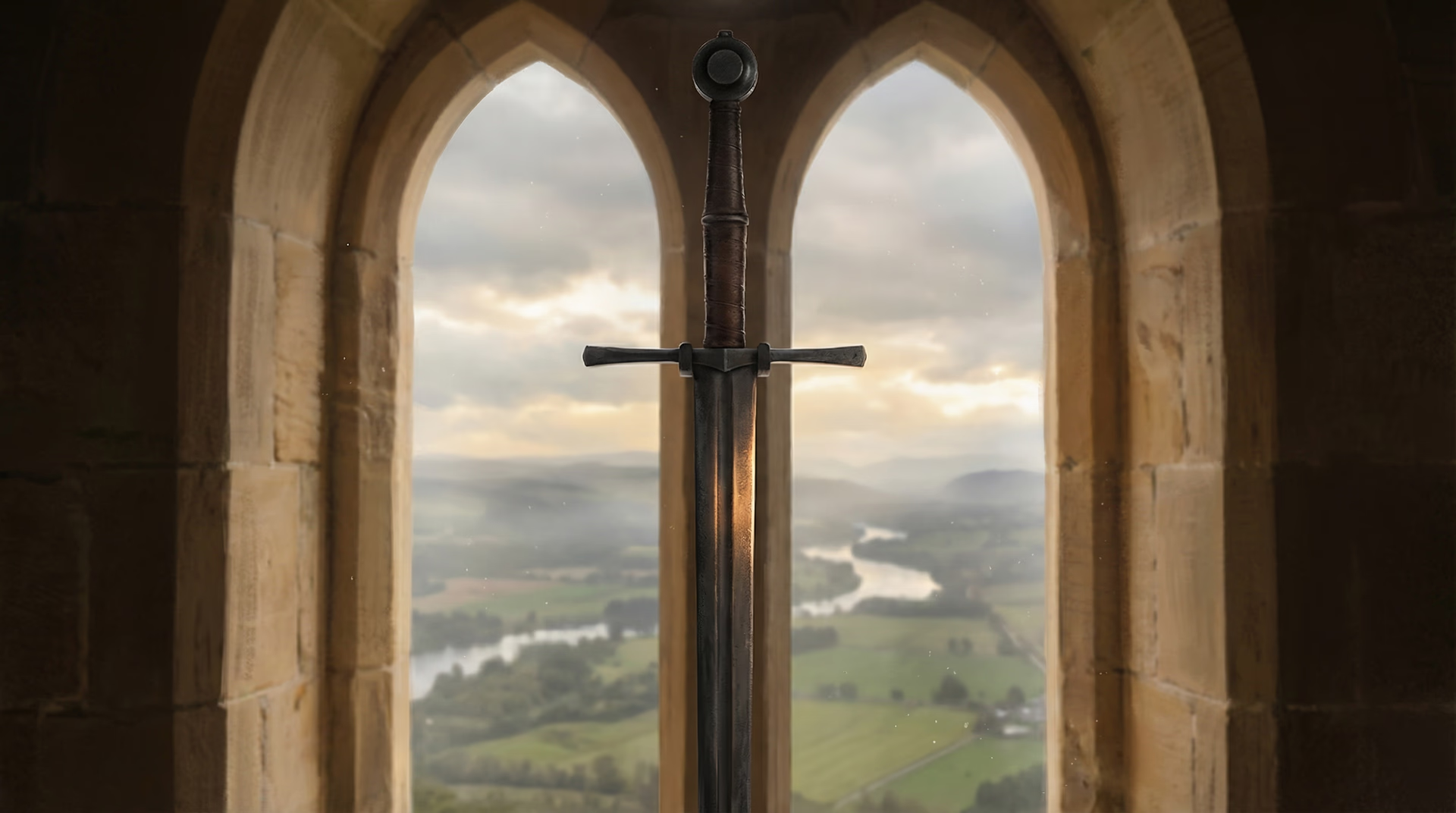
On Abbey Craig, where Wallace once stood watching an English army march to its doom, his monument looks down on the Scotland he helped create.
The sword is there. Five feet four inches of steel, too heavy for most men to wield, carried by a man who was never supposed to matter. A second son. A minor knight's offspring. A man with no title, no inheritance, no reason to be remembered.
Except he refused to forget what Scotland was. And he refused to let Scotland forget itself.
Edward I won every battle that mattered. He conquered Scotland, executed its rebel leader, displayed the pieces as a warning.
But the sword came home.
And the Scotland that Wallace died for--the Scotland that didn't exist on any map, that had no king and no army and no reason to survive--that Scotland survived anyway.
Because Wallace had shown them how.
Not by winning. By refusing to lose.
Not by tactics or formations or clever strategies. By simply not stopping. Even when stopping was rational. Even when stopping would save his life.
He didn't stop until they killed him.
And even then, what he had started didn't stop.
Stirling Bridge proved Scotland could fight. Falkirk proved Scotland could lose. The execution proved Scotland would never surrender.
Three lessons. Three stories. One man who was never supposed to matter.
His head rotted on a spike above London Bridge for years. His limbs hung in four cities until they fell apart.
But his sword stands in a monument on a hill, looking down on the river where five thousand Englishmen drowned.
The execution was supposed to end the story.
It was only the beginning.