
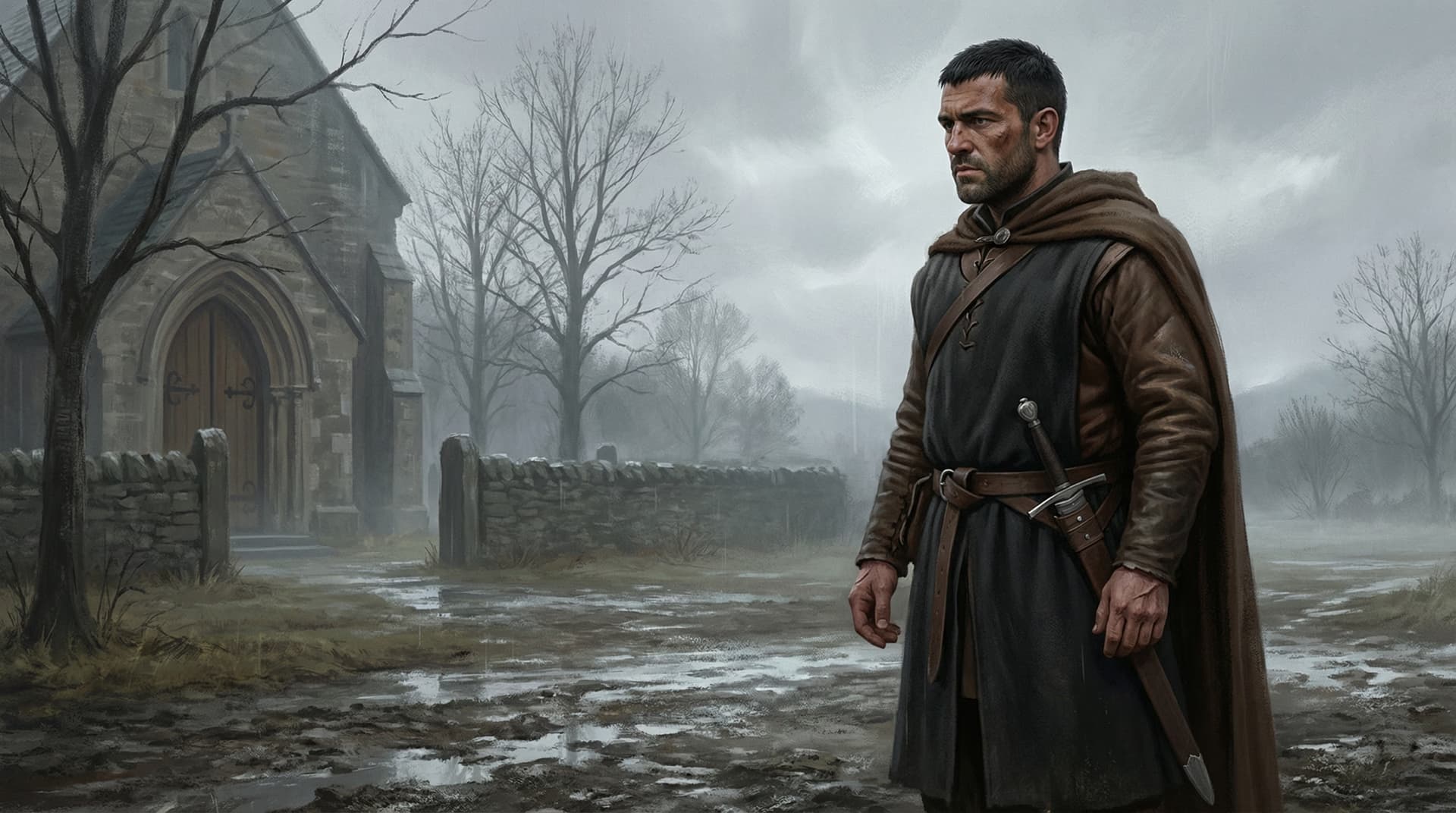
- Known for
- Delivering the killing blow to John Comyn at Greyfriars Church with the words "I'll mak siccar," the act that sealed Bruce's path to the Scottish throne
- Fatal flaw
- A man built for decisive violence in a world that eventually demanded something more than a bloody dagger and blind loyalty
The Story
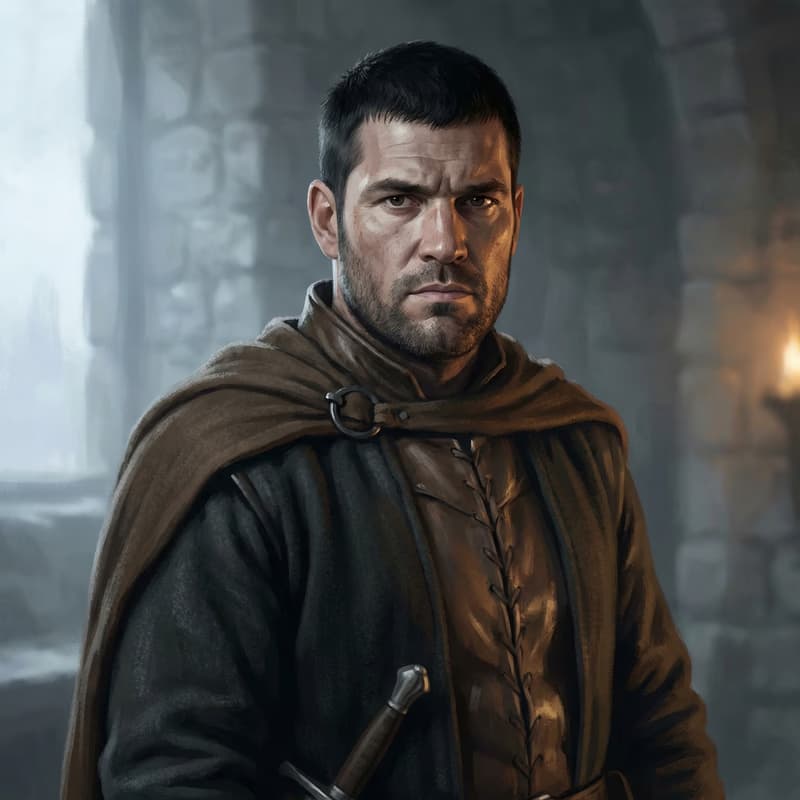
February 10th, 1306. Greyfriars Church, Dumfries. Robert Bruce stumbles out the door into the winter light, pale, his dagger wet. His companions are waiting in the churchyard. Bruce's hands are shaking. "I think I have slain the Red Comyn," he says. He thinks. He is not sure.
Roger de Kirkpatrick does not hesitate. He draws his own blade, pushes past Bruce, and walks into the church. John Comyn is crawling across the flagstones toward the high altar, bleeding from Bruce's dagger wound but alive. Kirkpatrick crosses the nave in a few strides and finishes the work. "I'll mak siccar," he says. I'll make sure.
Three words. They changed Scottish history, created a king, condemned a soul, and gave a family their motto for seven centuries.
Before that moment, Roger de Kirkpatrick was a Dumfriesshire knight from a family of comfortable but unremarkable standing. The Kirkpatricks had held the barony of Closeburn since 1232, when King Alexander II confirmed their charter. They were local men, rooted in Nithsdale, loyal to whoever sat on the throne. Roger's father, Stephen de Kirkpatrick, had sworn fealty to Edward I after the English conquest of 1296, his name recorded on the Ragman Rolls alongside nearly two thousand other Scottish landholders who bent the knee to survive. There was nothing unusual about the Kirkpatricks. Nothing that would have put them in the history books.
Then Roger walked into a church with a dagger and walked out immortal.
Personality & Motivations
Kirkpatrick was not a man who agonized. Where Bruce hesitated at the church door, uncertain whether he had killed or merely wounded his rival, Kirkpatrick saw only a problem that needed solving. Comyn alive meant witnesses, meant vengeance, meant a powerful family with the resources to destroy them all. Comyn dead meant certainty. Kirkpatrick chose certainty.
This was a man shaped by the brutal realities of the Scottish borders. Closeburn sat in Nithsdale, the corridor between England and Scotland's heartland, a landscape that had been fought over, burned, and rebuilt more times than anyone could count. Men who grew up in the borderlands learned to act first and justify later. Hesitation got you killed. Mercy got you killed slower.
His loyalty to Bruce was absolute, but it was the loyalty of a man who understood power, not idealism. He did not follow Bruce because he believed in Scottish freedom or the romance of kingship. He followed Bruce because Bruce was the strongest lord in the southwest, because the Kirkpatrick lands depended on Bruce's protection, and because when the moment came to choose sides, Roger chose the side with the sharpest sword. It was practical. It was also permanent. Once you finish a man off on a church floor, there is no going back.
What Most People Get Wrong
The popular image of Kirkpatrick is a brute, a thug who rushed into a church and butchered a defenseless man. But this misses the political calculation behind the act. With Comyn wounded but alive, Bruce faced catastrophe. A surviving Comyn would have rallied the most powerful noble network in Scotland against Bruce, called on his English connections through his wife Joan de Valence, and appealed to Edward I for justice. Bruce would have been hunted as a failed assassin rather than crowned as a king.
Kirkpatrick understood this in seconds. The killing was not mindless violence. It was the most politically decisive act of the Scottish Wars of Independence, the moment that made Bruce's coronation possible and the Comyn-Balliol claim impossible. Whether Kirkpatrick calculated all of this in the time it took to cross a church nave, or whether instinct and loyalty drove his hand, the result was the same. He did in thirty seconds what Bruce's entire political career had failed to accomplish.
Key Moments
The Ragman Rolls, August 1296. Roger's father Stephen de Kirkpatrick knelt before English officials at Berwick and swore fealty to Edward I, his name scratched onto the rolls alongside the rest of Scotland's broken nobility. The Kirkpatricks survived the English conquest the way most minor families did: by bowing. Roger grew up watching his father serve an occupying power, learning the lesson that survival sometimes meant kneeling to men you despised. It was a lesson he would eventually reject in the most violent way possible.
Greyfriars Church, February 10th, 1306. The defining moment. Bruce and Comyn met before the high altar to discuss their competing claims to Scotland's future. Words turned to accusations, accusations to drawn blades, and Bruce's dagger opened Comyn's chest. But Bruce's blow was not fatal. Kirkpatrick entered the church, found Comyn still alive, and killed him. Comyn's uncle, Sir Robert Comyn, was cut down trying to intervene. In less than five minutes, the most powerful family in Scotland lost its head, and Bruce's path to the throne was cleared in blood.
Bruce's Coronation, March 25th, 1306. Six weeks after the murder, Bruce was crowned King of Scots at Scone. Kirkpatrick stood among the small circle of men who had committed themselves to Bruce's cause before anyone knew whether it would succeed. The coronation was rushed, improvised, and attended by a fraction of Scotland's nobility. Most of the kingdom's lords were either hostile, terrified, or waiting to see which way the wind blew. The men who stood with Bruce at Scone were gambling their lives.
The Embassy to England, 1314. After Bruce's victory at Bannockburn shattered English military dominance, Kirkpatrick was sent on a diplomatic mission to England alongside Sir Neil Campbell to negotiate with Edward II. The border knight who had finished off a man in a church was now serving as a royal commissioner, treating with the English crown on behalf of the king he had helped create. In recompense for this service, the Kirkpatricks received the lands of Redburgh in the sheriffdom of Dumfries, adding to their ancestral holdings at Closeburn.
The Rewards of Loyalty, c. 1314-1319. Bruce did not forget the men who had stood with him before Bannockburn. Roger's son Thomas received royal charters confirming Closeburn and granting the additional lands of Redburgh, dated from the fourteenth year of Bruce's reign. The Kirkpatricks rose from minor Nithsdale gentry to one of the more significant landowning families in Dumfriesshire, their fortune built on the three words Roger spoke in a Franciscan church.
The Detail History Forgot
The Kirkpatrick family connection to the Scottish resistance ran deeper than Roger alone. His brother, Duncan Kirkpatrick of Torthorwald, married Isabel of Torthorwald, whose family was linked through the Crawford lineage to William Wallace's mother. The two most famous acts of the Scottish Wars of Independence, Wallace's rising and Comyn's murder, were connected by a web of kinship that modern accounts rarely mention.
Roger himself had served under Edward I's administration before switching sides. In October 1305, just four months before the Greyfriars killing, he was serving as one of two deputy justiciars of Galloway under English authority. He was, in other words, an English official who walked into a church and helped murder a man on behalf of Scotland's future king. The transition from English functionary to Scottish patriot took less than half a year. In the borderlands, loyalty was not a principle. It was a calculation.
The Downfall
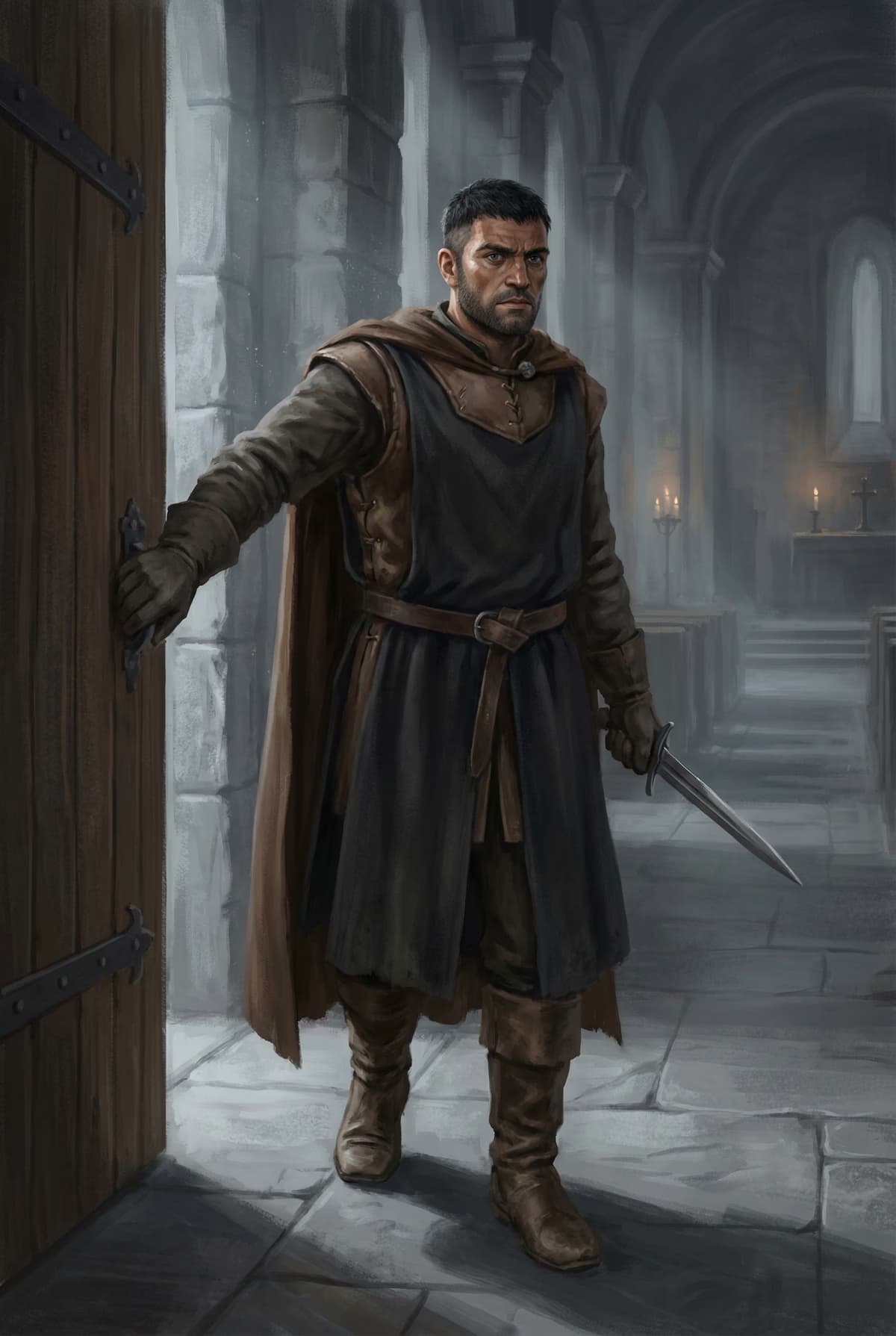
Roger de Kirkpatrick did not fall in battle or perish on an English scaffold. He disappeared from the historical record sometime in the early 1320s, likely dying around 1322 or 1323. Some sources suggest he was murdered in revenge for the Comyn killing, the blood debt finally collected by men who had waited nearly two decades for justice. The details are lost. For a man whose defining moment was recorded in vivid, unforgettable detail, his end is a blank page.
His legacy, however, carried a curse. Roger's son, also named Roger, distinguished himself in 1355 by recapturing Caerlaverock and Dalswinton castles from the English, proving the family's martial reputation was not a one-generation affair. But in 1357, the younger Roger was murdered by his own kinsman, Sir James Lindsay, in a private quarrel. King David II had Lindsay executed for the crime. The Kirkpatricks, it seemed, were a family that lived and died by the blade.
The fatal flaw was not in the act itself but in what it revealed. Kirkpatrick was a man of decisive violence, perfectly suited to the chaos of 1306 when a single dagger thrust could change a kingdom. But the skills that made him invaluable in a church in Dumfries, the willingness to act without hesitation, the comfort with blood, the inability to see any problem that could not be solved with a blade, were not the skills that built lasting dynasties. The Kirkpatricks held Closeburn for centuries after Roger's death, but they never rose to the first rank of Scottish nobility. They remained what they had always been: border men, useful in a crisis, forgotten in peacetime. Roger gave Bruce a kingdom. What Bruce gave back was land, a motto, and a family crest showing a hand gripping a bloody dagger. It was honest, at least.