
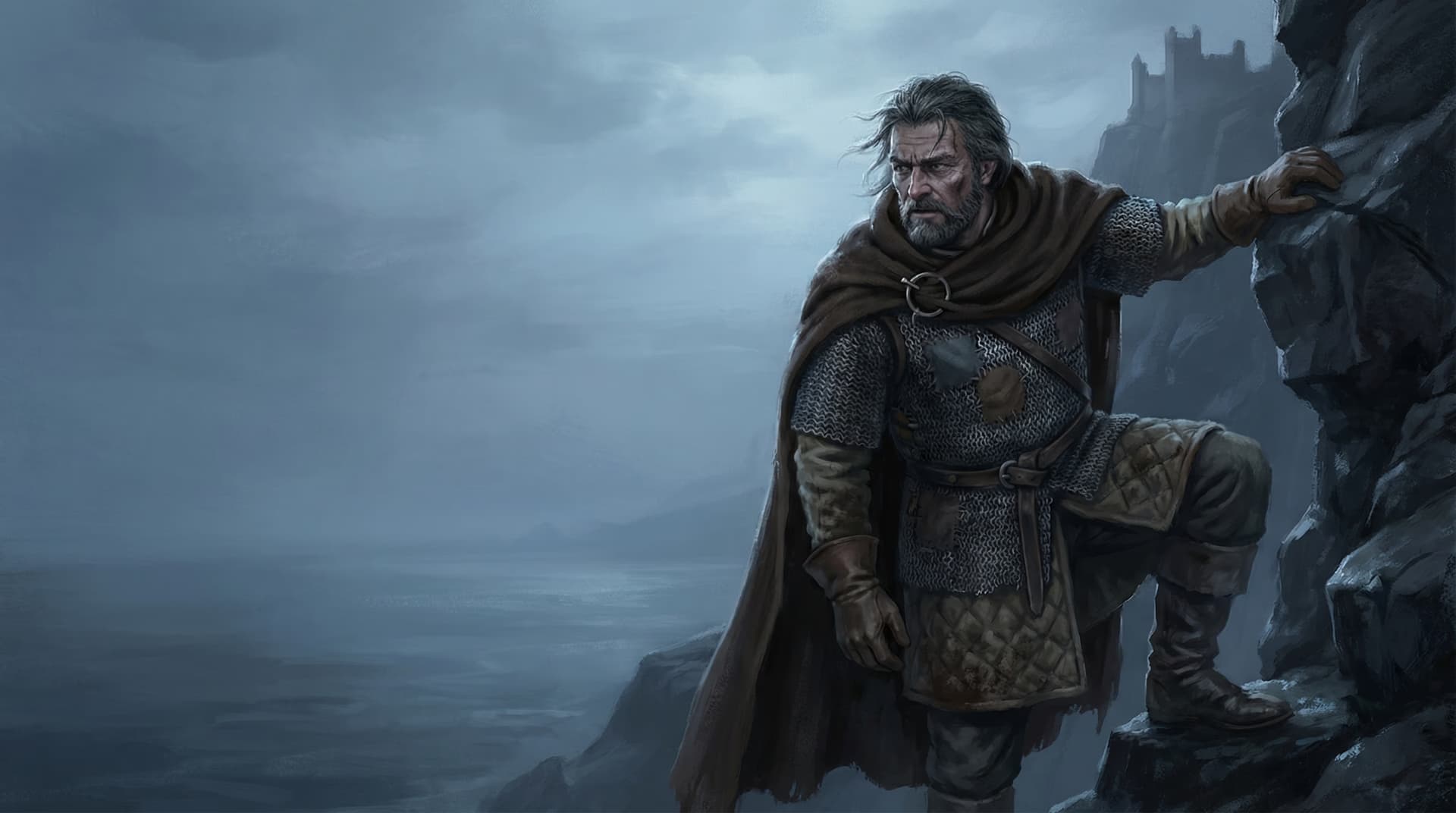
- Known for
- Wallace's most loyal companion, Lord of Cruggleton Castle, killed defending Wallace during the Robroyston betrayal
- Fatal flaw
- Loyalty so absolute it left no room for self-preservation, he would not leave the man who had retaken his castle even when staying meant dying
The Story
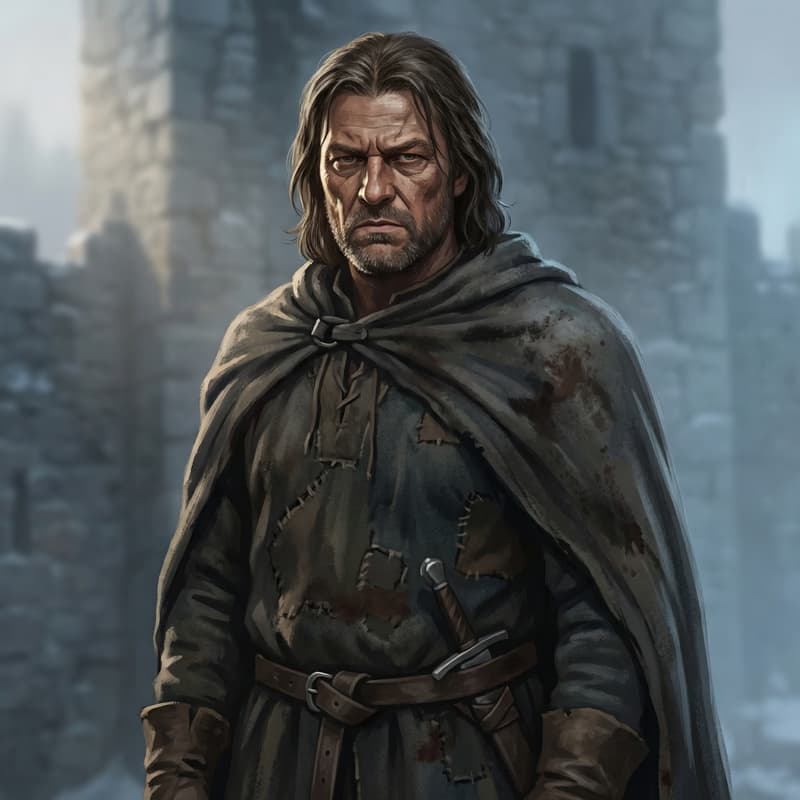
August 3rd, 1305. A house near Robroyston, outside Glasgow. Two men sleep inside. One is the most wanted man in Britain. The other is the only friend he has left.
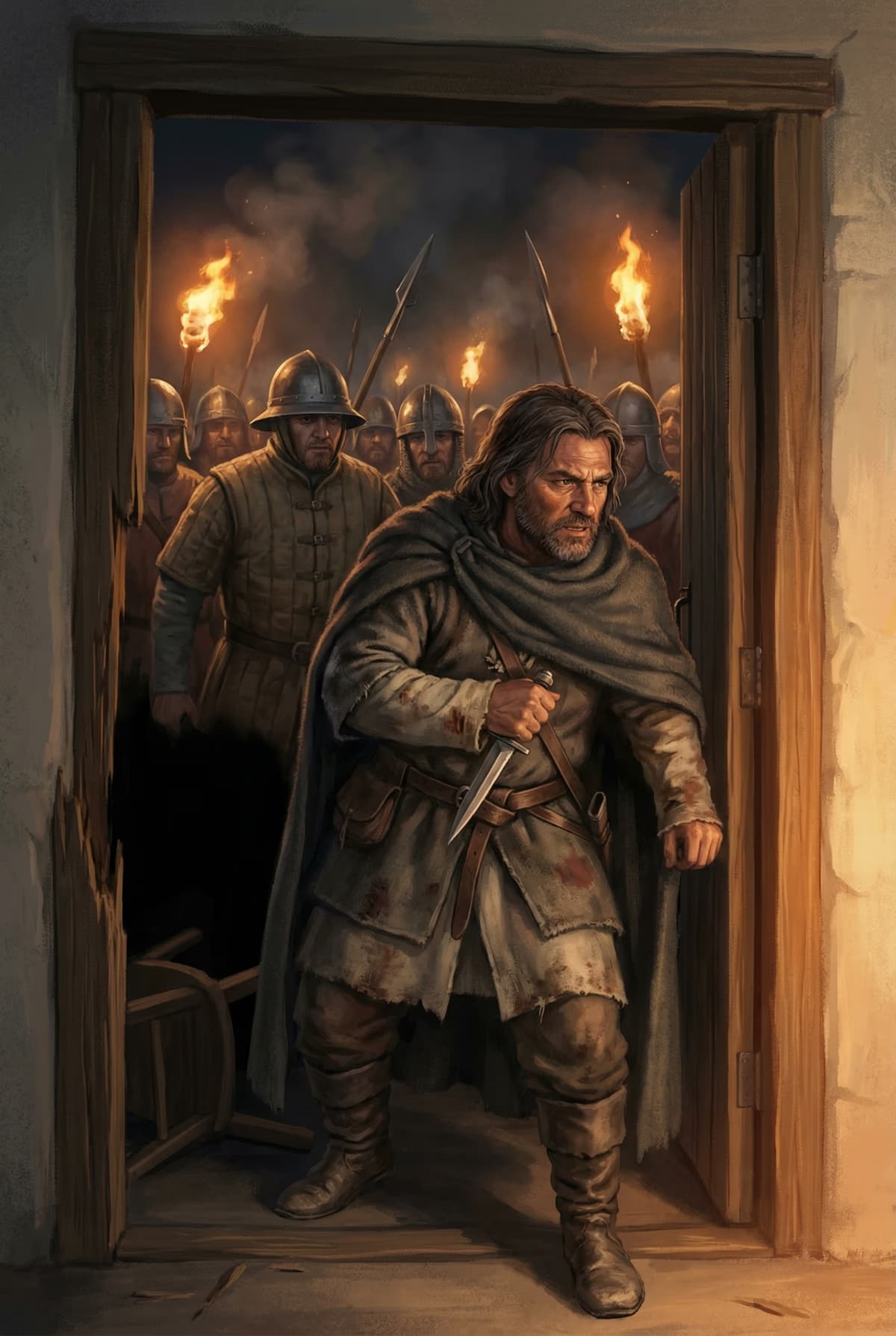
When the door splinters inward and torchlight floods the room, William MacCairill does not run. He does not bargain. He throws himself at the armed men pouring through the doorway, buying seconds for the man beside him, seconds that will not be enough. Wallace surges up from his bed, reaching for his sword, but there are too many of them. MacCairill goes down fighting. Wallace goes down in chains.
One man dies in the scuffle at Robroyston. One man dies on a scaffold in London three weeks later. History remembers the second. The first is a footnote, a name in a genealogy, "Kerlie" in a chronicle, "Wallace's companion" in the margins. But William MacCairill was more than the man who died in the doorway. He was the lord of an impregnable castle who lost everything to English treachery, the Galwegian nobleman who swam through freezing seawater and scaled a cliff face to take it back, and the one man who stayed beside William Wallace when every other ally had surrendered, fled, or been bought.
He was Wallace's closest friend. He was the last man standing. And he died the way he lived, fighting for someone else's cause with everything he had.
Personality & Motivations
MacCairill was a man forged by betrayal. In 1282, William de Soulis came to Cruggleton Castle as a guest, ate MacCairill's food, slept under his roof, then seized the fortress for Edward I while its garrison was thinned. That single act of treachery stripped MacCairill of his ancestral seat, his lands, and his place in Galloway's power structure. A man who experiences that kind of betrayal either breaks or hardens. MacCairill hardened.
What drove him was not abstract patriotism. It was personal fury. The English and their Scottish collaborators had stolen his castle, his inheritance, the fortress his family had held since the days of the Norse. When Wallace raised the standard of rebellion in 1297, MacCairill did not join because he believed in Scottish independence as a political principle. He joined because Wallace was the only man in Scotland willing to fight the people who had robbed him.
The bond between them ran deeper than politics. Wallace personally led the assault to retake Cruggleton. He swam through the sea to the base of the cliffs, scaled a hundred and fifty feet of shale in the dark, and killed the English sentry with his own hands. A man does not forget that. MacCairill repaid it with eight years of absolute loyalty, following Wallace through victory at Stirling Bridge, disaster at Falkirk, exile, and the long grinding fugitive years when the cause was lost and only stubbornness kept them alive.
What Most People Get Wrong
Most people who know MacCairill's story at all assume he was a common soldier, one of Wallace's ragged band of farmers and outlaws who happened to be in the wrong room at the wrong time. He was not. MacCairill was a nobleman, the lord of Cruggleton Castle, heir to a family that had held lands in Galloway since 1095 when his ancestor Lochlan MacCairill, the royal heir apparent of Ulster, fled Ireland after defeat at the Battle of Ard-Achadh.
The MacCairills were not peasant followers. They were a Norse-Gaelic dynasty with roots in Irish royalty, Crusading knights among their ancestors, and a cliff-top fortress that controlled the coast of Wigtown Bay. William MacCairill chose to follow Wallace not because he had nowhere else to go, but because he had already lost everything and Wallace was the only man who helped him take it back. His loyalty was not the devotion of a servant. It was the debt of a lord.
Key Moments
Cruggleton, 1282. The treachery that started everything. William de Soulis, secretly loyal to Edward I, visited Cruggleton Castle under the pretense of friendship. He found the garrison weakened, smuggled in his own men, and seized the fortress from within. MacCairill escaped with his life but lost his ancestral home, his lands, and his standing. The castle that his family had wrested from the Norse, the fortress perched on cliffs a hundred and fifty feet above the sea that was considered impregnable, was taken not by force but by a guest's betrayal. It would be fifteen years before he set foot inside it again.
Cruggleton, 1297. The retaking. Between the surrender of the Scottish nobles at Irvine in July and Wallace's invasion of Northern England in November, Wallace made a detour into Galloway for one reason: to restore his friend's castle. The assault on Cruggleton was one of Wallace's most daring exploits. The castle could only be approached from the sea, where shale cliffs rose over a hundred and fifty feet from the waterline. Wallace, MacCairill, and a companion named Steven of Ireland swam out to the base of the rock, scaled the cliff face in the dark, seized the sentry and threw him to his death, then opened the gates and lowered the drawbridge. On a blast of Wallace's horn, the hidden force stormed in and slaughtered the English garrison of sixty men. MacCairill was lord of Cruggleton again.
Stirling Bridge to Falkirk, 1297-1298. MacCairill fought beside Wallace through the greatest victory and the worst defeat of the Scottish rebellion. At Stirling Bridge in September 1297, he was among the Scots who watched five thousand Englishmen funnel across a narrow bridge into a killing ground. At Falkirk in July 1298, he endured the catastrophe when English longbowmen shattered the schiltrons and the Scottish cavalry fled without fighting. Where other men drifted away after Falkirk, MacCairill stayed.
The fugitive years, 1298-1305. After Falkirk, Wallace resigned as Guardian and Scotland's organized resistance collapsed. The nobles submitted one by one. The castles fell. MacCairill remained at Wallace's side through all of it, through the diplomatic mission to France, the return to a conquered country, the years of small raids and ambushes with a dwindling band of followers. By 1305, almost every Scottish leader had bent the knee to Edward. MacCairill had not. He and Wallace were among the last holdouts in a country that had given up.
Robroyston, August 3, 1305. The end. Jack Short, Wallace's servant, sold their location to Sir John de Menteith for thirty pounds. Menteith's men came in the dark, knowing exactly which house, which room. MacCairill fought. It was not enough. He was cut down in the scuffle, the only man killed during Wallace's capture. Wallace was dragged to Dumbarton Castle in chains. MacCairill was left where he fell.
The Detail History Forgot
In 1900, nearly six hundred years after MacCairill's death, a memorial to William Wallace was unveiled at Robroyston. The ceremony drew a thousand people. The person chosen to unveil the monument was not a politician, not a historian, not a descendant of Wallace. It was Miss Emmeline McKerlie, a direct descendant of the man who had died defending Wallace in that same place six centuries earlier.
The McKerlie name is the modern form of MacCairill. Over the centuries, "Cairill" became "Kerlie," then "McKerlie," as English-speaking clerks rendered Gaelic names phonetically. But the family survived. William MacCairill's only son, also named William, carried on the line, which in direct male descent was represented until 1855 by Captain Robert McKerlie. When the Robroyston monument needed someone to consecrate it, the organizers reached for the one family whose connection to the site was written in blood. Six hundred years, and the MacCairills were still standing beside Wallace.
The Downfall
MacCairill's fatal flaw was the same quality that made him extraordinary: loyalty that knew no limits. A pragmatic man would have submitted to Edward after Falkirk. A calculating man would have negotiated terms after the nobles surrendered in 1304. A self-preserving man would have recognized that Wallace's cause was dead and found a way to save himself. MacCairill could not. The man who had retaken his castle, who had swum through the sea and climbed the cliffs and killed the sentry and blown the horn, that man had earned something that could not be repaid with anything less than everything.
So MacCairill stayed. He stayed through the years when hope died, through the winters in the forests, through the dwindling of their band from dozens to a handful. He stayed until there was nowhere left to stay and nothing left to fight for except the principle that you do not abandon the man who fought for you.
At Robroyston, when the door came down and the soldiers poured in, MacCairill had one final choice. He could have surrendered. He could have let them take Wallace without resistance and claimed he was merely a servant, a bystander, no one worth killing. Instead he fought. He fought knowing he could not win, knowing the room was full of armed men, knowing that all he could buy was seconds. He bought those seconds with his life. Wallace used them to reach for his sword. It was not enough. But MacCairill died trying, which was the only way he knew how to do anything.