
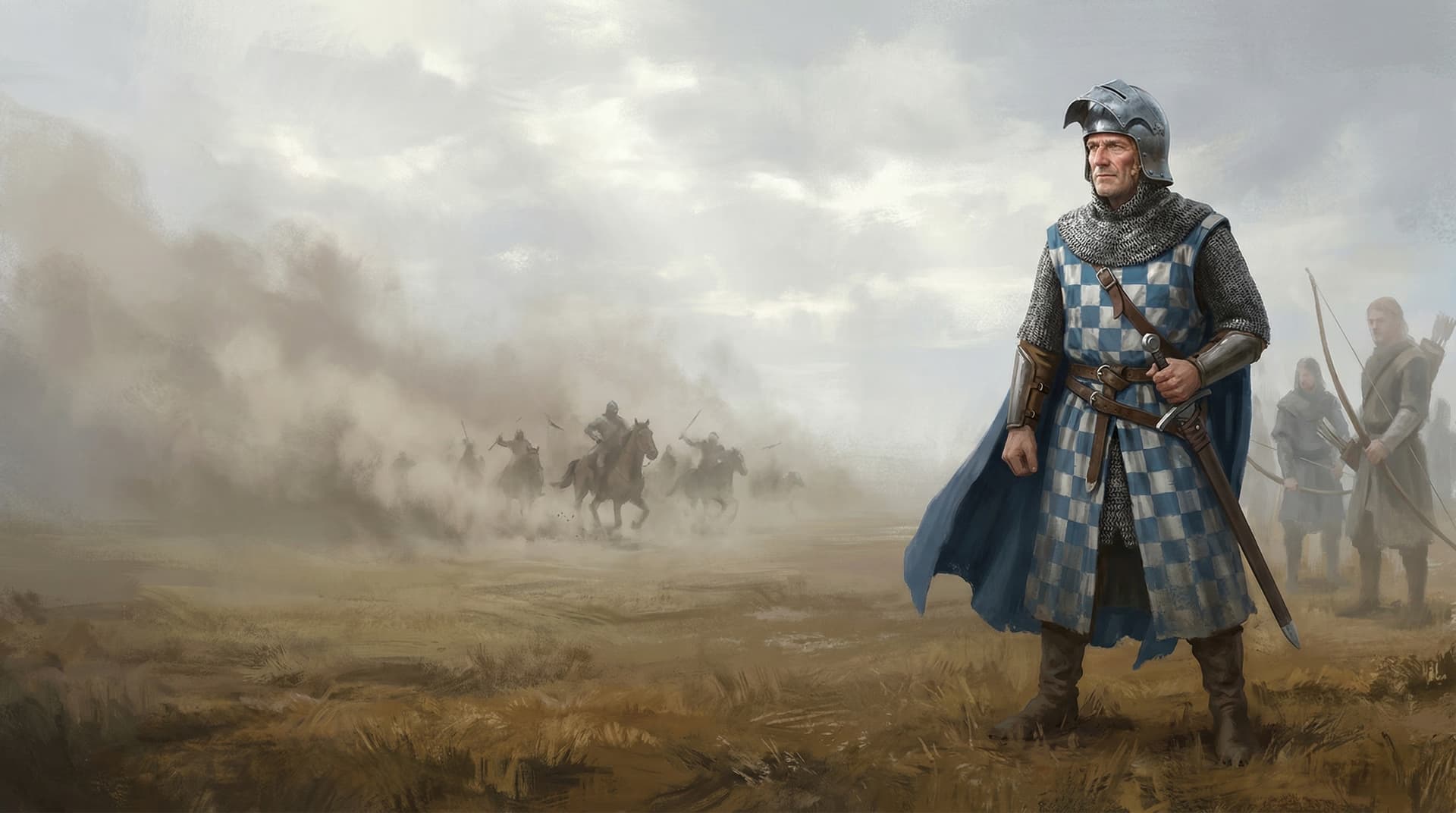
- Known for
- Commander of the Scottish archers at Falkirk who died with his men when the cavalry fled, and direct patrilineal ancestor of the Stuart royal dynasty
- Fatal flaw
- Duty without self-preservation, he stayed to die with common bowmen when every nobleman with a horse was already gone
The Story
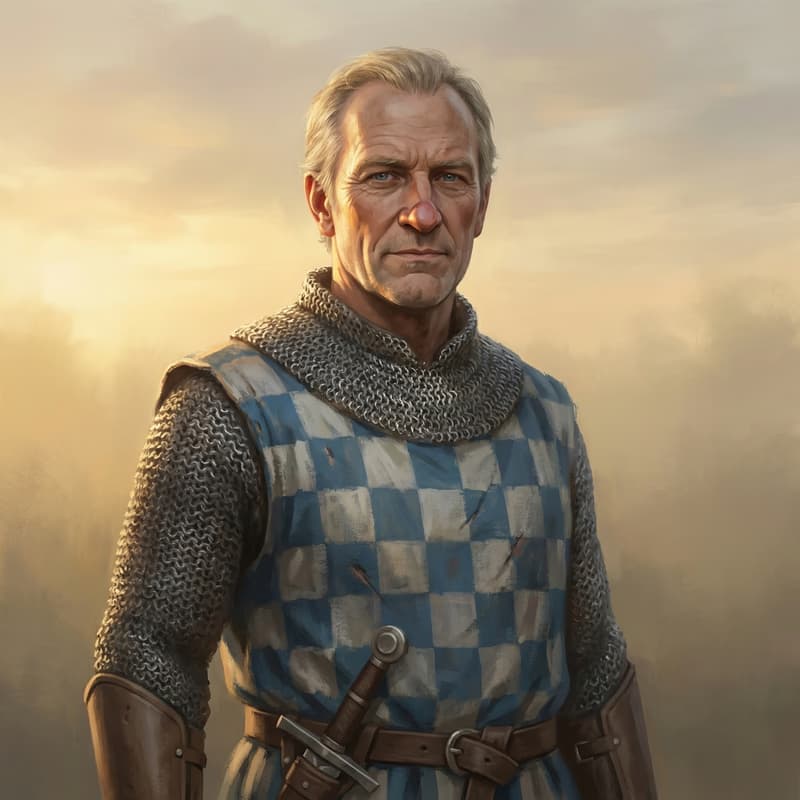
July 22nd, 1298. The Battle of Falkirk is turning. The English cavalry has charged, and the Scottish schiltrons have held. Horses have impaled themselves on twelve-foot spears. Knights have been thrown and trampled. For a few breathless minutes, it looks like Stirling Bridge all over again.
Then John Comyn's cavalry rides off the field without fighting. Every mounted nobleman with the sense to read the odds turns his horse and disappears into the tree line. The infantry is alone.
Sir John Stewart does not leave. He is standing with his archers in the gaps between the schiltrons, the most exposed position on the entire battlefield. Lightly armed men with short bows, positioned where the cavalry was supposed to protect them. The cavalry that is now gone.
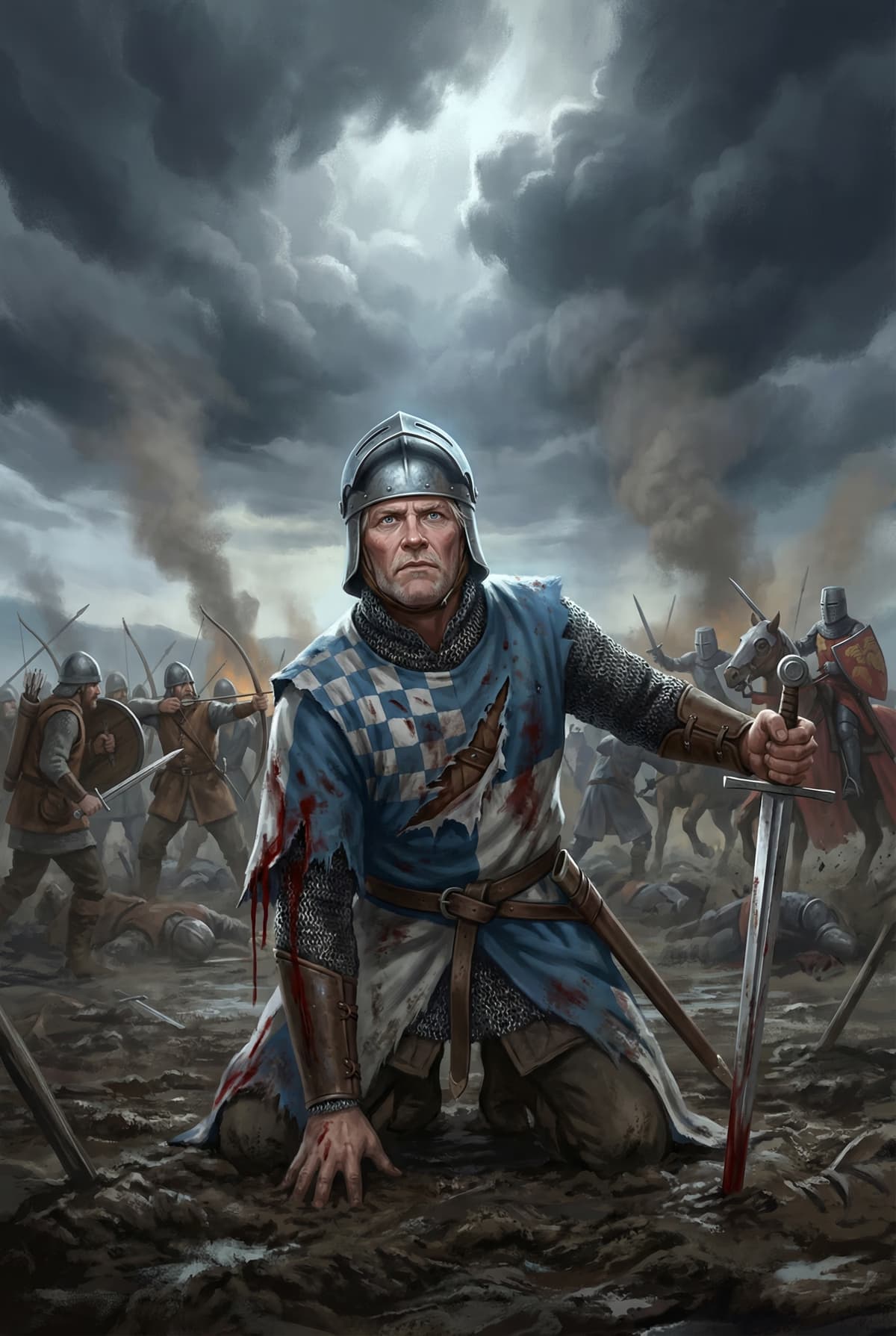
English heavy horse sees the gap and charges. Stewart is thrown from his horse in the first collision. What happens next is one of the most remarkable acts of loyalty in Scottish military history. His archers do not run. They form a ring around the body of their fallen commander and fight hand to hand against armored knights. They are bowmen, armed with knives and short swords against men in plate and chain. They die to the last man. When the killing stops, Stewart's body lies at the center of a circle of his own dead, surrounded by the men who chose to die with him rather than abandon him.
Wallace lost two friends at Falkirk. Sir John de Graham is the one the poems remember. But John Stewart's death carried a cost that would not be understood for three hundred years, because the man who died with his archers in the mud was the direct ancestor of every Stuart king who would ever sit on the thrones of Scotland and England.
Personality & Motivations
Stewart was born into the inner circle of Scottish power. His father, Alexander Stewart, was the 4th High Steward of Scotland, the hereditary chief officer of the realm. His elder brother James held the same office after him. John was not the heir. He was the second son, the spare, the one who married well and managed his wife's estates at Bonkyll in Berwickshire.
But second sons in the 13th century did not sit quietly. In May 1296, like most Scottish nobles, Stewart signed the Ragman Rolls at Roxburgh, swearing fealty to Edward I. Within a year, he was in open rebellion. Edward I's own correspondence names three men as the primary threats to English rule in Scotland: Robert Bruce, Earl of Carrick, James Stewart the High Steward, and Sir John Stewart of Bonkyll. Not a follower. A leader. One of three men the King of England considered dangerous enough to name.
What drove his rebellion is not recorded, but the timing is clear. He submitted when submission was the only option. He rebelled when rebellion became possible. And when the time came to fight, he did not command from the rear or delegate to subordinates. He stood with his archers, men from Bute and the Ettrick Forest, men connected to his family through bonds of service that went back generations. He fought where they fought. He died where they died.
What Most People Get Wrong
Most people assume Sir John Stewart was a minor figure, overshadowed by his brother the High Steward and his friend William Wallace. Some histories barely mention him at Falkirk, treating his death as a footnote to Graham's more dramatic end.
The truth is the opposite. Stewart commanded one of the three divisions of the Scottish army. He was not Wallace's subordinate in the way Graham was. He was a co-commander, a man of sufficient rank and military experience to lead an independent force. Some sources even suggest he disputed Wallace's overall command, arguing that a man of his birth should not take orders from a knight of lower standing. If that tension existed, it makes his decision to stay and die all the more striking. He may not have loved Wallace. He stayed anyway, because the men under his command had no way out, and he would not leave them.
Key Moments
Roxburgh, May 1296. Stewart presses his seal into wax on the Ragman Rolls, swearing loyalty to Edward I of England. Nearly every Scottish nobleman does the same. It is a survival act, not a conviction. That seal impression is the strongest surviving evidence of Stewart's heraldic arms. Within twelve months, the oath will be broken.
Scotland, 1297. Hugh Cressingham, Edward's hated treasurer in Scotland, sends letters demanding obedience. Stewart ignores them. A few months later, he formally confesses his rebellion alongside his brother James and Robert Bruce. Edward I now considers the three Stewarts and Bruce the most dangerous men in Scotland. The rebellion has begun.
Falkirk, July 22, 1298, morning. Stewart takes his position with the archers between the schiltrons. It is the most vulnerable spot on the field. The archers are there to screen the gaps between the spear formations, a role that depends entirely on cavalry support to protect their flanks. Stewart knows this. He takes the position anyway.
Falkirk, July 22, 1298, midday. Comyn's cavalry abandons the field. English heavy horse charges the exposed archer positions. Stewart is unhorsed in the fighting. His archers, rather than scatter, rally around his fallen body and fight until they are annihilated. The chroniclers record no survivors from Stewart's command.
The Detail History Forgot
The man who died in the mud at Falkirk founded a dynasty that would rule two kingdoms. Through his son Sir Alan Stewart of Dreghorn, the Bonkyll line continued through the Stewarts of Darnley, who became Earls of Lennox. In 1565, Henry Stuart, Lord Darnley, of this line, married Mary, Queen of Scots, reuniting the Bonkyll branch with the main royal Stewart line. Their son became James VI of Scotland and James I of England. Every British monarch since, including the current royal family, descends from John Stewart of Bonkyll through that Darnley marriage.
A man who held no great office, who was overshadowed by his brother and his commander, who died in a battle that Scotland lost, became the patrilineal ancestor of the Royal House of Stuart. In 2013, geneticist Jim Wilson identified a distinct Y-chromosome marker, S781, that formed specifically in John Stewart of Bonkyll and can be traced in his male-line descendants today. The DNA of the man who died with his archers still runs in thousands of living people.
The Downfall
Stewart's fatal flaw was the thing that should have saved him. He was a nobleman with a horse. When Comyn's cavalry fled, Stewart could have ridden with them. No chronicle would have condemned him. The battle was lost the moment the mounted knights disappeared.
He dismounted. Or he was never mounted to begin with, standing on foot among bowmen because that was where he believed a commander belonged. Either way, when the English cavalry came, he had no means of escape and no apparent desire to find one.
The archers who died around him were not knights. They were common men, recruited from Bute and the Ettrick Forest, armed with short bows and leather jerkins. They had no armor, no horses, no chance against heavy cavalry in open ground. They fought anyway, forming a ring around their commander's body, dying one by one until none remained.
Stewart left behind seven sons and a daughter. Three of those sons, Alan, James, and John the younger, would die at the Battle of Halidon Hill in 1333, thirty-five years later. The family paid for Scottish independence across two generations, father and sons falling in separate battles, a blood price that bought a dynasty. His daughter Isabella married Thomas Randolph, 1st Earl of Moray, Robert the Bruce's most trusted lieutenant and later Regent of Scotland. Even in death, Stewart's family remained at the center of Scotland's fight.
He is buried in the churchyard of Falkirk Old Parish Church, meters from Sir John de Graham. His memorial reads: "Here lies a Scottish hero, Sir John Stewart, who was killed at the Battle of Falkirk, 22nd July 1298." A separate monument, the Bute Memorial, a granite Celtic cross erected by the Marquis of Bute in 1877, stands nearby. It commemorates the "Men of Bute" who, under Stewart's command, "fell to a man at the Battle of Falkirk." Seven hundred years later, someone still remembers the archers.