- Known for
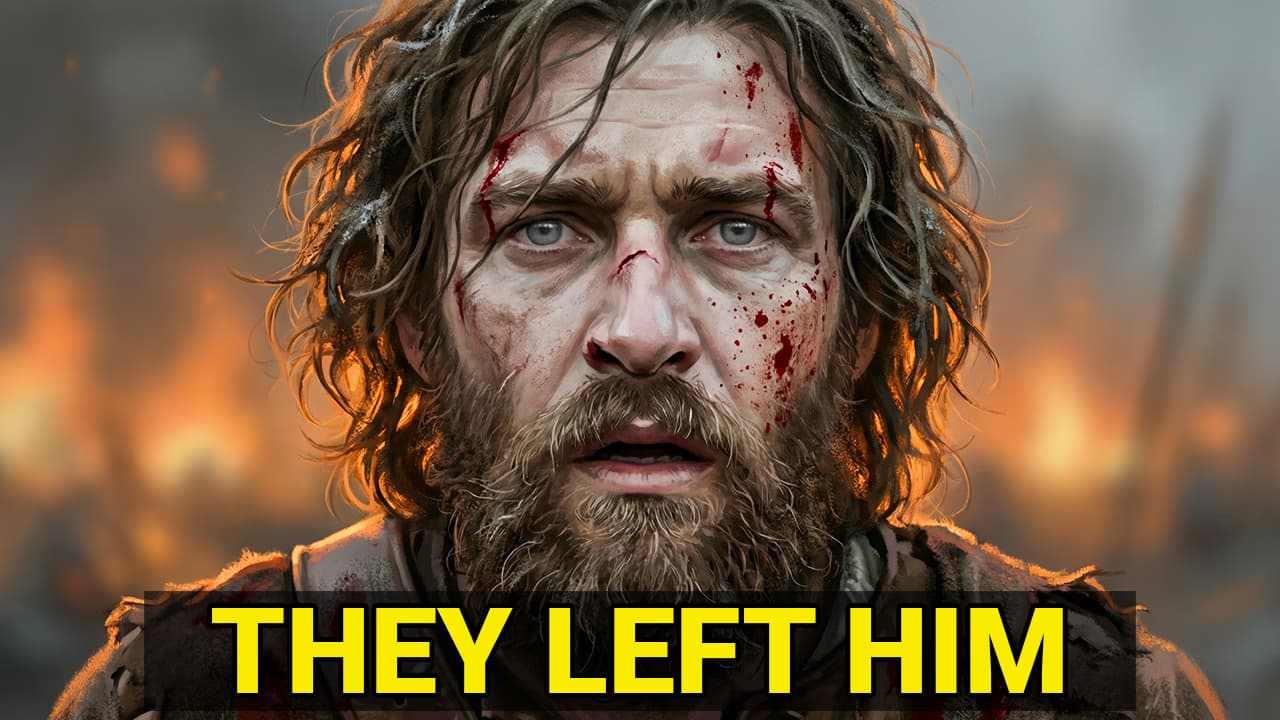
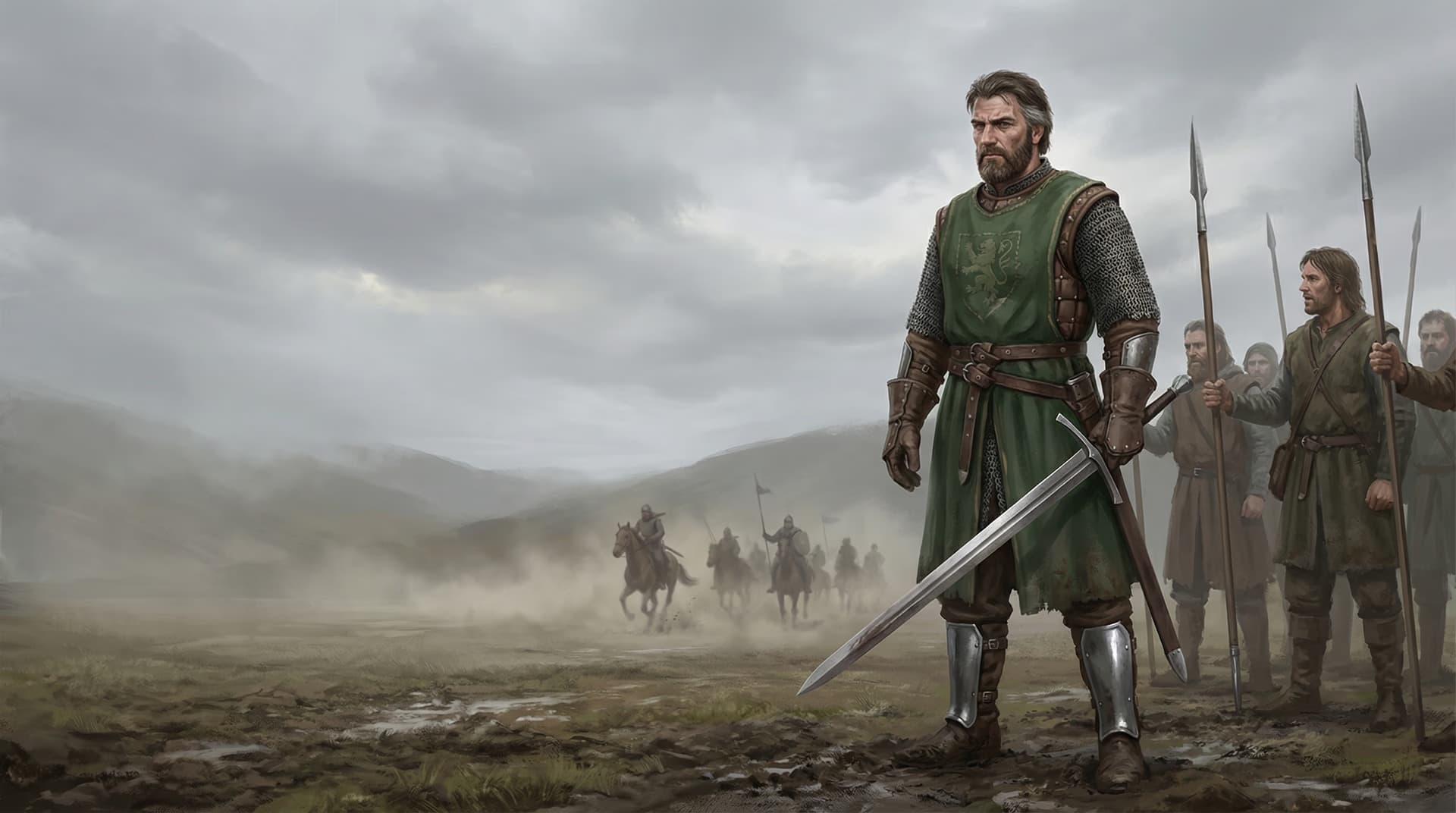
- Wallace's most trusted lieutenant, killed at the Battle of Falkirk while the Scottish cavalry fled the field
- Fatal flaw
- Loyalty without limit, he stayed when every instinct for survival said run, and died for a cause his own side had already abandoned
The Story
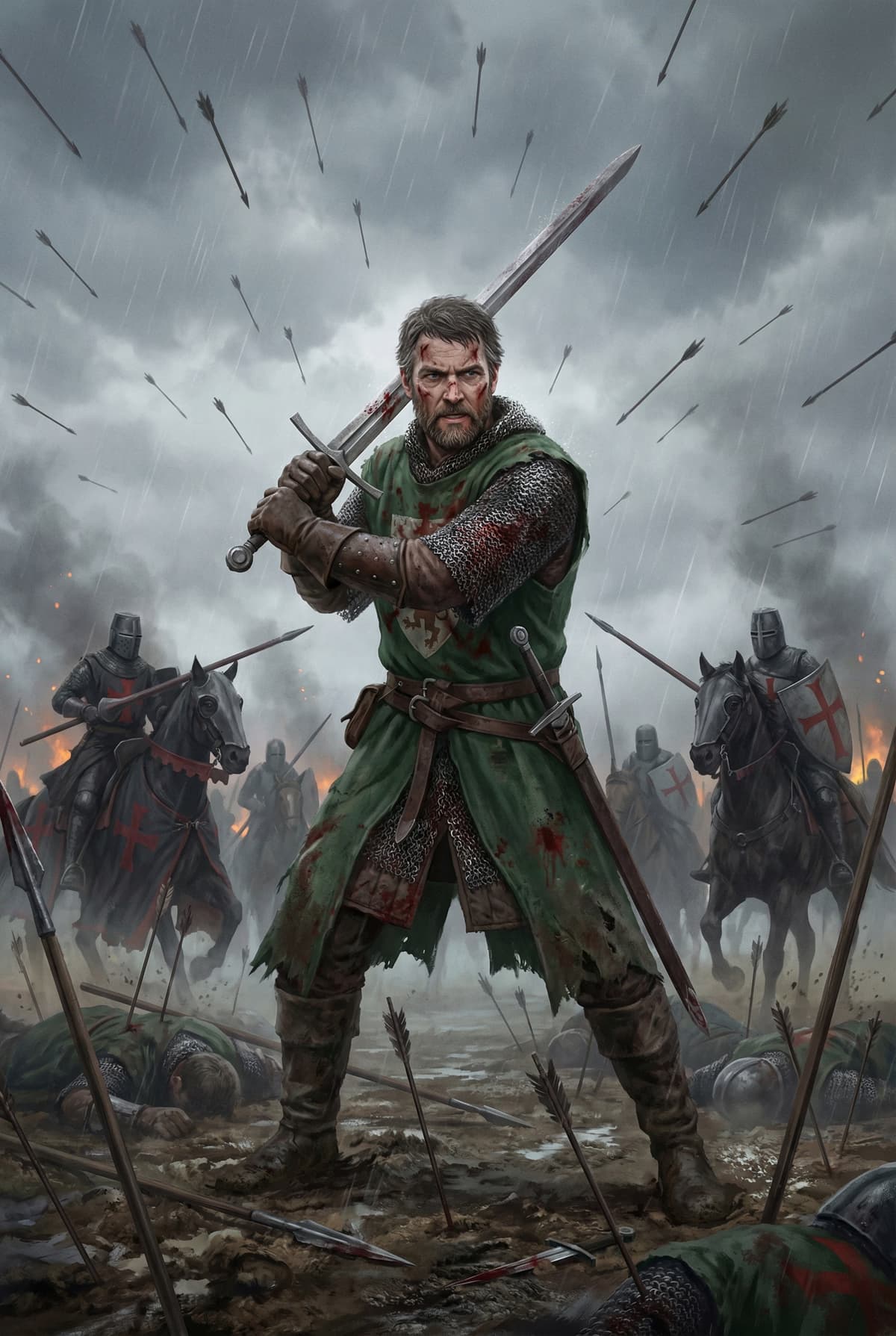
July 22nd, 1298. The Battle of Falkirk is lost. The Scottish cavalry has fled. English arrows are falling like iron rain on men who have no armor, no cavalry support, no way out. The schiltrons are breaking apart. Men are running, dying, screaming.
Sir John de Graham is not running.
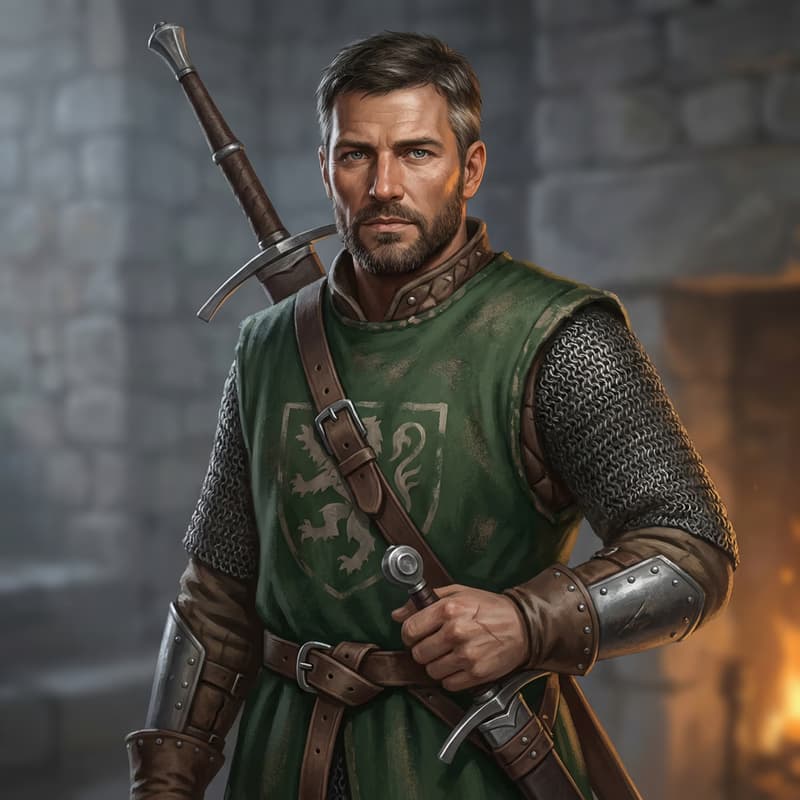
He is still fighting. Somewhere in the carnage, with his armor loose at the waist and English knights closing from every direction, Graham is swinging his sword at anything that moves. Wallace's closest friend, his most trusted commander, the man the chronicles would call "Graeme with the Bright Sword," is doing what he has always done. Standing where the killing is thickest because that is where he belongs.
An English knight finds the gap in his armor. The blade goes in at the waist, where the plates have come unfastened. Graham falls. Around his body, the dead Englishmen he took with him tell the story of his last minutes better than any chronicle could.
When Wallace found him the next day, he lifted the body in his arms and carried it to St. Mary's Kirk in Falkirk. Blind Harry's poem records the lament: "My best brother in world that ever I had, my faithful friend when I was hardest stead." It is considered the finest passage in the entire poem. Wallace would never have another friend like him.
Personality & Motivations
Graham was not a politician. He was not a negotiator. He was a man who fought, and the thing that set him apart from every other fighting man in Scotland was the simplicity of his loyalty. Where the earls calculated, where the nobles hedged, where John Comyn weighed his options and Robert Bruce waited for his moment, Graham chose his side and never wavered.
He was born into minor nobility at Dundaff Castle in Stirlingshire, the third son of Sir David de Graham. Not rich enough to matter in the aristocratic games that consumed Scottish politics, but noble enough to carry a sword and choose who to follow. He chose Wallace. He chose him before Stirling Bridge, before the victories, before there was anything to gain. According to Blind Harry, he first met Wallace in late 1296 when the fugitive swam the River Forth to escape English pursuers. Graham hosted him at Dundaff for three nights. From that moment, they were inseparable.
What drove that loyalty is impossible to know with certainty. The chronicles record actions, not motives. But the pattern is clear: Graham appears wherever the fighting is worst, wherever Wallace needs a man he can trust absolutely. At Lanark, while Wallace killed the sheriff, Graham led thirty men against the English garrison. At Stirling Bridge, he stood in the line. At Falkirk, when every nobleman with a horse rode away, Graham stayed on foot with the spearmen and died with them.
What Most People Get Wrong
Most people assume Graham was a minor figure, a sidekick who followed Wallace around and died conveniently to add drama to the Falkirk story. Some historians have gone further, arguing that no medieval chronicle explicitly names Graham among the dead at Falkirk, and that his entire legend comes from Blind Harry's 15th-century poem, written nearly two hundred years after the battle.
But the evidence runs deeper than poetry. When his tomb in Falkirk was opened in 1927 for structural work, excavators found bones approximately six feet deep. The thigh bones measured seventeen inches, marking him as an unusually tall man for the 13th century. Experts concluded the ground had never been disturbed since 1297. Someone important was buried there, at the right time, in the right place. And the inscription on his tomb, likely dating to the 14th century, calls him "ane of the chiefs who rescewit Scotland thrise." You do not engrave that kind of praise for a minor figure. Graham may have been inflated by legend, but the legend had something real at its core.
Key Moments
Dundaff, late 1296. Wallace arrived at Graham's door as a fugitive, soaking wet from swimming the Forth, hunted by English soldiers who had nearly caught him. Graham took him in for three nights. It was not a political calculation. It was an act of defiance that could have cost him everything. From that meeting, a partnership was forged that would last until Falkirk.
Lanark, May 1297. The night Wallace killed Sheriff William Heselrig, Graham led a simultaneous assault on the English garrison. While Wallace's rage drove him to butcher the sheriff, Graham commanded thirty men in a coordinated attack that killed the garrison commander and every soldier under him. This was not a man who simply followed. He planned, he led, he finished the job.
Stirling Bridge, September 11, 1297. Graham fought alongside Wallace and Andrew Moray in the masterpiece that changed Scotland. Eight thousand Scots destroyed an English army twice their size by letting them funnel across a bridge too narrow for two horses. Graham stood in the line that held while the English poured across to their deaths. After the battle, Wallace was knighted and named Guardian. Graham remained what he had always been: the man standing next to him.
Falkirk, July 22, 1298. The day everything ended. Wallace's scorched earth strategy had Edward I's army starving, but two Scottish earls betrayed his position. On an open field, with no bridge to channel the enemy, the schiltrons became targets. John Comyn's cavalry fled without fighting. English longbowmen opened fire on unarmored men packed so tightly they could not fall. Graham stayed. He fought until an English blade found the gap in his armor. They found his body later, ringed by the men he had killed.
The Detail History Forgot
Graham's gravestone in Falkirk Old Parish Church is not one stone. It is four, stacked on top of each other across five centuries, each generation adding its own tribute to a man who died in 1298.
The lowest slab is a stone effigy of a knight, probably carved in the 14th century, within living memory of the battle. Above it sits a table tomb placed around 1570. The Duke of Montrose added a third slab around 1752. And in 1773, William Graham of Airth furnished the uppermost stone bearing the inscription that visitors read today: "Here lyes Sir John the Grame, baith wight and wise, ane of the chiefs who rescewit Scotland thrise, ane better knight not to the world was lent, nor was gude Graham of truth and hardiment."
In 1860, the Falkirk Iron Company built a Gothic cast iron cupola over the entire monument, complete with a gilded coronet and the Scottish Lion. A bronze replica sword was added in 1869. Robert Burns visited in 1787 and noted the tomb in his journal. The district of Grahamston, which gave its name to Falkirk's railway station, was named for him. A man who held no title, commanded no army of his own, and died in a battle that Scotland lost has been continuously commemorated for over seven hundred years. That tells you something about what loyalty is worth, even when it fails.
The Downfall
Graham's fatal flaw was the thing that made him admirable. He was loyal past the point of reason, past the point of survival, past the point where any rational man would have turned his horse and ridden for the hills. When Comyn's cavalry abandoned the field at Falkirk, Graham had the same choice every mounted nobleman had. He could have followed them. No one would have blamed him. The battle was lost the moment the cavalry fled.
He stayed. He dismounted, or was never mounted at all, and fought on foot with the spearmen who had no choice but to stand. Farmers and tradesmen, the men Wallace had turned into soldiers, the men the nobles considered expendable. Graham chose to die with them rather than live with the men who abandoned them.
There is no record of his last words. No dramatic speech, no final defiance. Just a man fighting until his armor failed and an English sword found flesh. Wallace's lament, preserved in Blind Harry's poem, says everything that needs to be said. He lifted his friend's body from the field and carried him to the church. He called him "my best brother." He meant it. Seven years later, when Wallace himself was betrayed, captured, and butchered in London, there was no one left to carry him. Graham had been the last man Wallace could trust with his life, and Graham was already in the ground at Falkirk.