
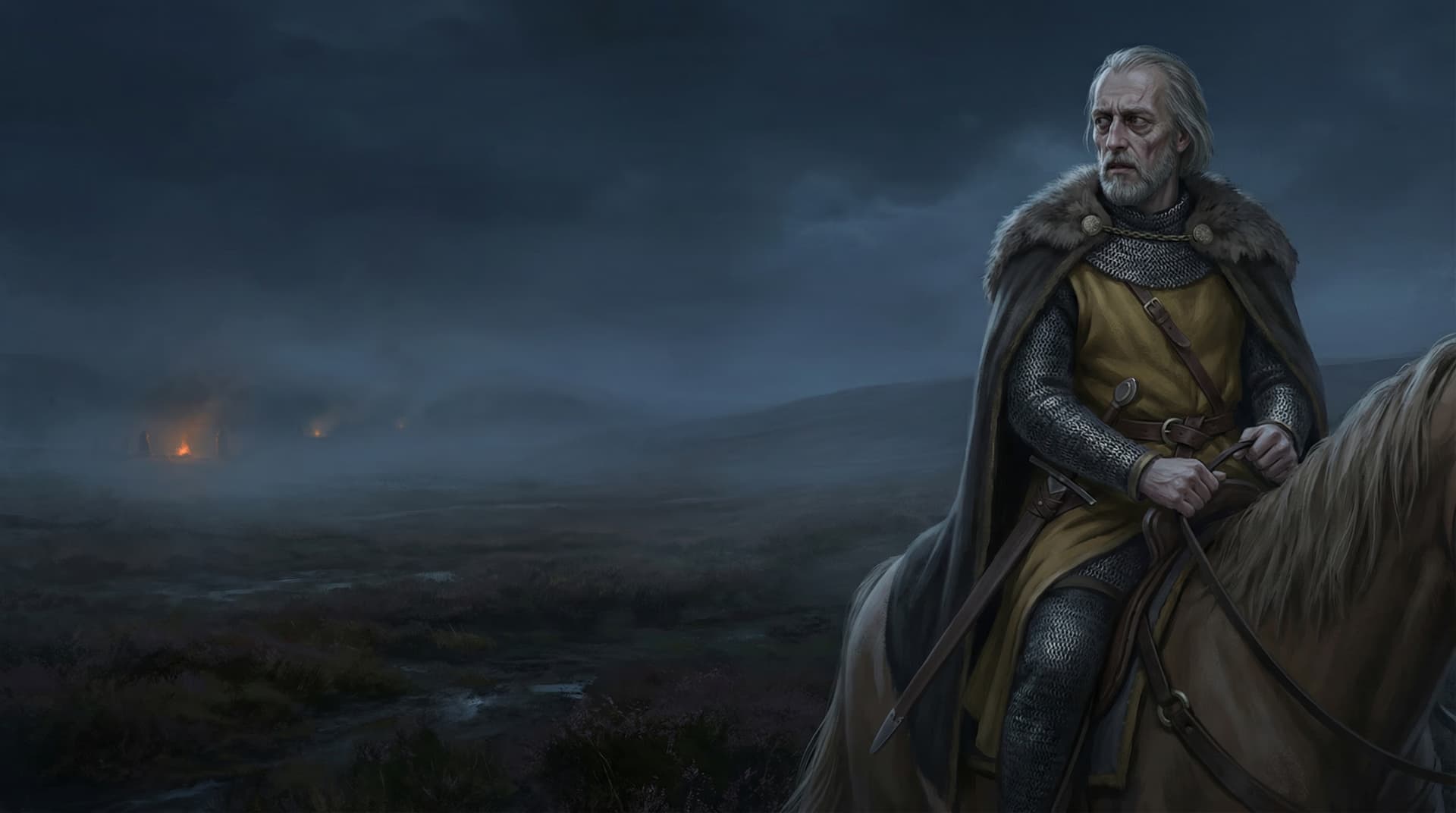
- Known for
- Betraying William Wallace's position to Edward I before the Battle of Falkirk, dooming the Scottish army to destruction on an open field
- Fatal flaw
- A man with roots in two kingdoms who chose to serve only one, he preserved his English estates and lost Scotland forever
The Story
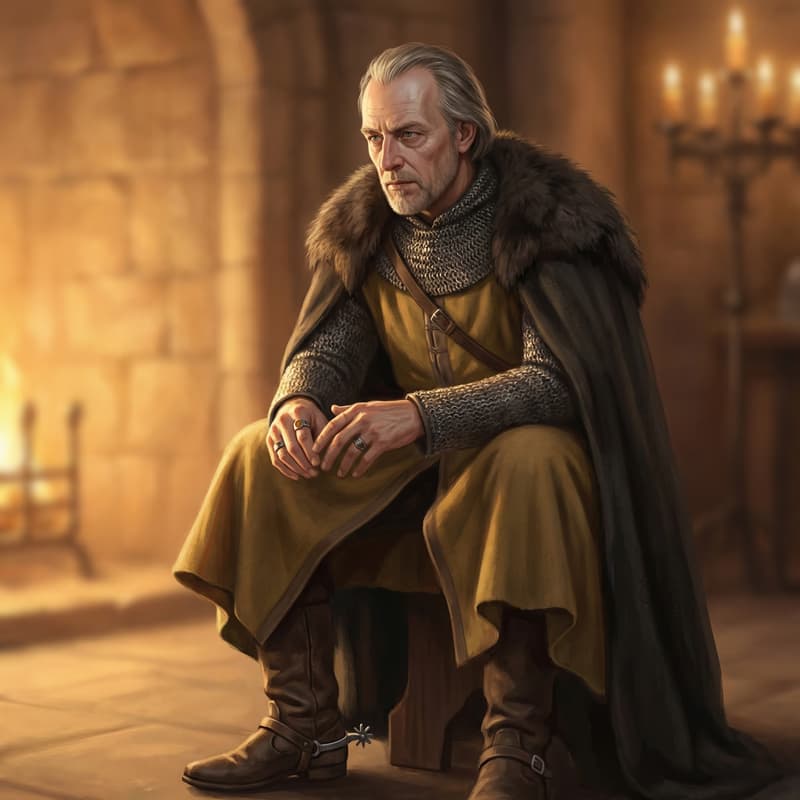
Sometime in mid-July 1298, two horsemen ride out of the Scottish darkness and into King Edward I's camp. The English army is starving. The supply ships never arrived. Welsh infantry rioted two nights ago. Edward is days from ordering a humiliating retreat to Edinburgh.
Gilbert de Umfraville, Earl of Angus, has news. He knows exactly where William Wallace is hiding. He knows the Guardian plans a night attack on the English camp. He knows the location, the timing, the route.
Edward smiles for the first time in weeks.
The information Umfraville delivers will transform a failing campaign into a decisive victory. Within forty-eight hours, thousands of Scottish spearmen will be dead on an open field near Falkirk, Wallace's military reputation will be destroyed, and the Guardian who had humiliated England at Stirling Bridge will resign in disgrace.
Umfraville did not act alone. Patrick, Earl of Dunbar, rode with him. But Umfraville was the man the chronicles name first, the earl who spoke the words that condemned an army. He was called the Red Earl, and the color suited him. Not for his hair or his temper, but for what he left behind.
Personality & Motivations
To understand Umfraville, you have to understand what he was not. He was not Scottish. Not really. His family name came from a village in Normandy. His ancestor Robert "with the Beard" had crossed with William the Conqueror in 1066 and received the lordships of Prudhoe and Redesdale in Northumberland as his reward. For two hundred years, the Umfravilles had been border lords, English barons who acquired a Scottish earldom through a fortunate marriage.
That marriage was the key to everything. Gilbert's mother, Matilda, was the Countess of Angus in her own right, the last of the old Gaelic mormaer line that had ruled the province for centuries. When she married Gilbert's father, the earldom passed from Gaelic to Norman hands. Gilbert inherited his Scottish title through his mother and his English lordships through his father. He was an infant when his father died, no older than three, and the wardship of this valuable orphan was purchased by none other than Simon de Montfort, the great rebel baron, for the staggering sum of 10,000 pounds.
Gilbert grew up in the Montfort household during the explosive politics of the Barons' War against Henry III. He was the same age as Montfort's son Guy. He learned early that loyalty was transactional, that great men switched sides when the price was right, and that the only thing that mattered was keeping your estates intact when the dust settled. After Montfort's defeat and death at Evesham in 1265, Gilbert was quick to make his peace with the victorious king. He avoided disinheritance. He always avoided disinheritance.
What Most People Get Wrong
Most people assume Umfraville was a Scottish traitor, a nobleman who sold out his own country. The reality is more complicated and, in some ways, worse. Umfraville never considered himself Scottish. He was an English baron who happened to hold a Scottish earldom. His primary seat was Prudhoe Castle in Northumberland, not any fortress in Angus. He attended English parliaments and fought in English campaigns in Wales under Edward I in 1276.
When he rode to Edward's camp at Falkirk, he was not betraying his country. He was serving his king. In his mind, Wallace was a rebel against the legitimate overlordship that Edward I claimed over Scotland, and the Guardian's low birth made his authority doubly offensive. Umfraville's betrayal was not an act of cowardice. It was an act of class warfare, an earl reminding the world that commoners had no business commanding their betters.
Key Moments
Prudhoe Castle, c. 1245. Gilbert inherits his father's English lordships as an infant. His wardship is purchased by Simon de Montfort for 10,000 pounds, one of the largest wardship payments of the 13th century. The boy who will betray Wallace grows up in the household of England's most famous rebel.
Evesham, 1265. Montfort is killed and his cause destroyed. The twenty-year-old Umfraville, raised by the rebel leader, switches sides with practiced ease and makes his peace with the Crown. He will not make the mistake of picking the losing side again.
Gwynedd, 1276. Umfraville answers Edward I's summons and campaigns against Llywelyn ap Gruffudd in Wales. This is his apprenticeship in Edward's wars of conquest, learning the tactics and the ruthlessness that Edward will later bring to Scotland.
Scotland, 1284. As Earl of Angus, Umfraville participates in the Scottish parliament that acknowledges Margaret of Norway as heir to the throne. He is playing both sides of the border, a Scottish earl in Edinburgh and an English baron in Northumberland, collecting rents and influence in two kingdoms.
Wark, March 1296. When war erupts, Umfraville makes his choice. He swears fealty to Edward I at Wark alongside Patrick, Earl of Dunbar, and Robert Bruce. From this point forward, he fights exclusively for England.
Falkirk, July 1298. Umfraville and Patrick, Earl of Dunbar, ride to Edward's camp and reveal Wallace's position. "The Guardian is at Falkirk, by the River Carron. He plans to attack your camp tomorrow night." The intelligence saves the English campaign and dooms the Scottish army.
The Detail History Forgot
Gilbert de Umfraville's stone effigy still lies in Hexham Abbey in Northumberland, where he was buried after his death in 1307. The knight is carved in the cross-legged pose that Victorians believed indicated a Crusader, though modern scholars have debunked this myth. The effigy shows a man in full armor, the military equipment of a 13th-century border lord rendered in stone.
He chose to be buried at Hexham, not in Angus. Not in Scotland at all. In death, as in life, he went home to England. His son Robert would fight for the English at Bannockburn in 1314, be captured, and eventually lose the Scottish earldom entirely. Robert the Bruce stripped the Umfravilles of Angus and gave it to the Stewarts. The family that had held a Scottish earldom for three generations lost it because they never stopped being English. The Red Earl's effigy lies in an English abbey, a fitting monument to a man who held a Scottish title and never once put Scotland first.
The Downfall
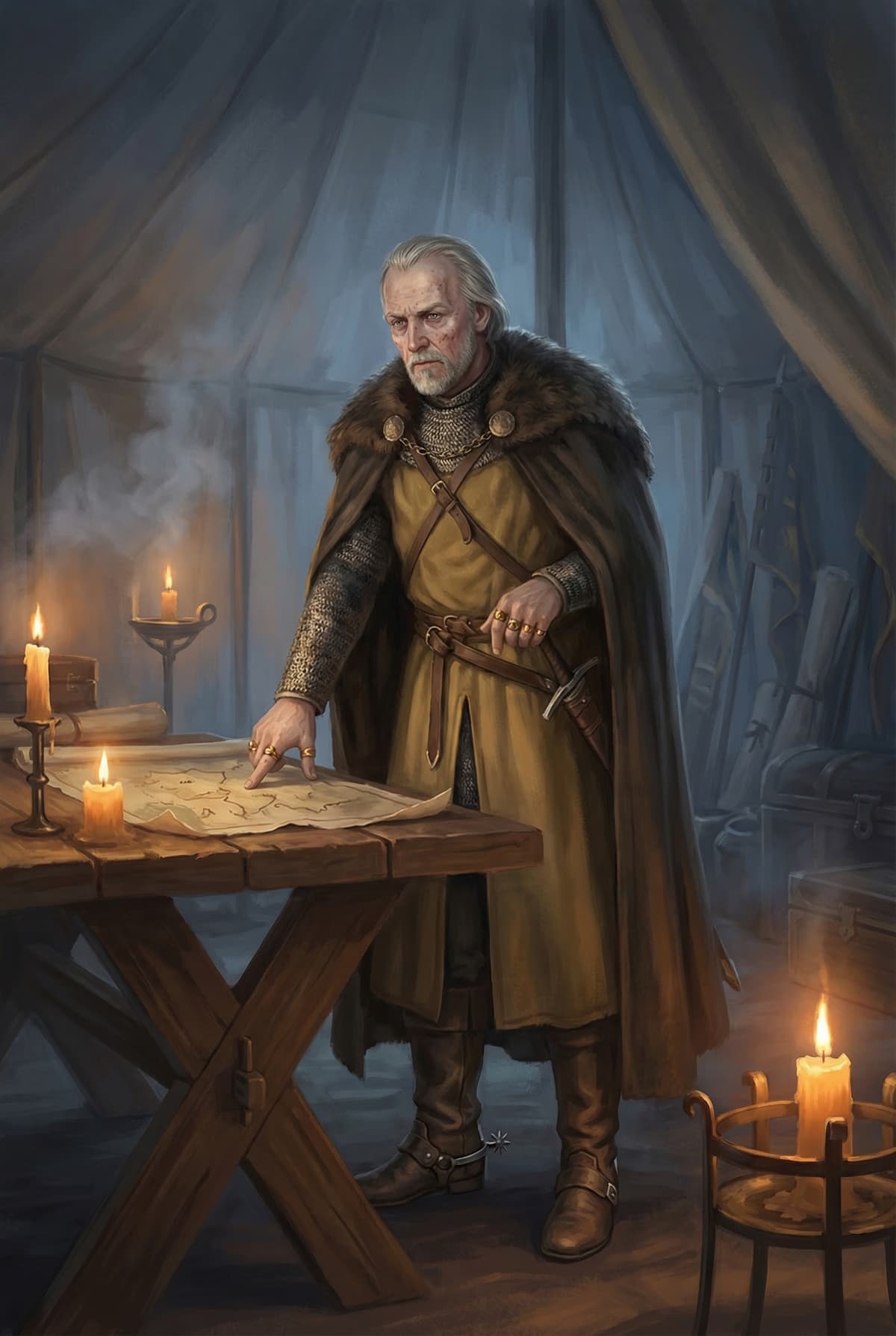
Umfraville's fatal flaw was not disloyalty. It was certainty. He was certain that he was English, certain that Edward I was his rightful king, certain that Wallace was beneath him, and certain that preserving his estates on both sides of the border was worth any price.
For most of his life, this calculation worked. He served in Wales and was rewarded. He submitted early in the Scottish wars and kept his English lordships. He betrayed Wallace at Falkirk and cemented his position as one of Edward's most trusted Scottish allies. He even served briefly as joint Guardian of Scotland in 1300, appointed by the English to govern the country he had helped conquer.
But certainty has a cost. When Robert the Bruce seized the Scottish throne in 1306, the Umfravilles were on the wrong side of a line that could no longer be straddled. Gilbert died in 1307, the same year Edward I died on the march north. His eldest son Gilbert had already died without issue in 1303. His second son Robert inherited a contested earldom, fought for England at Bannockburn in 1314, and was captured fleeing to Bothwell Castle.
After Bannockburn, Robert the Bruce declared at Cambuskenneth Abbey that any Scottish earl or baron not present on the field would forfeit their Scottish estates. The Umfravilles, who had never come home to Scotland, lost Angus. The earldom was given to the Stewart family. The Norman barons who had married into a Gaelic mormaership and traded it for English favor ended with nothing on the Scottish side of the border. Prudhoe Castle remained. Redesdale remained. The Scottish earldom did not.
Gilbert de Umfraville chose England, and England was all he kept.