
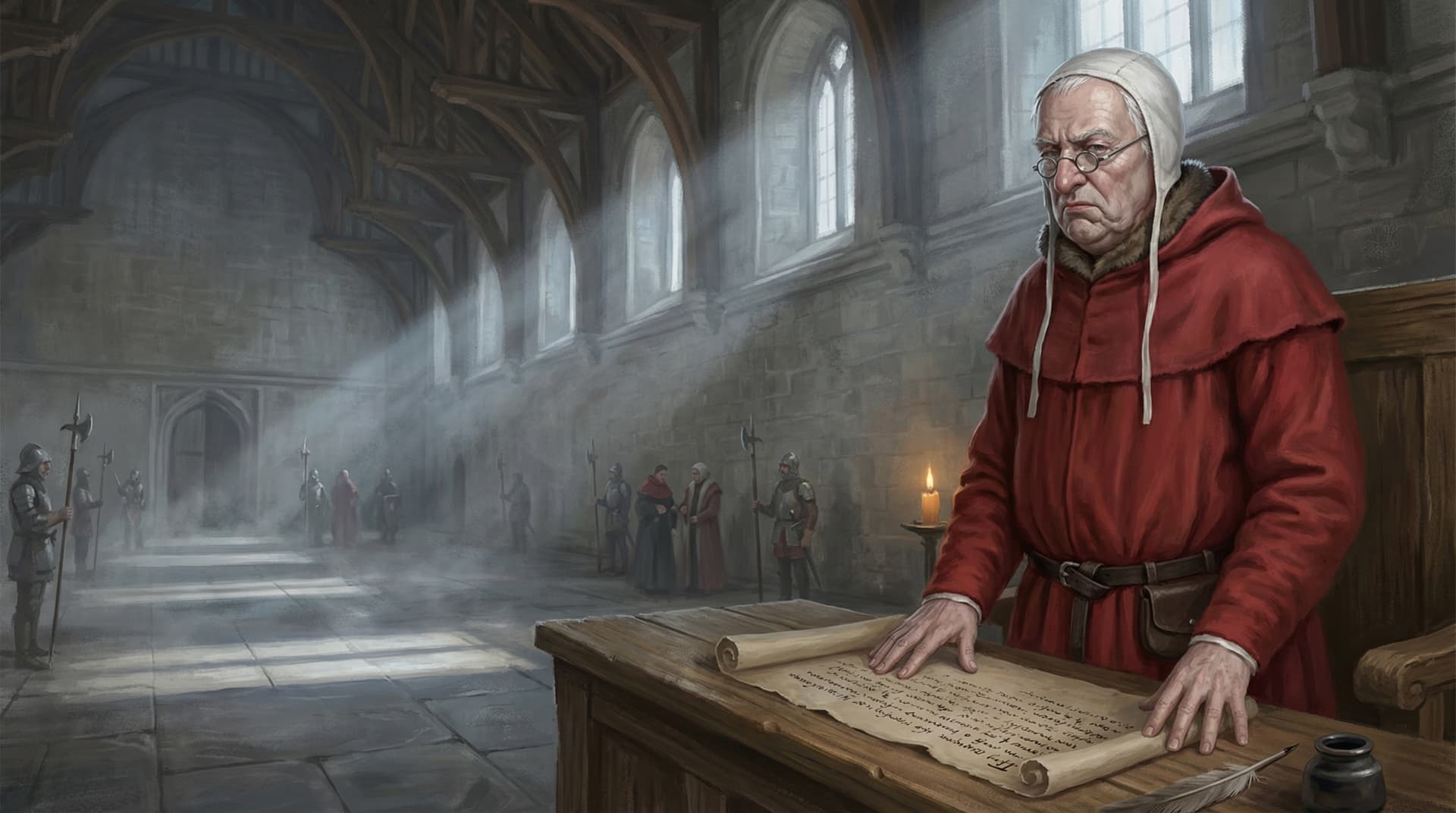
- Known for
- Justice of the Court of Common Pleas who presided over the show trial and condemnation of William Wallace at Westminster Hall in August 1305
- Fatal flaw
- He believed that lawful procedure could sanitize political murder, and spent his career proving it
The Story
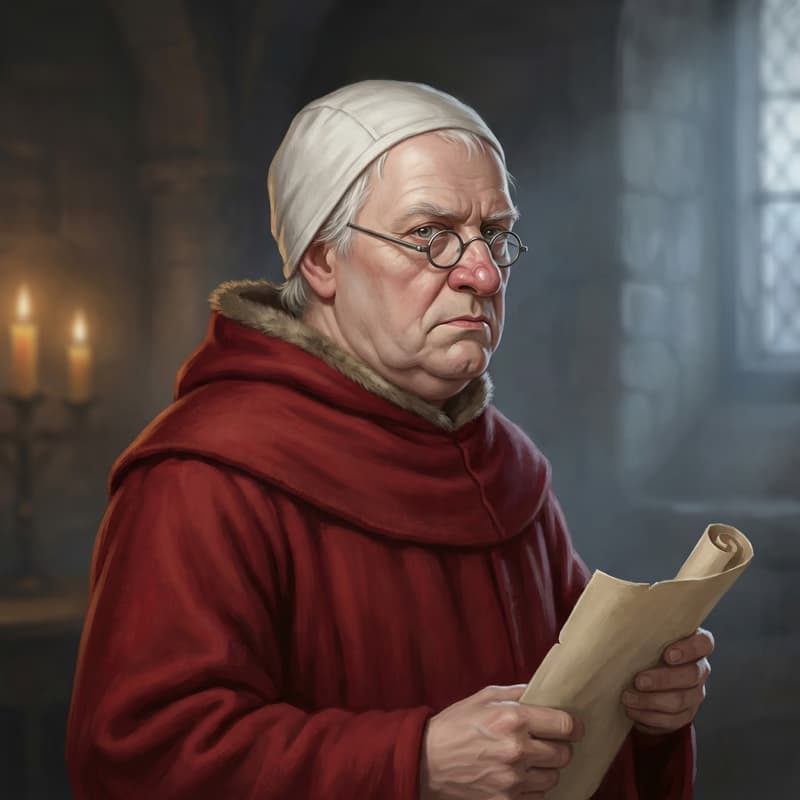
Westminster Hall. August 23rd, 1305. The largest hall in England, two hundred and forty feet long, its stone walls six feet thick, built to make every man inside feel small. Light falls through high windows onto a bench where a prisoner sits in chains.
On that bench, wearing a crown of oak leaves jammed onto his head by English guards, sits William Wallace. He has been dragged from Scotland in chains. He has not slept. He has not eaten. The crown is a joke, declaring him king of outlaws. The five judges arrayed before him are not laughing.
Sir Peter Mallory rises. He is the senior justice on the commission, a veteran of the Court of Common Pleas, a man who has spent decades turning the machinery of English law with careful, practiced hands. He holds a document. He begins to read.
Treason against King Edward. Murder. Robbery. Arson. The burning of villages. The killing of sheriffs. The slaughter of Englishmen "sparing neither age nor sex, monk nor nun." The charges roll out across the silent hall, each one precise, each one calculated to justify what everyone in the room already knows is coming. Wallace is not permitted to speak in his own defense. There is no jury. The sentence has been written before Mallory opened his mouth.
This is the moment Peter Mallory exists for in history. Not a battle. Not a betrayal. A legal proceeding so transparently rigged that seven centuries later, legal scholars still use it as one of the earliest examples of a political show trial. Mallory gave Edward I what the king needed: the appearance of due process wrapped around a predetermined execution. The law as weapon. Justice as theater.
Personality & Motivations
Mallory was not a soldier. He was a bureaucrat, a creature of parchment and precedent, trained in the Inns of Court and appointed to the bench of Common Pleas by a king who valued obedience above all else. He belonged to a class of professional justices that Edward I had cultivated throughout his reign, men who understood that the law existed to serve the crown and that their careers depended on remembering it.
He would have known, reading those charges in Westminster Hall, that the trial was a legal fiction. Wallace had never sworn allegiance to Edward. He could not, by any honest reading of English law, commit treason against a king he had never acknowledged. Mallory read the charges anyway. He pronounced the verdict anyway. He ordered the sentence anyway. This was not a failure of legal reasoning. It was a demonstration of institutional loyalty.
What drove men like Mallory was not cruelty but something quieter and more durable: the conviction that order mattered more than justice, that the machinery of the state must grind forward regardless of what it ground up. He was Edward's instrument. He performed his function. He went home.
What Most People Get Wrong
Popular accounts often describe Mallory as a corrupt judge or a personal enemy of Wallace. He was neither. He was a professional justice of the Court of Common Pleas, one of England's two central common law courts, which handled the vast majority of civil litigation between subjects. His normal work involved land disputes, debts, and property claims. He was not a hanging judge by temperament or career. He was a civil lawyer pressed into service for a political trial because Edward needed credible legal authority behind the execution.
The Wallace commission was a "gaol delivery," a standard mechanism for trying prisoners held in royal jails. By framing it this way, Edward made the trial look routine. Mallory's presence on the bench was meant to signal that this was ordinary justice, not royal vengeance. The fiction required a real judge, and Mallory was the real judge who agreed to play his part.
Key Moments
The Commission, August 1305. Edward I issued letters patent appointing five men to deliver judgment on William Wallace: Sir John de Segrave, who held custody of the prisoner; Peter Mallory, justice of Common Pleas; Ralph de Sandwich, Constable of the Tower of London; John de Bakewell; and Sir John le Blound, Mayor of London. The commission's wording was explicit. It instructed the judges to deliver Wallace "according to the ordinance on the matter enjoined by us upon you." Edward had written the verdict into the appointment itself. The judges were not asked to determine guilt. They were told to carry out a sentence.
Westminster Hall, August 23rd, 1305. The trial lasted less than a day. Wallace was brought to the south side of the great hall and seated on a bench. A crown of oak leaves was placed on his head. Mallory, as the senior legal authority on the commission, read the indictment. The charges covered treason, murder, robbery, sacrilege, and the destruction of property across Scotland and northern England. Wallace was denied the right to speak in his defense. When he shouted that he was no traitor because he had never sworn loyalty to Edward, the court ignored him. The sentence was pronounced: hanging, drawing, and quartering, to be carried out that same day.
The Legal Precedent. The Wallace trial established something that modern scholars recognize as one of the earliest documented political show trials in English legal history. Mallory's role was to make it look legitimate. The use of a gaol delivery commission, a standard legal mechanism, to try a foreign prisoner of war on charges of treason against a king he had never acknowledged was a legal innovation. It meant that English law could reach anyone Edward declared an enemy, regardless of whether they owed allegiance to the English crown. Mallory's signature on the proceedings gave that innovation the weight of judicial authority.
Service on the Bench, 1290s-1305. Mallory served as a justice of the Court of Common Pleas during the most consequential period of Edward I's legal reforms. Edward had restructured England's court system, splitting the old curia regis into specialized branches and professionalizing the judiciary. Mallory was part of the first generation of career judges who rose through the legal profession rather than the church or the military. His entire career was built on the system Edward created, which made him both competent and compliant.
The Aftermath. After the trial, Mallory returned to his duties at Common Pleas. There is no record of protest, regret, or hesitation. Wallace was dragged naked through the streets of London to Smithfield, hanged until nearly dead, castrated, disemboweled while still breathing, and finally beheaded and quartered. His head was dipped in tar and mounted on a spike on London Bridge. His limbs were sent to Newcastle, Berwick, Stirling, and Perth as warnings. Mallory's legal paperwork made all of it lawful.
The Detail History Forgot
The charges read against Wallace at Westminster Hall survived for over four centuries in a medieval manuscript held in the Tower of London. That manuscript was destroyed by fire in 1731. The only reason we know the exact wording of Mallory's indictment is that antiquarians had transcribed it before the flames reached it. The parchment that Mallory held in his hands that August morning, the document that condemned the most famous Scotsman in history, no longer exists. What survives is a copy of a copy, preserved by the accident of scholarly curiosity.
The transcription reveals something the popular accounts miss. The charges were not simply a list of crimes. They were a narrative, a story Edward's lawyers crafted to transform a war of independence into a criminal rampage. Every clause was designed to strip Wallace of political legitimacy and recast him as a common outlaw. Mallory did not just read charges. He read a propaganda document disguised as a legal indictment, and he read it with the full authority of the king's bench behind him.
The Downfall
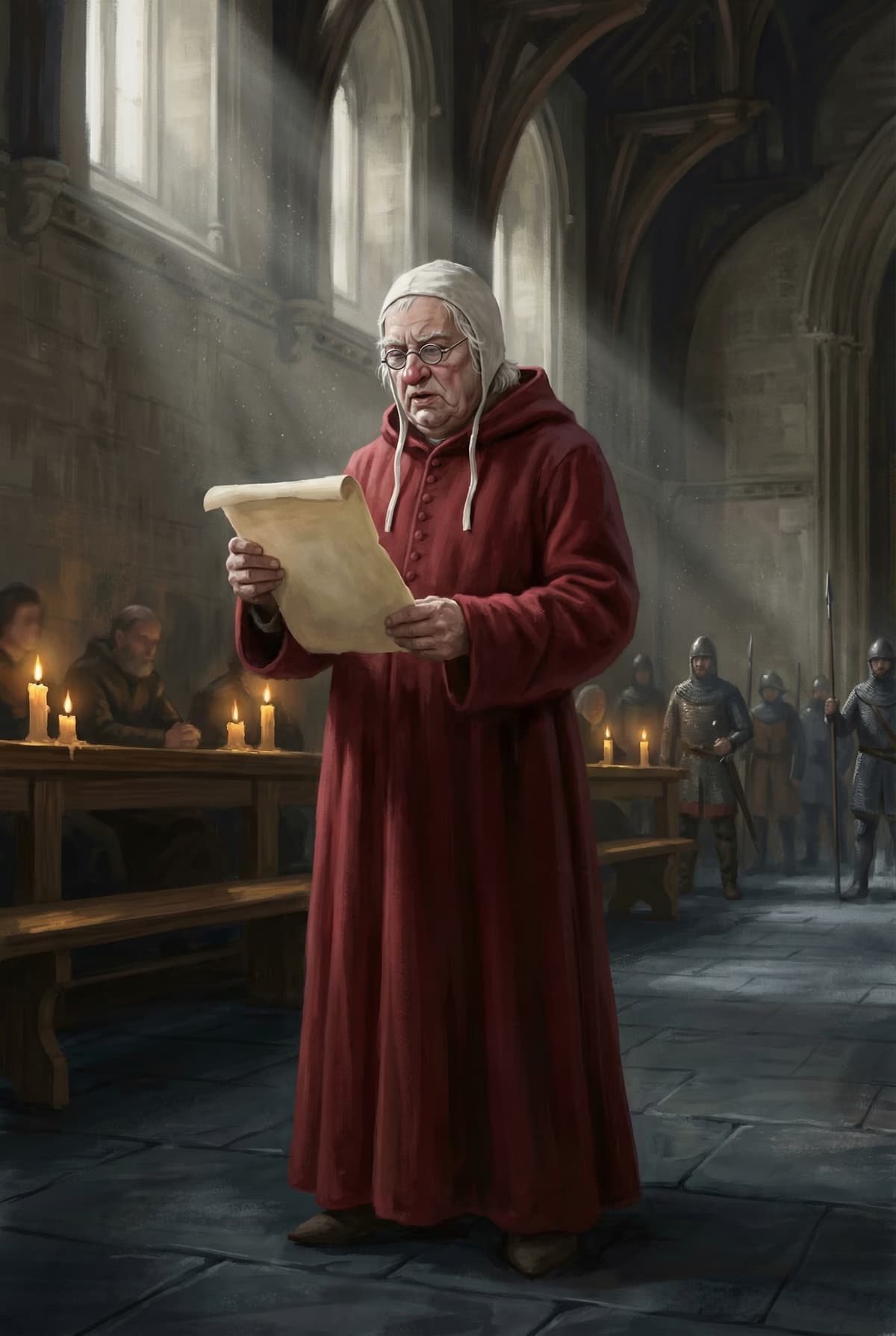
Mallory died around 1309, roughly four years after the Wallace trial. He did not fall from power. He was not punished or disgraced. He simply served out his remaining years on the bench and died, presumably in his bed, presumably in comfort. There was no dramatic reckoning, no moment of justice for the injustice he administered.
That is precisely the point. Mallory's flaw was not that he committed a single spectacular crime. It was that he built a career on the belief that legal procedure could justify anything, that following orders and following the law were the same thing, and that a man who kept his head down and did his work could not be held accountable for what his work accomplished. He believed the system would protect him, and he was right. It did.
But the system could not protect his reputation. Within a generation, the Wallace trial was recognized across Europe as a judicial atrocity. Scotland's war of independence intensified after the execution, not because Wallace's death weakened the cause but because it enraged an entire nation. Robert Bruce was crowned king of Scotland seven months after Mallory read the charges. The English legal machinery that Mallory represented, the careful, procedural, parchment-and-seal apparatus of royal justice, had produced the opposite of its intended result. It did not crush Scottish resistance. It gave Scottish resistance its most powerful martyr.
Mallory never saw that outcome. He went back to his courtroom, back to his land disputes and debt claims, back to the quiet, orderly work of a common law judge. He had done his duty. He had followed the law. History would decide what the law was worth.