
- Known for
- English commander who lost the Battle of Stirling Bridge to William Wallace through overconfidence and contempt for his enemy
- Fatal flaw
- A lifetime of easy victories and royal favor convinced him that reputation alone could win wars, until he met an enemy who did not care who he was
The Story
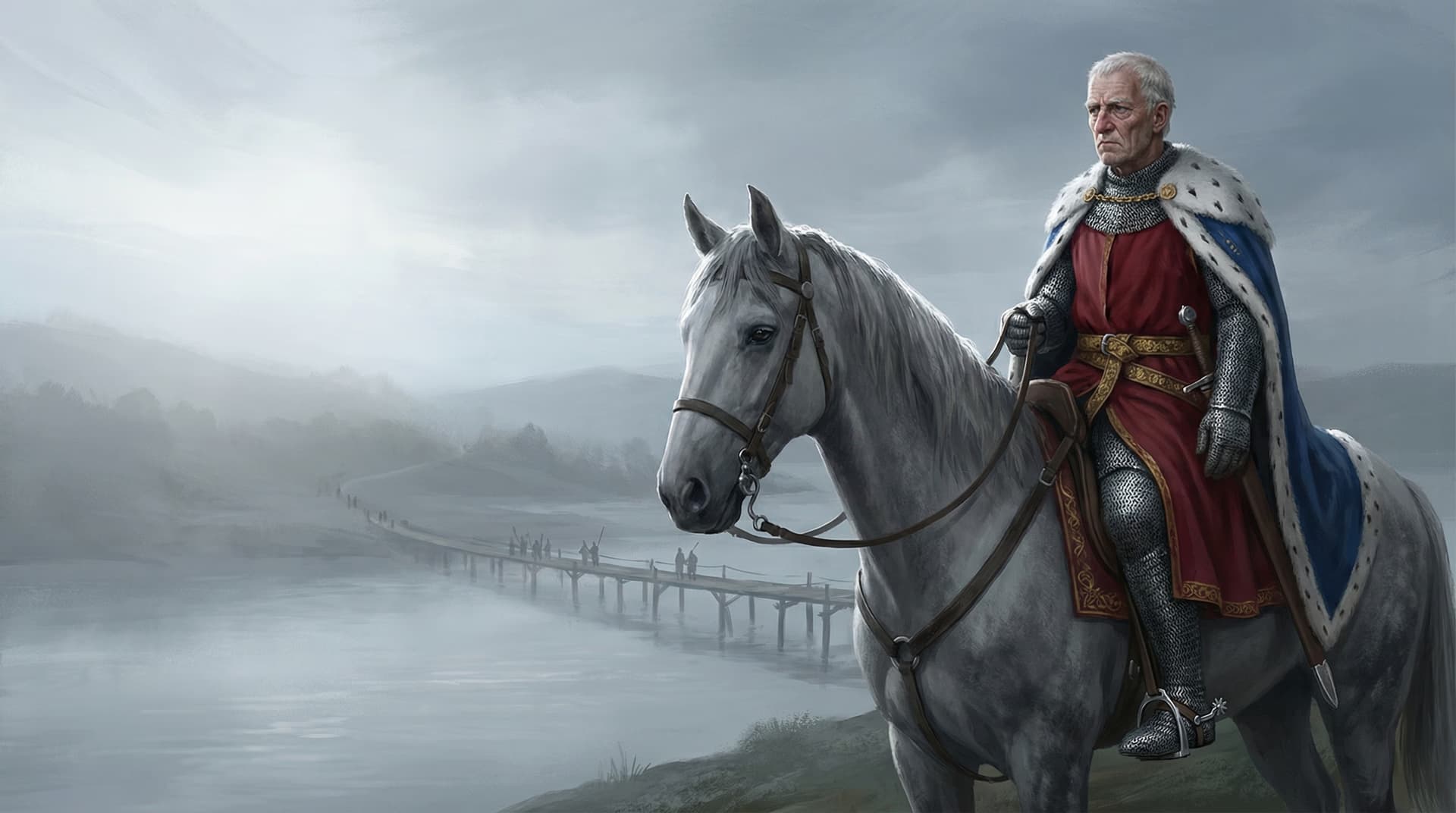
September 11th, 1297. The old earl sits on his horse on the south bank of the River Forth, watching the first English cavalry clatter across a wooden bridge so narrow that two horsemen can barely ride abreast. He is sixty-six years old. His joints ache. The Scottish climate, which he has complained about for months, has settled into his bones like a curse. On the far bank, a line of Scottish spearmen waits on the high ground, silent and still.
John de Warenne, Earl of Surrey, Warden of Scotland, does not take them seriously. He has beaten Scots before. Last year at Dunbar, the Scottish cavalry broke and ran before his knights even finished their charge. These men on the hill are worse than that. Farmers. Peasants. Led by a commoner nobody had heard of six months ago. Sir Richard Lundie, a Scottish knight who has defected to the English side, offers to lead cavalry upstream to a ford where sixty horsemen can cross at once and flank the enemy. Warenne waves him off. There is no need for tricks against rabble.
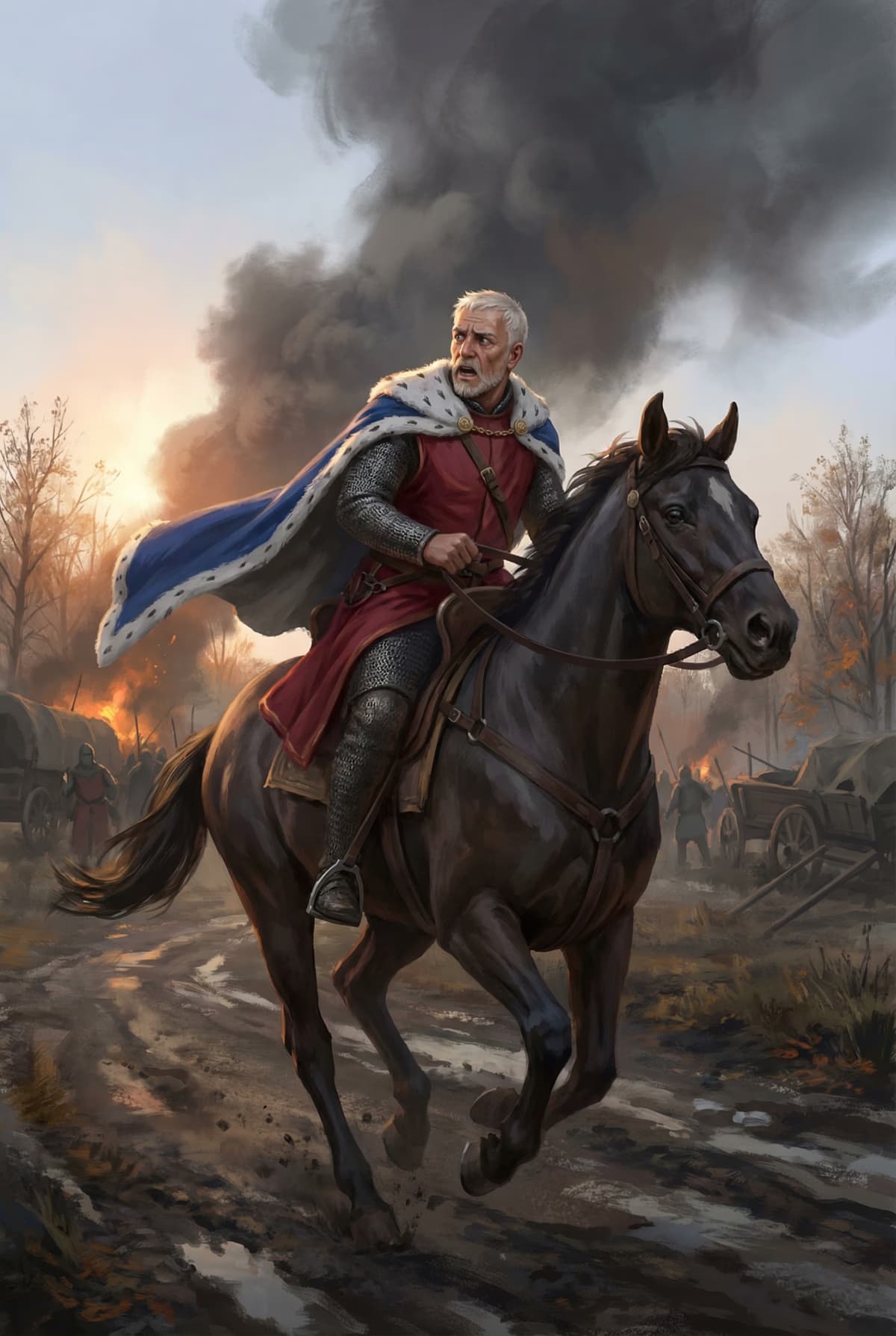
Three hours later, five thousand of his men are dead. The bridge is destroyed. Hugh de Cressingham, the royal treasurer who pushed hardest for the crossing, has been killed on the north bank, his body stripped and skinned by the Scots who will cut his flesh into strips and send them across the country as trophies. Warenne is galloping south toward Berwick, abandoning Stirling Castle, abandoning Scotland north of the Forth, abandoning everything Edward I entrusted to him.
It is the worst English military disaster in a generation. And it happened because an old man, comfortable in his rank and tired of a country he never wanted to govern, could not imagine losing to men he considered beneath him.
Personality & Motivations
Warenne was not stupid. He was something worse: complacent. For forty years, from the Barons' War to the Welsh campaigns to the conquest of Scotland in 1296, he had been on the winning side of almost every fight. He had stood beside Edward I at Evesham when Simon de Montfort was cut down. He had crushed the Scottish army at Dunbar with a single cavalry charge. Victory was what he knew. It was the only thing he knew.
He was also violent when crossed. In 1270, during a property dispute at Westminster Hall, he attacked Alan de Zouche and his son so savagely that Zouche died of his wounds six weeks later. Warenne was fined for the assault but never truly punished. When Edward I's commissioners demanded to know by what legal right he held his estates, Warenne reportedly drew a rusty sword and declared that his ancestors had won their lands with steel alongside William the Conqueror, and he would defend them the same way. He was a man who believed that power answered to nothing but older power.
But beneath the bravado was a man increasingly unwilling to do the hard work that power demanded. When Edward appointed him Warden of Scotland in August 1296, Warenne accepted the title, then promptly returned to England claiming the Scottish climate was bad for his health. He governed Scotland from his estates in Yorkshire. He let Hugh de Cressingham, Edward's treasurer, handle the actual administration. When Wallace's rebellion erupted in the spring of 1297, Edward had to order Warenne north. He went reluctantly. He arrived late. And when he got to Stirling, he fought the battle with the same carelessness with which he had governed: quickly, impatiently, and without taking his enemy seriously for a single moment.
What Most People Get Wrong
Most people assume Warenne was an incompetent fool, a bumbling aristocrat who stumbled into disaster through pure ignorance. The truth is more complicated and, in many ways, more damning. Warenne had forty years of genuine military experience. He had fought at Lewes, Evesham, and Chesterfield during the Barons' War. He served in Edward's Welsh campaigns of 1277, 1282, and 1283. He commanded the decisive English victory at Dunbar in 1296, the battle that effectively conquered Scotland in a single afternoon.
He was not inexperienced. He was experienced in the wrong kind of war. Everything he had ever fought had been settled by heavy cavalry charges against opponents who played by the same feudal rules he did. Dunbar had reinforced every assumption he held: that Scottish armies were poorly led, poorly equipped, and would break at the first serious charge. At Stirling Bridge, he faced something he had never encountered, a commander who refused to fight on English terms and instead chose ground that made English advantages irrelevant. Warenne lost not because he was ignorant of war, but because he could not adapt to a war that no longer followed his rules.
Key Moments
Lewes, May 1264. The young Warenne fought alongside his friend Prince Edward against Simon de Montfort's rebel barons at the Battle of Lewes. The royalists were defeated, King Henry III was captured, and Warenne fled across the Channel to France. It was the first of many times he would run from a lost battlefield. But unlike Stirling Bridge, Lewes taught him nothing about humility. He came back the following year, fought at Evesham, and watched Montfort hacked to pieces. The lesson he took was that defeat is temporary and loyalty to the crown always pays.
Westminster Hall, July 1270. A property dispute with Alan de Zouche over two manors in Northamptonshire turned into bloodshed when Warenne attacked Zouche and his son during court proceedings. Zouche died of his injuries on August 10th. Warenne was fined but faced no imprisonment, no exile, no real consequence. He learned that violence, when wielded by the right people, carried an acceptable price.
Dunbar, April 1296. Edward I sent Warenne north with the English vanguard during the invasion of Scotland. The Scottish cavalry charged downhill in a disorderly mass, and Warenne's knights cut through them in a single disciplined charge. It was easy. It was fast. It confirmed everything Warenne believed about Scottish military capability. He would carry this lesson with him to Stirling Bridge seventeen months later, where it would destroy him.
Stirling Bridge, September 1297. The disaster that defined his legacy. Warenne ordered his army across a bridge barely wide enough for two horses, ignoring advice to use a nearby ford. When roughly two thousand English soldiers had reached the north bank, Wallace and Andrew Moray attacked, cutting them off from the bridge and slaughtering them against the river. Cressingham died in the trap. Warenne, watching from the south bank, ordered the bridge destroyed to prevent the Scots from crossing and then fled to Berwick. Five thousand Englishmen were dead. Scotland was lost.
Falkirk, July 1298. Edward I came north personally to deal with Wallace, and Warenne rode with him, commanding one of the cavalry divisions. This time, on open ground, English longbowmen and heavy cavalry shattered Wallace's schiltrons. It was the kind of battle Warenne understood, the kind he had always won. Falkirk avenged Stirling Bridge in tactical terms, but it could not undo the damage to Warenne's reputation. He had proven he could follow orders in someone else's victory. He had already proven he could not lead on his own.
The Detail History Forgot
Warenne's wife, Alice de Lusignan, was the half-sister of King Henry III. She was seven years older than her husband when they married in 1247, and by all accounts the marriage was a genuinely loving one. When Alice died in February 1256 after giving birth to their son William, Warenne never remarried. He spent the remaining forty-eight years of his life a widower.
That son, William de Warenne, predeceased his father, dying sometime around 1286. When the old earl finally died in September 1304, his title and vast estates passed to his grandson, another John de Warenne, who was still a minor. The boy became a royal ward of Edward I and was married off to the king's granddaughter, Joan of Bar. The family that had fought beside English kings since the Norman Conquest became absorbed into the royal household itself. The 7th Earl would be the last Warenne to hold the title. When he died without legitimate heirs in 1347, the earldom of Surrey, held by the same family for nearly three centuries, ceased to exist.
The Downfall
Warenne did not die at Stirling Bridge. He did not die in disgrace. He lived seven more years, served at Falkirk, kept his title, kept his lands, and died in his bed at Kennington on September 27th, 1304. The Archbishop of Canterbury presided over his burial at Lewes Priory, the family mausoleum where Warenne earls had been interred since the Norman Conquest. By every external measure, he ended his life as he had lived it: wealthy, titled, and protected by royal favor.
But Stirling Bridge followed him like a shadow. Edward I never trusted him with independent command again. The man who had been warden of an entire conquered kingdom was reduced to a subordinate role, a divisional commander taking orders from the king himself. He had been given Scotland and he had lost it, not to a rival earl or a foreign army, but to a commoner with a band of spearmen and a better understanding of the ground.
His fatal flaw was not arrogance in the simple sense. It was the deeper failure of a man who had spent so long winning that he forgot winning required effort. He governed Scotland from England because he found the country unpleasant. He dismissed intelligence about Wallace's army because he could not imagine peasants defeating knights. He ordered a frontal crossing of a narrow bridge because flanking maneuvers felt unnecessary against an enemy he despised. Every decision at Stirling flowed from the same source: a man so accustomed to deference that he mistook it for superiority. The Scots at Stirling Bridge did not defer. And Warenne, for the first time in his long life, had no idea what to do when the enemy refused to lose on schedule.