The Doorway
Persepolis. The deserts of what is now southern Iran. May, 330 BC. A man stands in a doorway. Torch in his right hand. Wine still wet on his chin. Behind him, seventy two stone columns hold up a ceiling of cedar and gold. In front of him, an army that has not lost a battle in eight years is chanting his name. He is twenty five years old. He is the most powerful person alive. And he has not yet decided.
His name is Alexander. The decision he is about to make is the same one every Western army has eventually faced when it stands over Iran's treasures. The latest version cracks the walls of Golestan Palace, damages the dome of Chehel Sotoun, hits the Masjed-e Jame, the oldest Friday mosque in Iran. The press calls it strategic. The Iranians call it something older.
Hold that image. We are coming back to it.
The question he is about to answer in the next ten seconds is the same one every man with a flame over an ancient ceiling has had to answer.
Why?
The fire didn't start with him. It started two centuries earlier.
What He Is About to Burn
The Persian king Darius the First broke ground on Persepolis around 515 BC. He didn't want a fortress. He wanted a statement. A place where the known world would come, once a year, and witness what civilization looked like when it was done right.
The centerpiece was the Apadana. Seventy two columns, each twenty four meters tall, holding up a roof that covered thirty six hundred square meters of open hall. The capitals at the top of each column were carved into the forequarters of two kneeling bulls, placed back to back, their necks supporting the ceiling beams. The eyes of those bulls were painted red. Their hooves were gilded. Their beards were inlaid with lapis lazuli, deep blue stone imported from what is now Afghanistan, set into carved limestone by craftsmen whose names survive on clay tablets.
Because the workers who built Persepolis were not slaves.
The Fortification Tablets, thousands of cuneiform records found in the ruins, show that masons, plasterers, and laborers were paid in silver from the king's treasury. One tablet names an Egyptian foreman, Herdkama, leading a hundred men. It records his exact wage: three karsha and two and a half shekels.
Carved into the grand staircase, delegations from twenty three nations climbed toward the hall in stone relief. Each figure wore the distinct clothing of their homeland. Each carried tribute. At the entrance, the Gate of All Nations, colossal human-headed winged bulls guarded the doorways, their wings folded against their flanks, their beards curled in the Assyrian style. Above them, Xerxes had carved his name in three languages.
Remember the workers. Remember the names on the tablets. We are coming back to them.
The Grudge That Walked from Greece
The man in the doorway was raised on a story.
A hundred and twenty four years before he was born, in 480 BC, Xerxes, the same Xerxes whose name was carved above the Gate of All Nations, marched a Persian army into Greece, climbed the Acropolis of Athens, and burned it. The temples. The old Parthenon. The wooden statues of the gods. Athens went up in smoke while its citizens watched from boats in the harbor.
The Greeks never forgot.
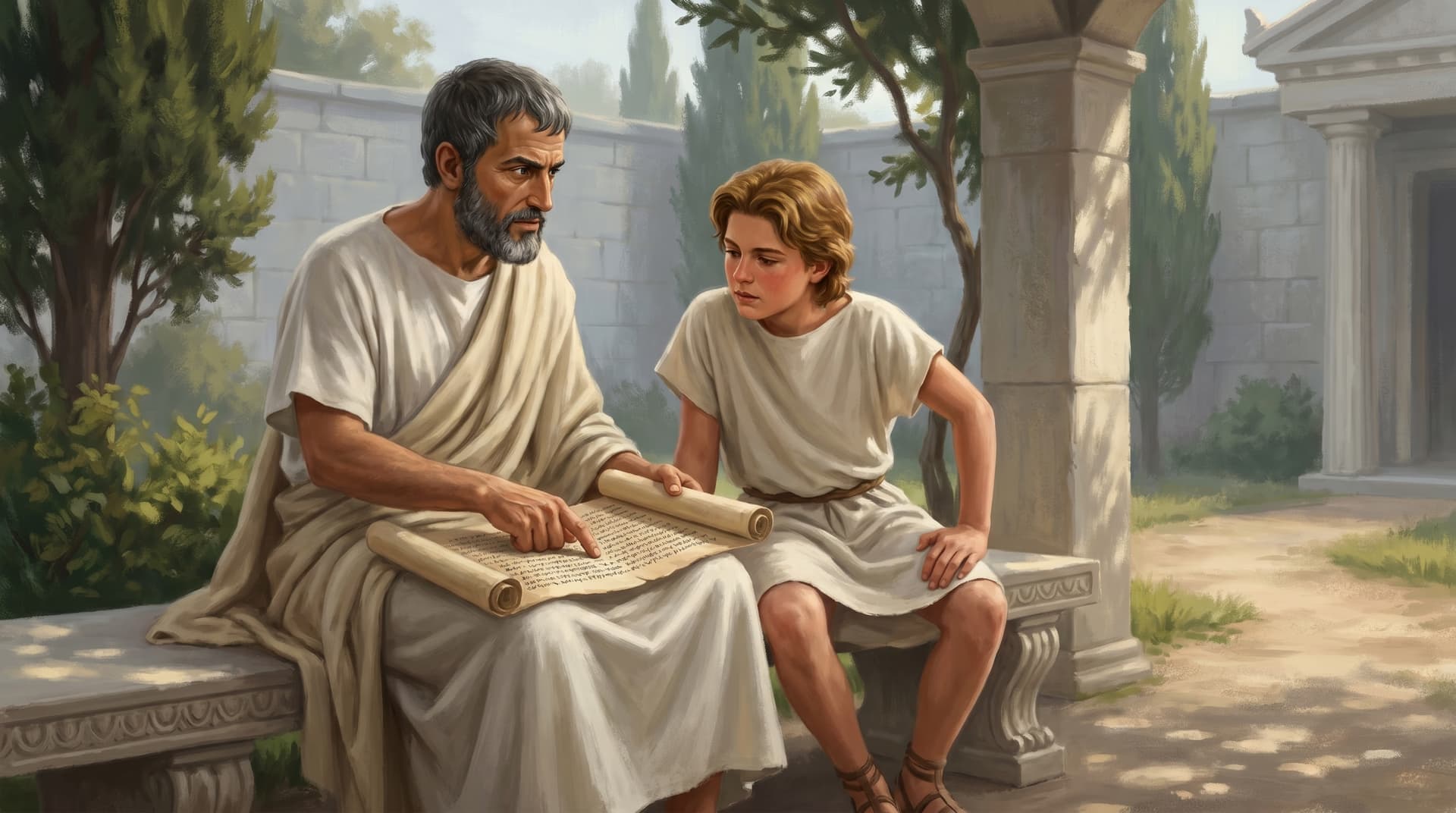
Aristotle himself tutored the young Macedonian prince. The invasion of Persia was framed, from the beginning, as payback. Cross the Hellespont. Beat the Persian army. Burn what they burned. By the autumn of 331 BC, Alexander had destroyed the Persian field army at Gaugamela. Darius the Third, Persepolis's reigning king, was on the run with the broken remnants of his guard. The road south, into the heart of Persia itself, was open.
Almost.
Subscribe to Nightfall History on YouTube
Join our community on YouTube for more historical deep dives and visual storytelling
The Persian Gate
Between Alexander and Persepolis stood a narrow mountain pass. The locals called it the Persian Gate. The man holding it was a general named Ariobarzanes, and he had fewer men, worse equipment, and no hope of reinforcement.
What he had was terrain.
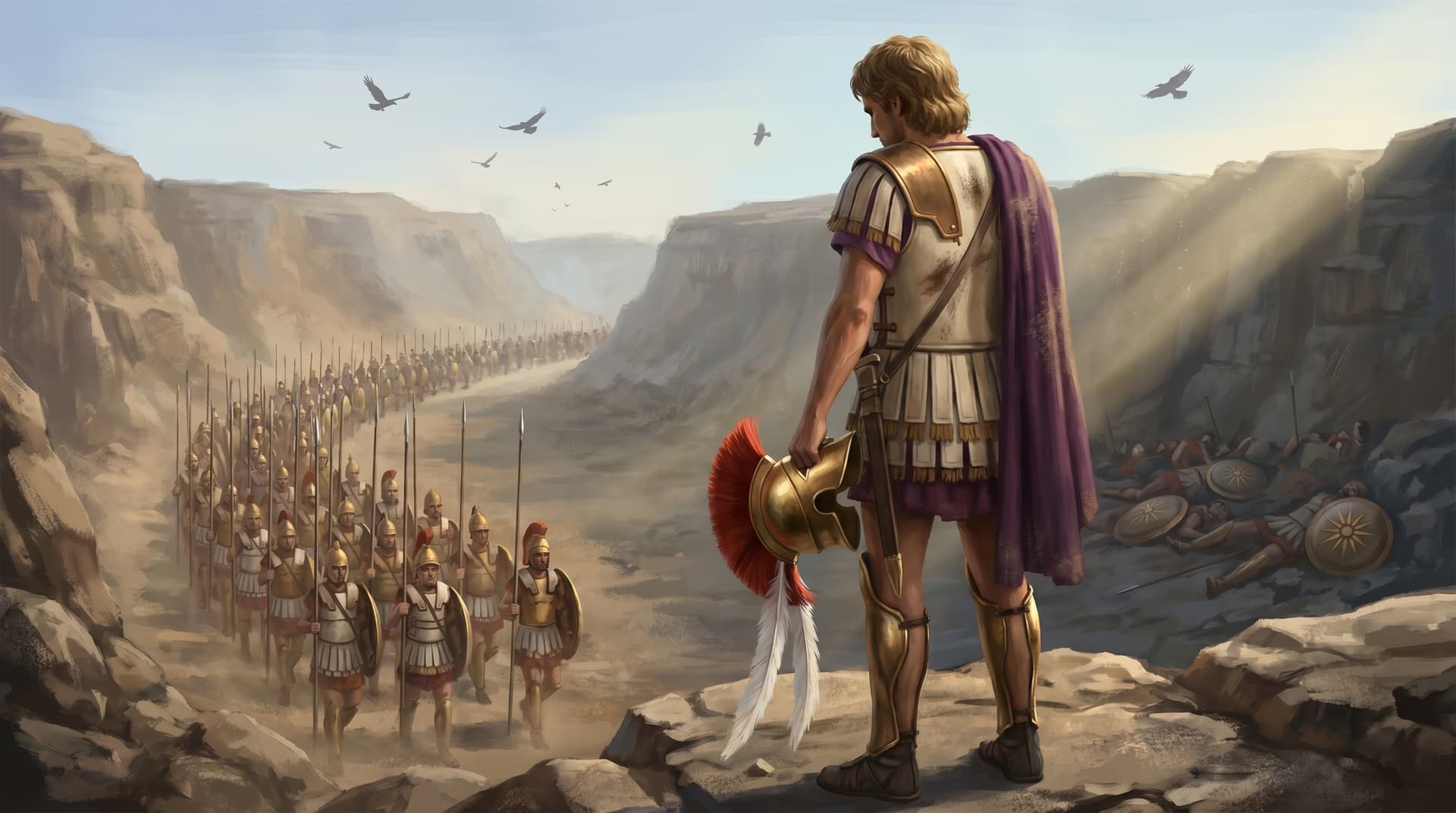
When Alexander's army pushed into the pass, boulders rained from the northern slopes. Arrows came from the south. Entire platoons were crushed. The Macedonians tried to retreat, but their own rear guard had blocked the way. Alexander was forced to leave his dead where they fell, unburied, unrecovered. For a Greek commander, there was no deeper disgrace.
He found a way around. A captured shepherd, or a prisoner depending on which historian you trust, showed him a mountain path that led behind Ariobarzanes' position. The pass fell. The general died fighting. Persepolis lay open.
And what met Alexander at the gates was not an army.
The Eight Hundred
Eight hundred people came out to meet him.
Greek captives. Artisans who had been held in Persepolis for years. Some had lost their hands. Others their feet. Some their ears. Some their noses. They had been mutilated so that they could never escape. Only work. They could carve, but not run. They could write, but not sign their names. They had been kept alive as living tools.
Alexander's men stared at them.
Then they looked at the city behind them.
The Greek historian Diodorus called Persepolis the richest city under the sun. Alexander, that night, told his Macedonians it was the most hateful of the cities of Asia. And then he gave it to them.
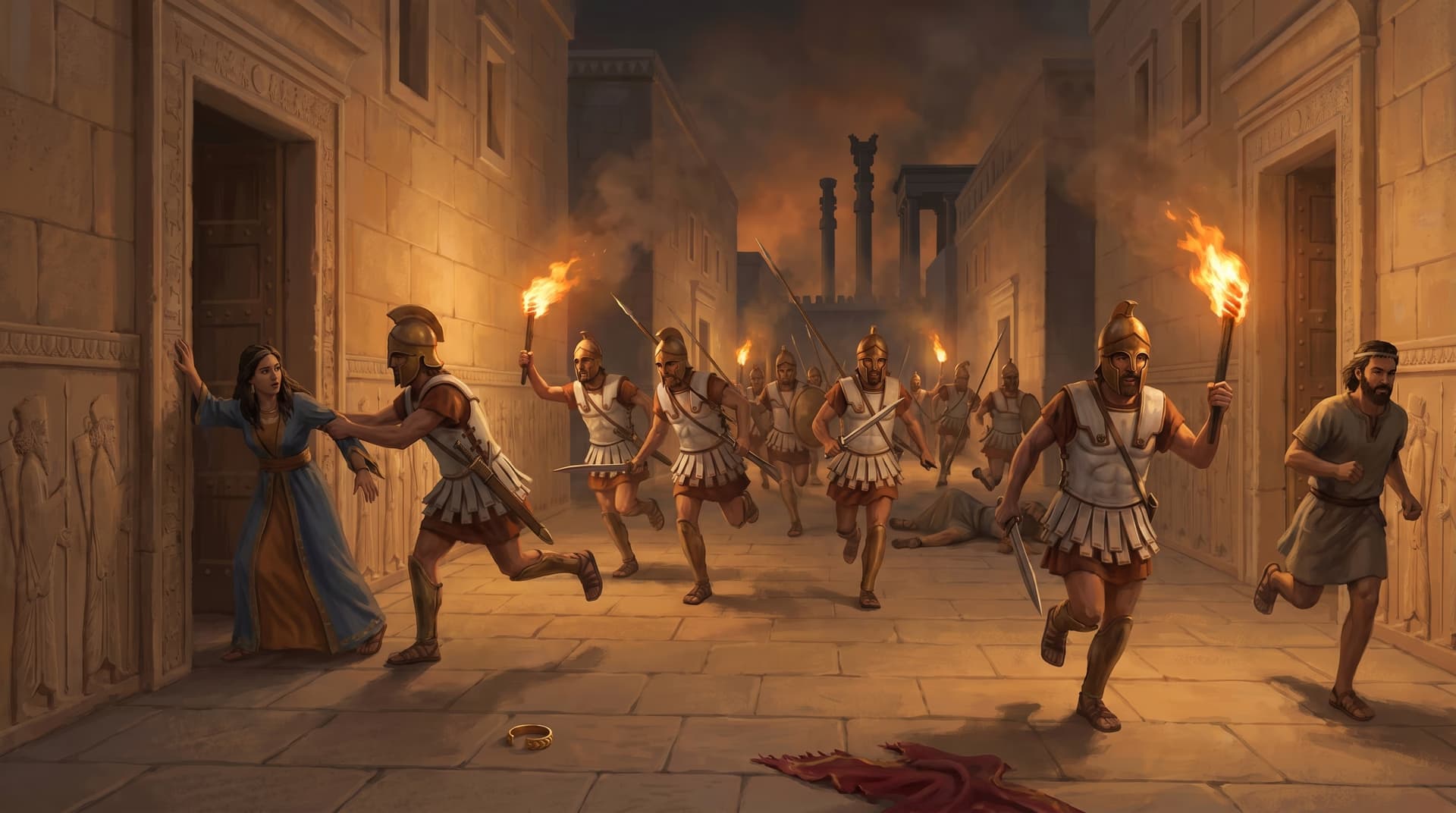
What happened next was not a battle. The soldiers poured through the streets. They killed every man they found. They dragged women from their homes, tearing jewelry from their bodies. Some fought each other over the spoils, hacking captives apart rather than sharing them. The houses of Persepolis had been furnished with every sort of wealth across generations of empire: silver couches, gold-threaded textiles, carved ivory, gemstones stockpiled across centuries. The soldiers took what they could carry and smashed the rest.
But the rage was the small part. What came next was logistics.
Four Months of Mules
Ten thousand pairs of mules. Five thousand camels. That is what the historian Plutarch says it took to carry the treasure out of Persepolis. A caravan that, lined end to end, would have stretched roughly seventy miles. Historians estimate approximately twenty five hundred tons of gold, silver, and precious materials.
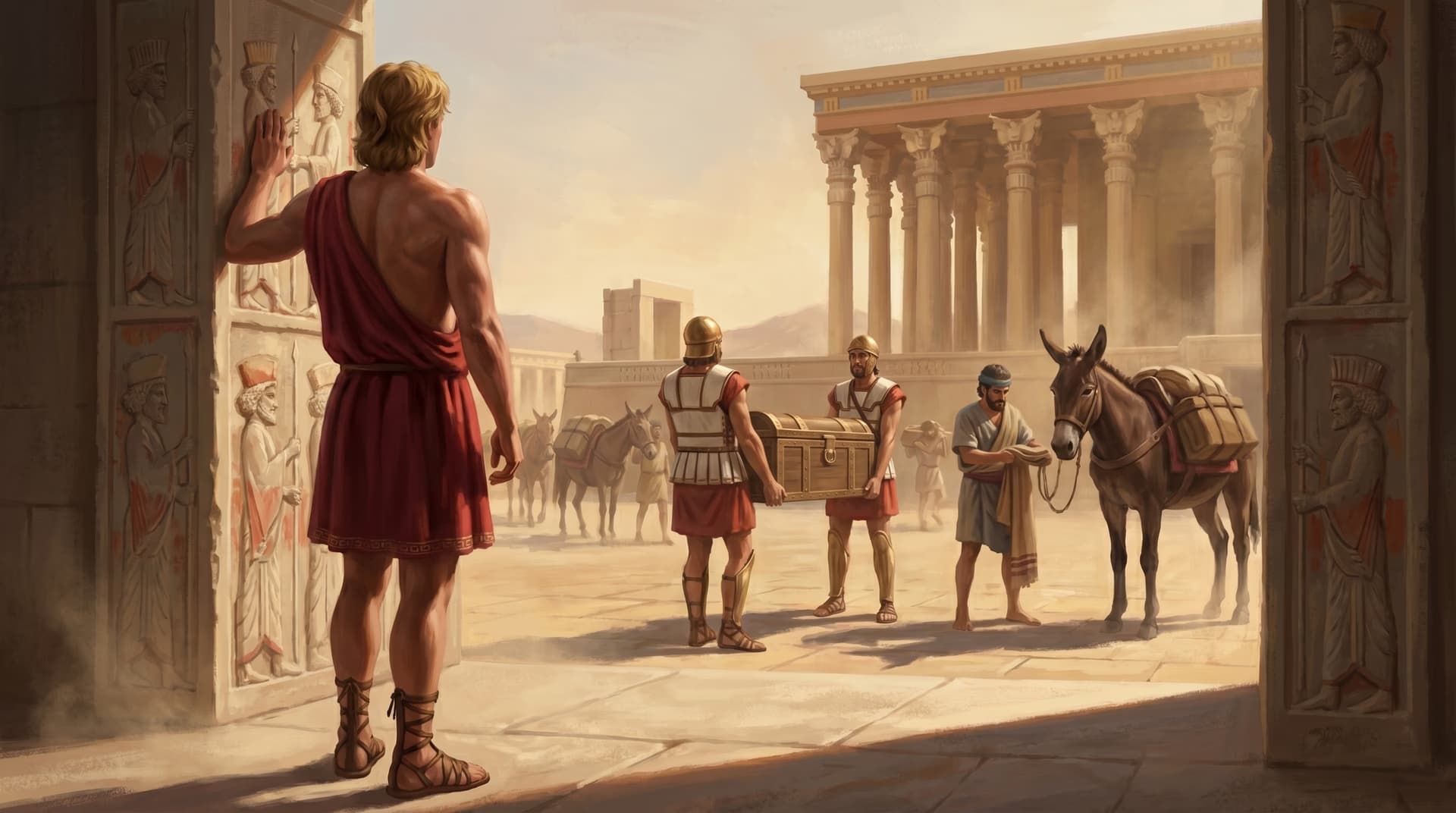
It took four months.
This was not a tantrum. It was not vengeance overflowing. It was logistics. Crate after crate, room after room, loaded onto animals and marched west toward Babylon. The same man who had wept over the mutilated Greek captives at the gates supervised the most efficient looting operation in ancient history.
And when it was done, when every room had been emptied, every house stripped, every person who could be taken had been taken, Alexander was still in Persepolis.
Which brings us back to the doorway.
Stay in the Loop
Get notified when new articles and videos drop. Unsubscribe anytime.
The Doorway, Again
Torch in his right hand. Wine still wet on his chin.
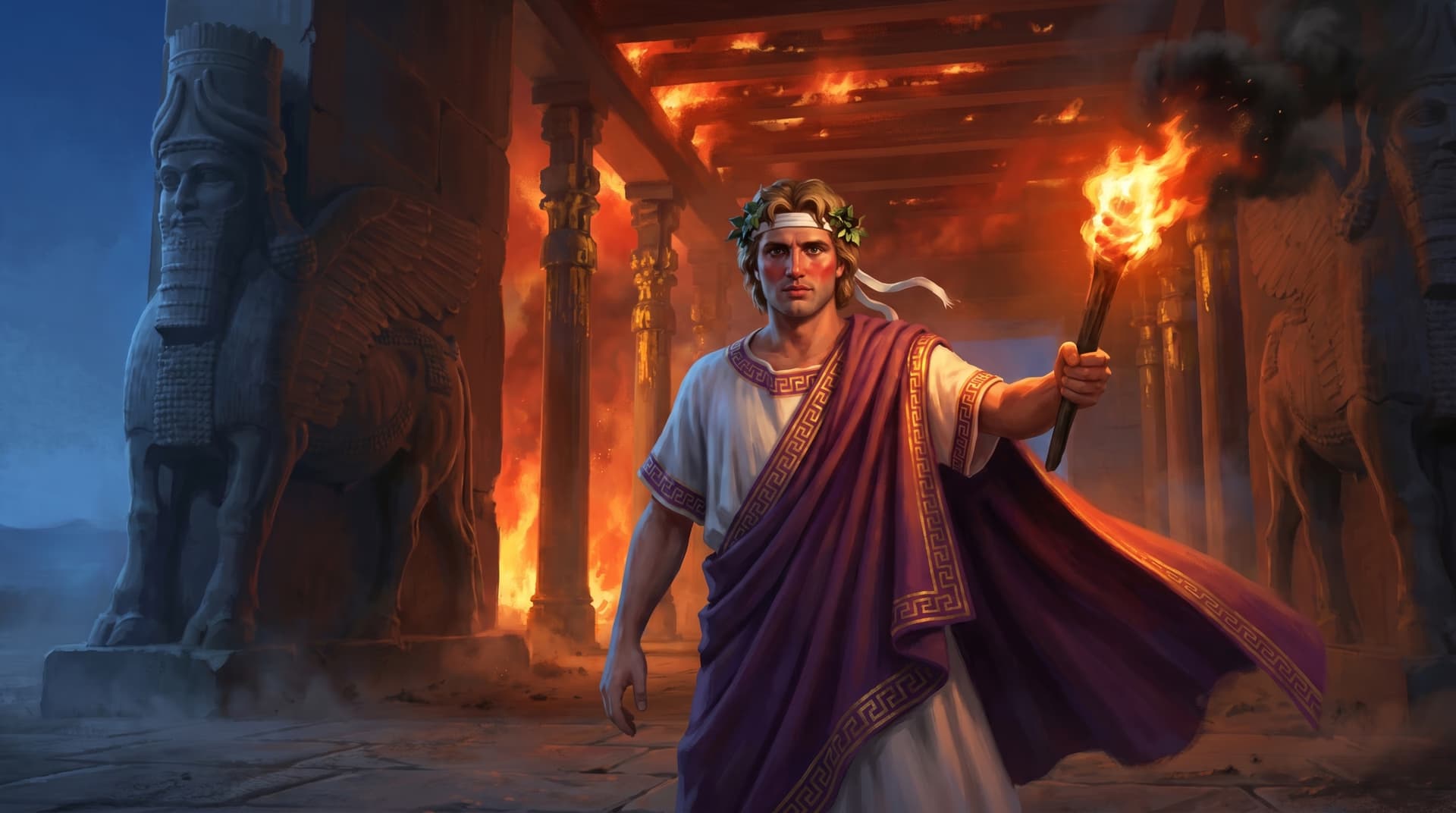
The hall is loud. There is a feast in progress. A victory symposium, the kind that has been running for weeks. The cedar beams in the ceiling are still gold-leafed. The lapis lazuli is still in the bulls' beards. The columns still hold.
One version of this night says a woman named Thais, an Athenian courtesan traveling with the army, has just stood up and challenged him. Xerxes burned the Acropolis a hundred and fifty years ago, she says. It is time for a woman's hand to avenge what Persian men did to Greek women. The crowd roars. Alexander grabs the torch.
That story comes from Cleitarchus, a man later historians ranked among the least trustworthy of Alexander's biographers. Ptolemy, who was in the room that night and would later become pharaoh of Egypt, never mentions Thais. Aristobulus, also a witness, never mentions her either. The two people who were actually present left the woman out of the story entirely.
What we know for sure is the torch. The flame. The cedar.
Cedar burns fast and hot. The fire caught the roof first and raced along the wooden ceilings that linked the stone halls. Painted surfaces blackened. Gold leaf melted into puddles on the floor. The lapis lazuli cracked in the heat. Some sources say Alexander, sobering up, ordered the fire put out. It was too late. The roofs collapsed inward, burying the floors in burning timber.
But the columns did not fall.
Stone does not burn. The seventy two pillars of the Apadana, cracked, scorched, stripped of their painted surfaces, stayed standing while the fire ate everything around them. By dawn, the cedar was ash and the gold was puddles. The columns stood in the smoke like bones.
Three Stories, No Answer
Twenty three centuries later, historians are still arguing about why he did it.
Theory one is revenge. Acropolis for Apadana. Eye for an eye. Burning Persepolis was not a side effect of conquest. It was the entire point. The climax of a century and a half old grudge that Aristotle had pressed into a young prince's hands like a torch of his own.
Theory two is the drunk party. Thais, the wine, the chanting crowd. But Alexander had been in Persepolis for four months. A drunk man does not wait four months.
Theory three is politics. Burning the ceremonial capital was punctuation. A signal to every satrap, every governor, every garrison still loyal to Darius the Third: the old world is ash. The new one has already started. In this version, the fire was the most calculated decision Alexander ever made.
Three stories. No consensus. Academic papers are still published. Conferences still convene. The question remains open like a wound that will not close.
But here is the question no one asks: does it matter?
Does it matter whether the hand that held the torch was steady or shaking? Whether the decision took four months or four seconds? The cedar is ash. The gold is gone. The painted surfaces are scorched beyond recognition. The result is identical. The intent only changes the story we tell about Alexander. It changes nothing about Persepolis.
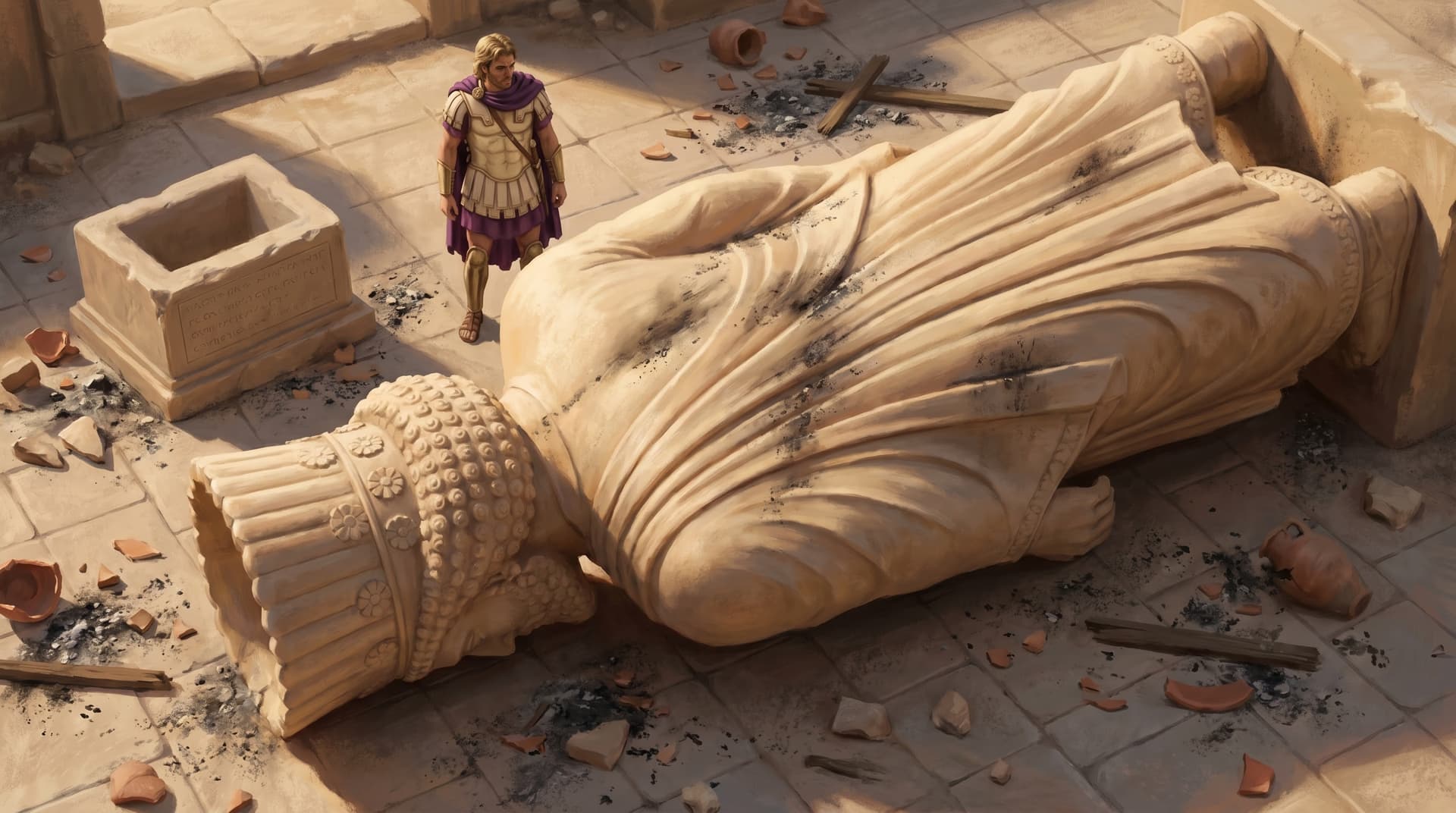
Plutarch describes a moment, sometime after the fire, when Alexander came upon a colossal statue of Xerxes that had been knocked from its pedestal by soldiers and left face-down on the ground. He stopped. He stood over it. And then he spoke to the stone as if it were alive.
"Shall I pass by and leave you lying there because of the expedition you led against Greece, or shall I set you up again because of your magnanimity and your virtues in other respects?"
He stood there a long time, staring at the face of the king whose invasion had justified his own.
Then he walked away. He left the statue where it lay.
The conqueror of the known world, asking a stone face for an answer he could not give himself.
The Columns Still Stand
The columns of Persepolis still stand in the Iranian desert.
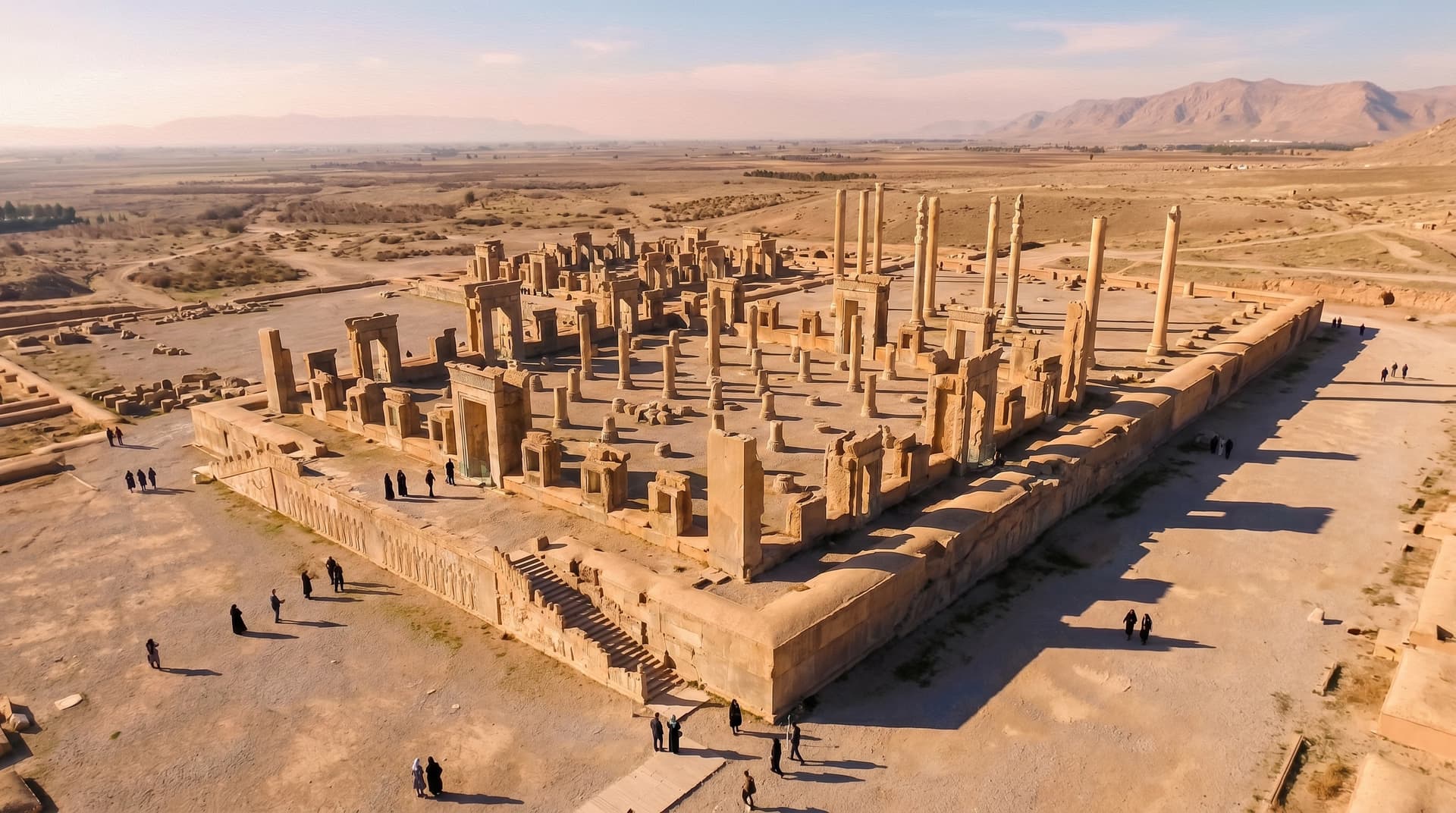
Burned, broken, stripped of their paint and gold and lapis lazuli, but standing. Twenty five centuries of wind and sun and dust, and they are still there. Iranians visit them the way Americans visit the Statue of Liberty. Not as ruins. As proof. Schoolchildren stand between the columns and look up. Musicians have played concerts among them. The stone that Alexander's fire could not bring down has become something he never intended. A monument not to Persia's fall, but to its refusal to disappear.
Remember the workers paid in silver, whose names survive on clay tablets while dynasties crumble around them. Herdkama, the Egyptian foreman with three karsha and two and a half shekels and a hundred men under him. His work is still standing. Alexander's empire is not. It fractured within a decade of his death.
In Tehran, a four hundred year old ceiling cracked when a Western missile struck the wall beneath it. Dust fell on the tiles. Different army. Different century. Different justification. The press will spend years arguing the strategic logic, the geopolitical necessity, the calibrated message. It will sound exactly like the three theories about why Alexander burned Persepolis.
The Persians have a saying: this too shall pass. They would know. They have been saying it for twenty five hundred years. And they have been right every time.
The man with the torch is dust. His empire is a memory. The debate about why he did it is a footnote in books most people will never read. But the columns, burned, cracked, still standing in the desert wind, the columns don't care why.
They just stand. They have always just stood.
And they will be standing long after the next fire, and the next, and the one after that.
That is what Persepolis knows that Alexander never learned. You can burn a palace. You cannot burn what it meant to the people who built it.