The Woman Who Wouldn't Stop
A woman stands in a narrow street in Strasbourg, arms jerking, feet slapping cobblestone. There is no music. No audience. No joy on her face. She has been dancing for three days. Her feet are bloody and swollen, and she cannot stop. Within a month, four hundred people will be dancing beside her. And the authorities will do something so catastrophically wrong that it will turn a strange affliction into a mass grave.
Her name is Frau Troffea, and no one will ever know why she started.
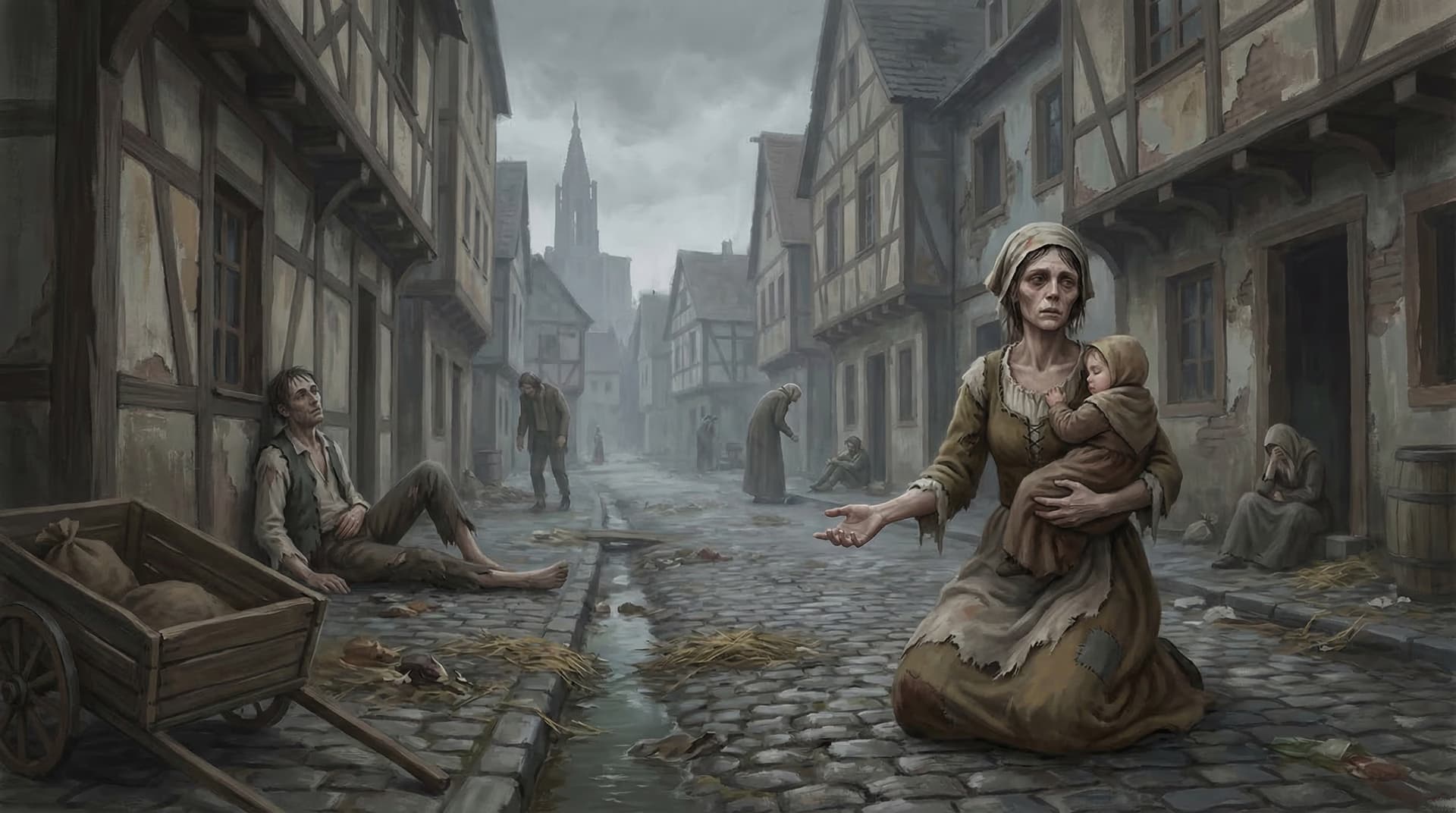
It is July 1518, and Strasbourg is already dying. The previous two years have been what the locals call the Bad Year -- a season of failed harvests stretched into a nightmare that never ended. The granaries are empty. The price of bread has climbed beyond what most families can afford. Smallpox moves through the cramped neighborhoods like a rumor, and syphilis follows close behind. The drinking water runs brown with filth. Orphanages and hospitals have been full for months.
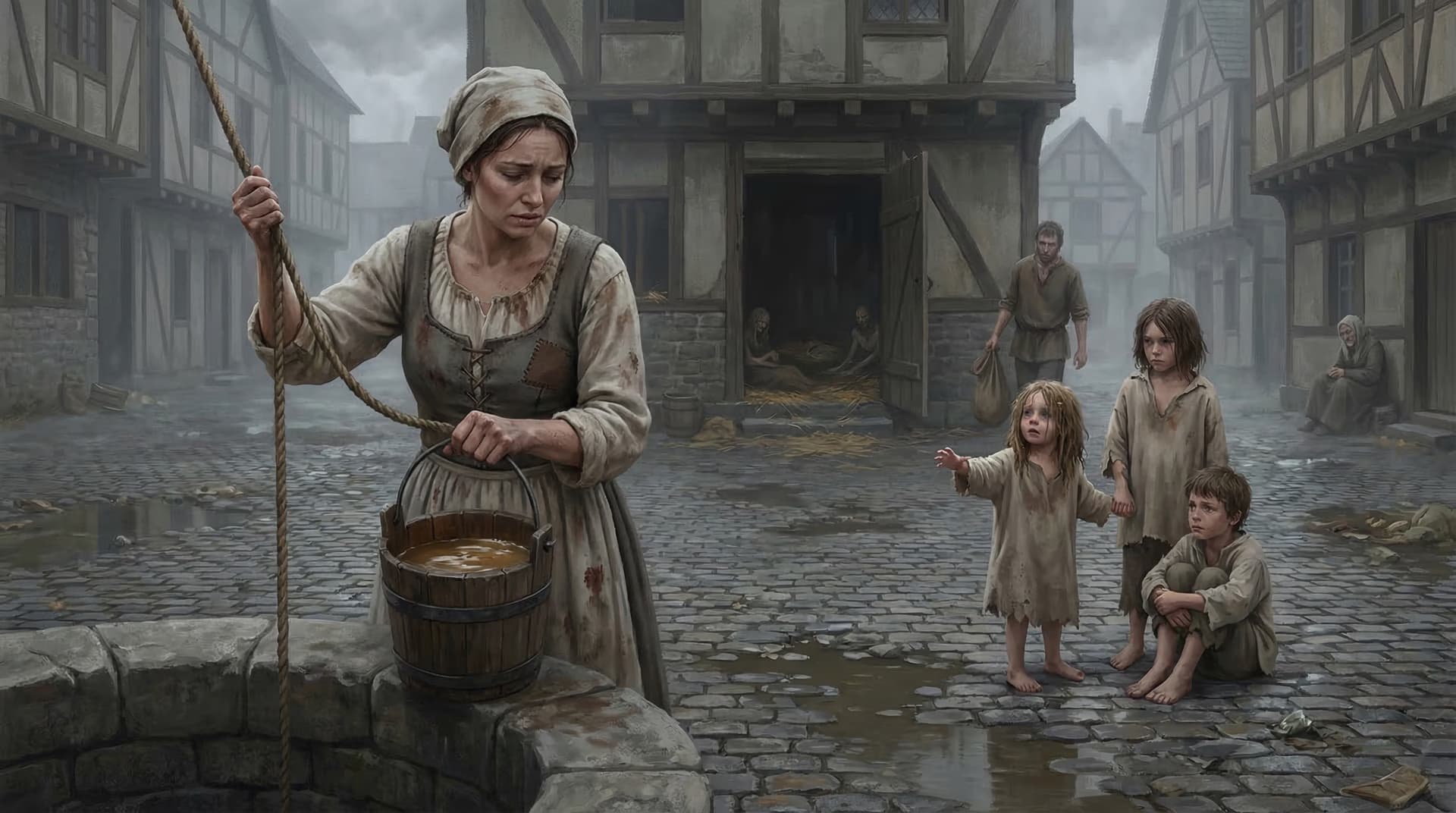
And the people of Strasbourg believe in something specific: a saint named Vitus, who has the power to curse the living with a dancing plague. You displease him, and your body moves until it cannot move anymore. This is not metaphor to them. It is as real as the famine, as real as the graves filling at the edges of the city. Remember this belief. It is about to become the most dangerous thing in Strasbourg.
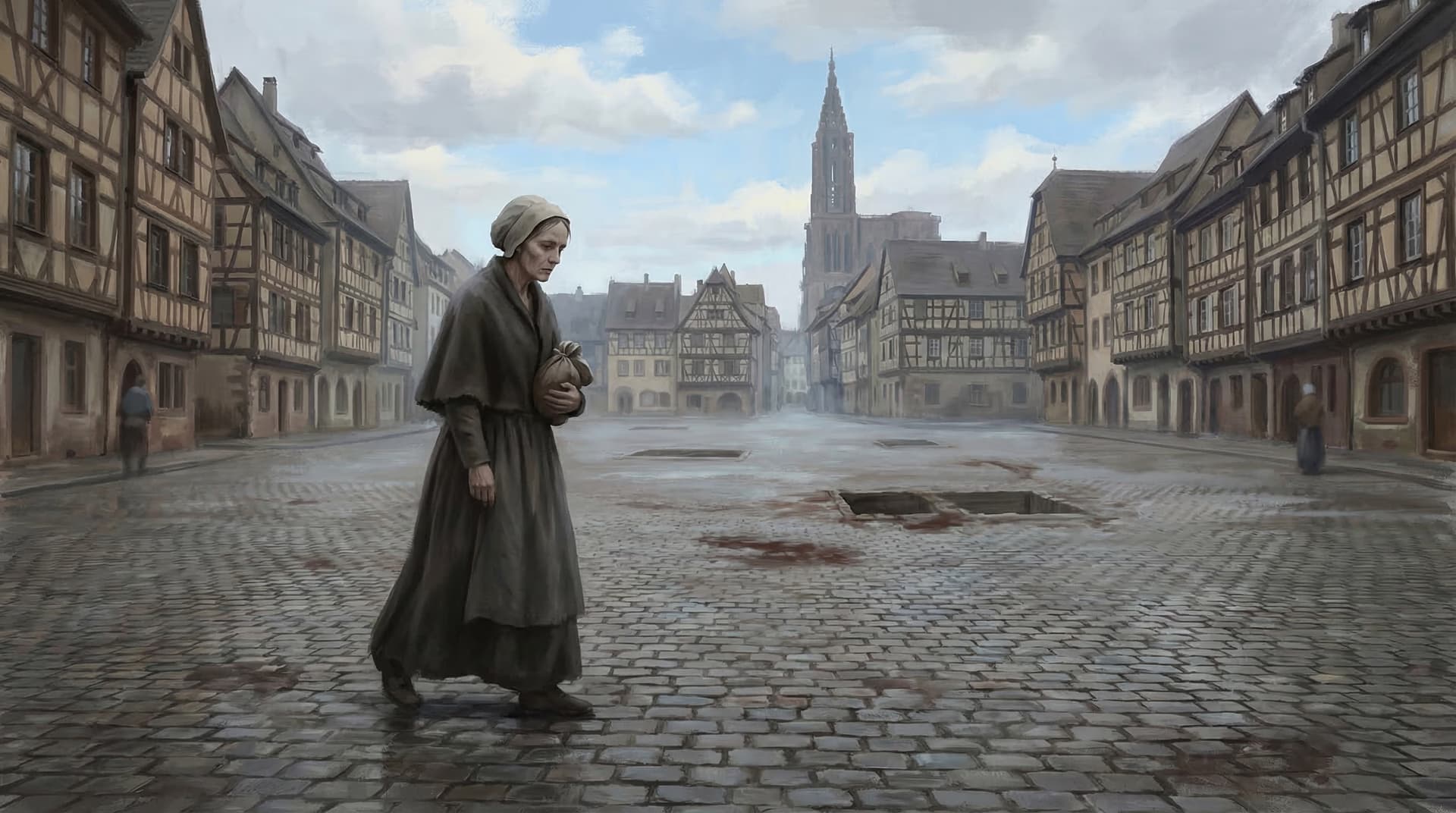
On July 14th, Frau Troffea steps out of her half-timbered house and begins to dance. Silent, alone, on the narrow cobblestones. Her husband begs her to stop. She does not stop. She dances through the night. Collapses in a twitching heap. And at dawn, she rises and begins again, her feet swollen and cracked and leaving bloody prints on the stone.
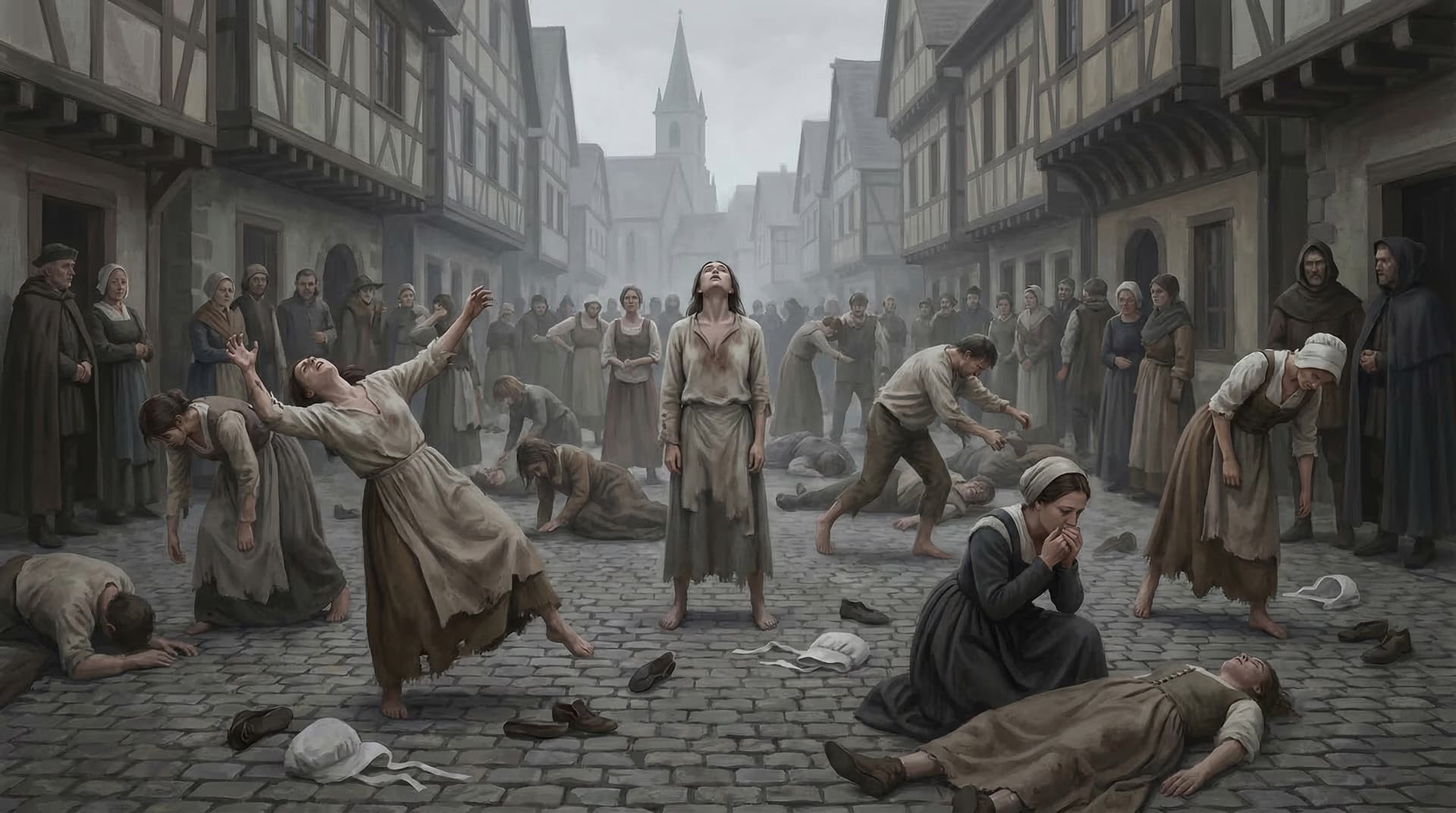
Within four days, thirty-four men and women have joined her. Their movements are spasmatic -- violent convulsions more than anything resembling dance. Their arms thrash. Their eyes are vacant, expressionless, as though the person behind them has left. There is no music. There is no joy. Just bodies jerking through the streets of a starving city.
After four to six days of ceaseless movement, Frau Troffea is loaded into a wagon and sent thirty miles to the shrine of Saint Vitus, near the town of Saverne. No one in Strasbourg knows it yet, but they will all be following her.
The council turns to its physicians for an answer.
Subscribe to Nightfall History on YouTube
Join our community on YouTube for more historical deep dives and visual storytelling
The Cure That Killed
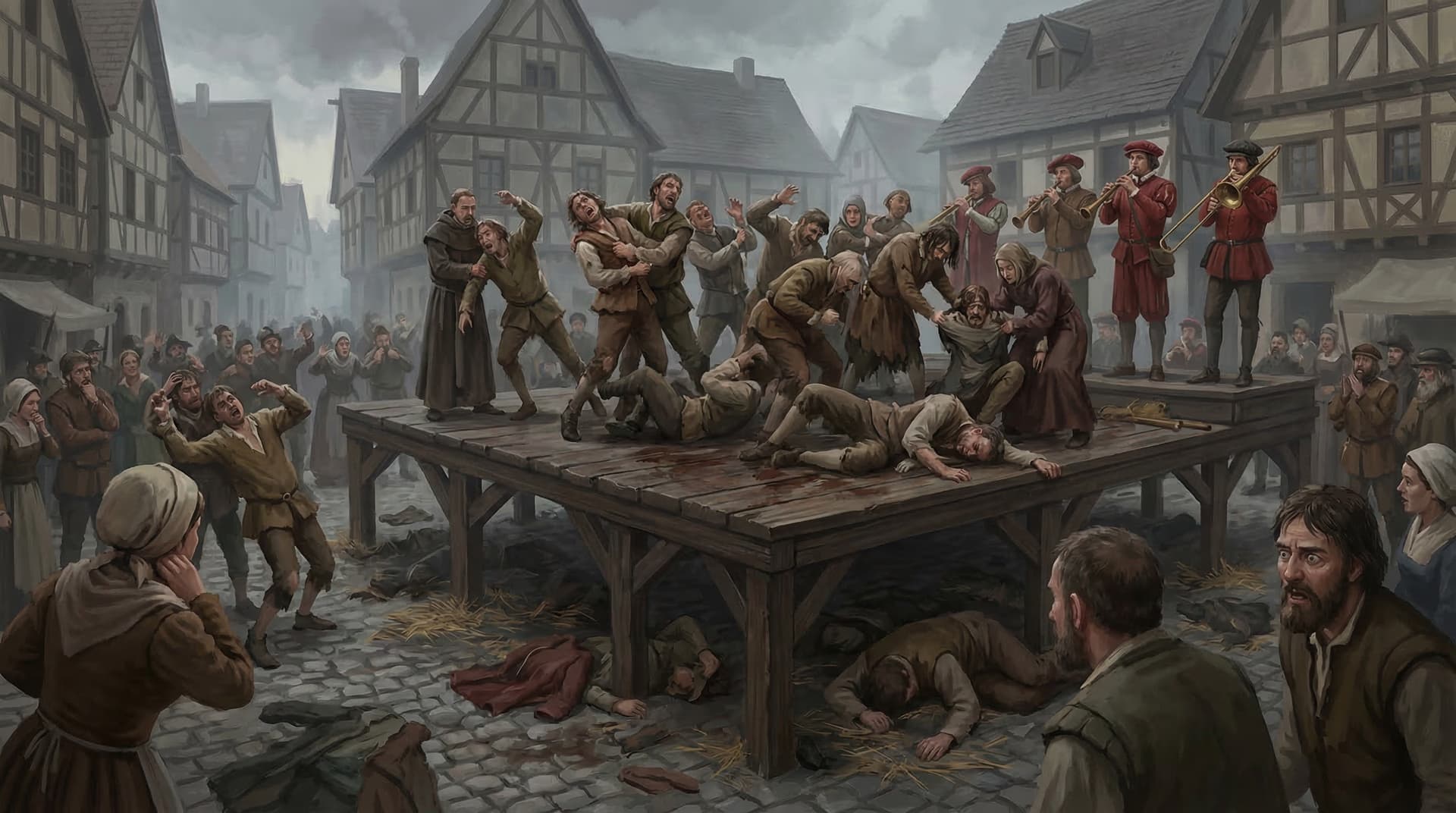
The physicians deliver their diagnosis with confidence: it is a natural disease. Hot blood. An excess of bodily heat that must be released through perspiration. Their prescription is simple, logical, and disastrously wrong. The afflicted must dance more. Sweat the fever out.
The council acts immediately. Workers build a wooden stage at the horse market -- the broad square now called Place Broglie. They hire professional musicians: drummers, fifers, horn players. The music begins and does not stop, day or night. They bring in strong men to hold up dancers too exhausted to stand on their own.
And the plague detonates.
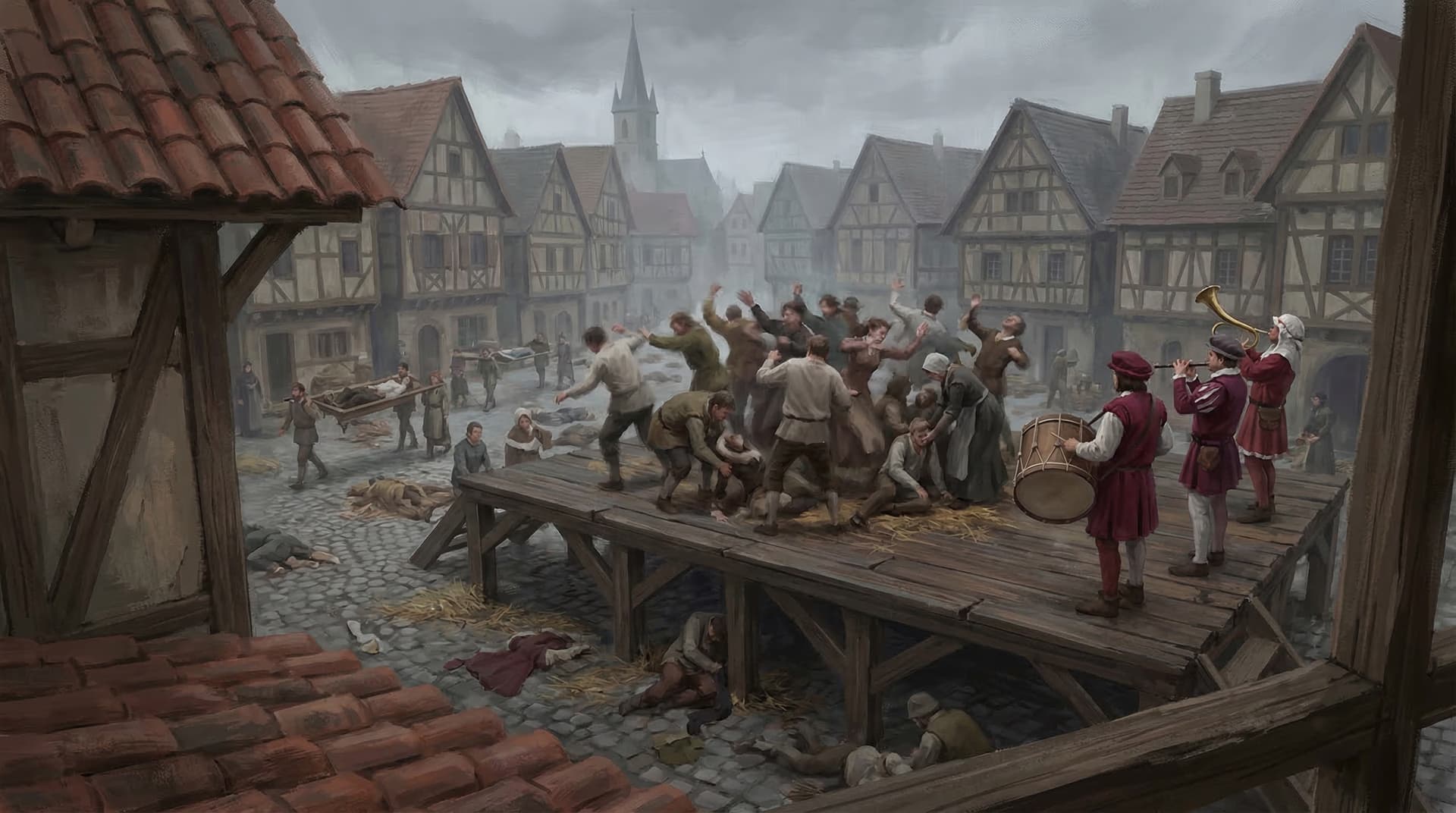
The number of dancers does not decrease. It explodes. From thirty-four to a hundred. From a hundred to two hundred. Within weeks, the count reaches four hundred. A contemporary chronicle records what it looks like: "There occurred among men a remarkable and terrible disease called St Vitus' dance, in which men in their madness began to dance day and night until finally they fell down unconscious and succumbed to death."
This is what the cure looks like: bodies drenched in sweat, convulsing on a public stage while hired musicians play on. People collapsing mid-step from strokes, from heart attacks, from sheer exhaustion. Reports claim as many as fifteen people dying each day. The authorities have not contained the plague. They have built it an amphitheater.
The Confession of Failure
On August 3rd, the Strasbourg city chancellor, Sebastian Brant, puts his name to a municipal order. Its language is frantic. "When sadly at this time a horrible episode arose with the sick, dancing persons, which has not yet stopped, our lord councilors of the XXI turned to the honor of God and forbade, on pain of a fine of 30 shillings, that anyone should hold a dance until St. Michael's Day."
It is the sound of an institution admitting it was wrong.
But the ban is almost meaningless. The stage is dismantled, the musicians sent home -- and still the dancing continues. Because the people are not dancing by choice. They are dancing out of fear. They believe Saint Vitus has cursed them, and they believe that to resist the curse is to invite something worse. Some join the dancing voluntarily, hoping to appease the saint before he strikes them down on his own terms. The superstition is stronger than any fine.
There is a bitter footnote in Brant's order: an exception for "honourable persons" who wish to dance at weddings. Even in a crisis that is killing the poor on a public stage, the wealthy are quietly exempted.
Every rational tool has been exhausted. Medicine made it worse. The law cannot touch it. And then someone -- perhaps a priest, perhaps a desperate councilor -- proposes something that sounds like surrender: stop fighting the superstition. Use it. If Saint Vitus cursed these people, then only Saint Vitus can release them. Send them to the shrine.
Stay in the Loop
Get notified when new articles and videos drop. Unsubscribe anytime.
The Road to Saverne
They load the dancers into wagons.
Picture it: wooden carts rattling over dirt roads, carrying men and women who are still convulsing, still thrashing, their bodies moving involuntarily even as they're jolted along the rutted path. One chronicler describes them as thrashing about like landed fish. The journey to Saverne takes three days. It is the same road Frau Troffea traveled alone, in a single wagon, weeks before. Now the wagons come in convoys.
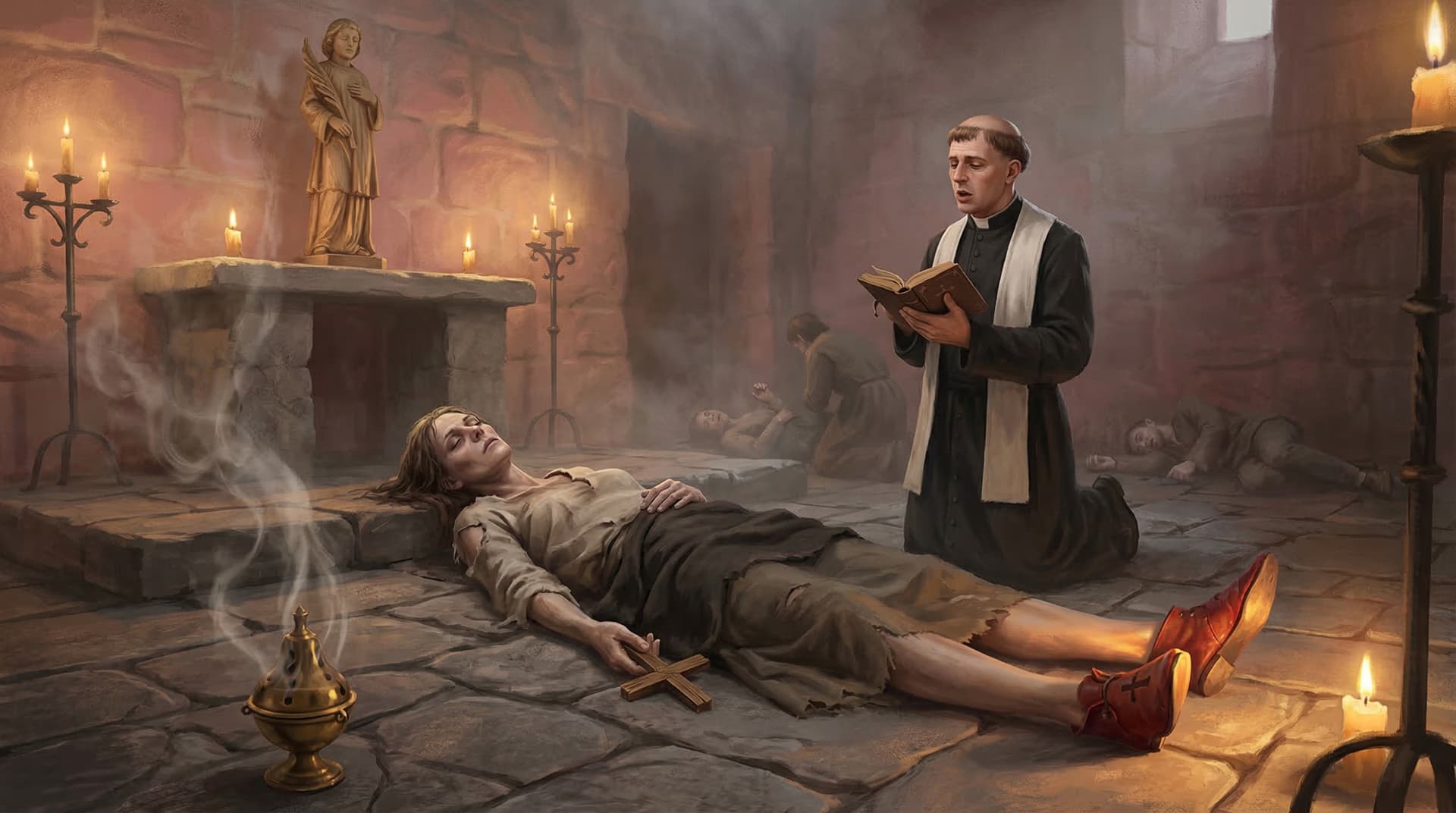
At the shrine, priests are waiting beneath a wooden carving of Saint Vitus. The ritual is precise. They place the dancers beneath the carving. They put small crosses in their hands. They slip red shoes onto their ruined feet -- shoes sprinkled with holy water, with crosses of consecrated oil painted on the soles and tops. The air is thick with incense. Latin incantations fill the chapel.
And one by one, the dancers stop.
Not all at once. But the convulsions slow. The thrashing arms still. The vacant eyes refocus. Whatever held these bodies in motion begins to release its grip. Word reaches Strasbourg. More are sent. The wagons keep rolling east to Saverne as the summer stretches into early September.
"Many hundreds in Strassburg began to dance and hop, women and men, in the public market, in alleys and streets, day and night," a chronicle records, "and many of them ate nothing until at last the sickness left them."
The stream of suffering pilgrims swells -- then, within a week, diminishes to a trickle. Back in Strasbourg, the horse market stage where the musicians once played stands empty. The square falls silent.
And here is the thing that no one could explain then and no one can fully explain now: the 1518 outbreak was not unique. A nearly identical episode struck Erfurt in 1247. Another consumed Aachen in 1374 and spread across the Low Countries. Trier in 1467. Always the Rhine and Moselle region. Always in times of famine, plague, and existential dread. And the ergot poisoning theory -- the most rationally satisfying explanation -- has been debunked. Ergot victims cannot physically sustain coordinated movement for days on end.
Something else was happening. Something that lived not in the grain but in the mind.
What the Dancing Meant
By September 1518, it is over. The plague lasted approximately two months. Hundreds were afflicted. The true death toll was never recorded, but the bodies were real, and the municipal orders that survive in the Strasbourg archives are not the work of people inventing a story. This is the best-documented dancing plague in history, confirmed by multiple independent sources -- and it remains one of the least understood.
The leading theory, advanced by the medical historian John Waller, is mass psychogenic illness. A population that was starved, diseased, grieving, and terrified -- who also happened to believe, with absolute conviction, that a saint could curse them with uncontrollable dancing. Under enough pressure, the mind can compel the body to do extraordinary and terrible things. The belief became the disease.
And here is the darkest symmetry of this story: the same faith in Saint Vitus that drove four hundred people into the streets to dance until their hearts gave out is exactly what pulled them back. The shrine worked -- not because holy water has medicinal properties, not because red shoes cure anything -- but because the ritual operated within the same framework of belief that had caused the crisis. If the saint could curse you, the saint could forgive you. The mind that broke the body also healed it.
Eight years later, the physician Paracelsus visited Strasbourg and offered his own theory: that Frau Troffea had danced simply to embarrass her husband, and other women copied her for the same petty reason. It is perhaps the earliest recorded instance of mass suffering being dismissed as women seeking attention. Modern historians have not been kind to this assessment.
The dancing plague of 1518 ended. Strasbourg rebuilt. The dead were buried. The musicians found other work.
But the question remains, standing in a narrow street where the cobblestones have been worn smooth by five centuries of feet. One woman, dancing alone, without music, without audience, without joy. Just a body that could not stop, in a city that had forgotten how to. And no one -- not the physicians, not the priests, not the chroniclers who wrote it all down -- could ever say why she started.
When the mind breaks, the body follows. And when an entire city's mind breaks at once, the result is not madness. It is the most human thing imaginable: a population so desperate, so afraid, so shattered, that their bodies did the only thing left to do. They moved. They danced. And some of them never stopped.