
- Known for
- Provoking Saladin into the war that ended the Kingdom of Jerusalem
- Fatal flaw
- An appetite for violence and plunder that no truce, no king, and no threat of annihilation could restrain
The Story
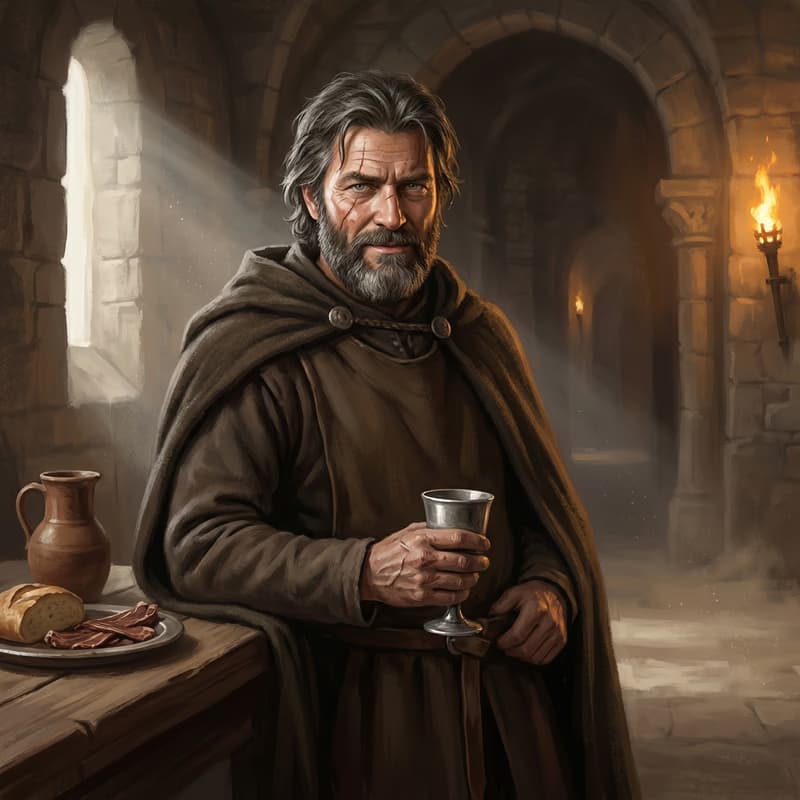
July 4, 1187. Inside Saladin's tent at the Horns of Hattin, the defeated King Guy de Lusignan sits trembling with thirst. Saladin offers him a cup of iced water. Guy drinks and passes the cup to the man beside him, Raynald of Chatillon. Saladin's face hardens. He tells Guy through an interpreter: "You gave him the drink, not I." Under Islamic custom, a host who offers food or drink guarantees a prisoner's life. Saladin has not offered Raynald anything.
The sultan turns to Raynald and recounts his crimes. The broken truces. The raided caravans. The ships launched on the Red Sea to threaten Mecca and Medina. Saladin had sworn a personal oath to kill this man with his own hands. He draws his sword and strikes Raynald across the shoulder. The guards finish the job. Guy de Lusignan watches, shaking. Saladin reassures him: "Kings do not kill kings. But that man had transgressed all bounds."
Raynald of Chatillon had arrived in the Holy Land thirty-four years earlier with nothing: no land, no fortune, no prospects beyond his sword arm. He was born around 1125 in France, the second son of a minor noble family in Chatillon-sur-Loing. The Second Crusade of 1147 carried him east, and when the Crusade collapsed, he stayed. He was tall, strong, and recklessly brave. He was also ruthless, calculating, and entirely untroubled by concepts like honor or restraint.
His first stroke of fortune came through marriage. In 1153, Constance, Princess of Antioch, chose him as her husband over several more distinguished suitors. The choice stunned the Crusader nobility. Raynald was a nobody. But Constance wanted a fighter, not a diplomat, and Raynald was exactly that.
As Prince of Antioch, he immediately demonstrated the qualities that would define his career. When the Byzantine Emperor Manuel I delayed a promised subsidy, Raynald invaded Cyprus, a Christian island under Byzantine protection. His soldiers looted every church, raped, murdered, and mutilated the civilian population. He forced the Patriarch of Antioch, who had objected to one of his schemes, to sit on the citadel roof in the summer sun with his head smeared with honey, attracting swarms of insects. This was not a man who responded to criticism gently.
In 1160, Raynald was captured during a raid into Armenian territory and imprisoned in Aleppo. He would remain in Muslim custody for sixteen years. Most men would have been broken by it. Raynald emerged in 1176 harder, leaner, and angrier. He found Antioch lost to him. Constance was dead, and the principality had passed to her son by a previous marriage. But Raynald married again, this time to Stephanie de Milly, Lady of Oultrejordain, gaining control of the massive fortress of Kerak and the territory east of the Dead Sea.
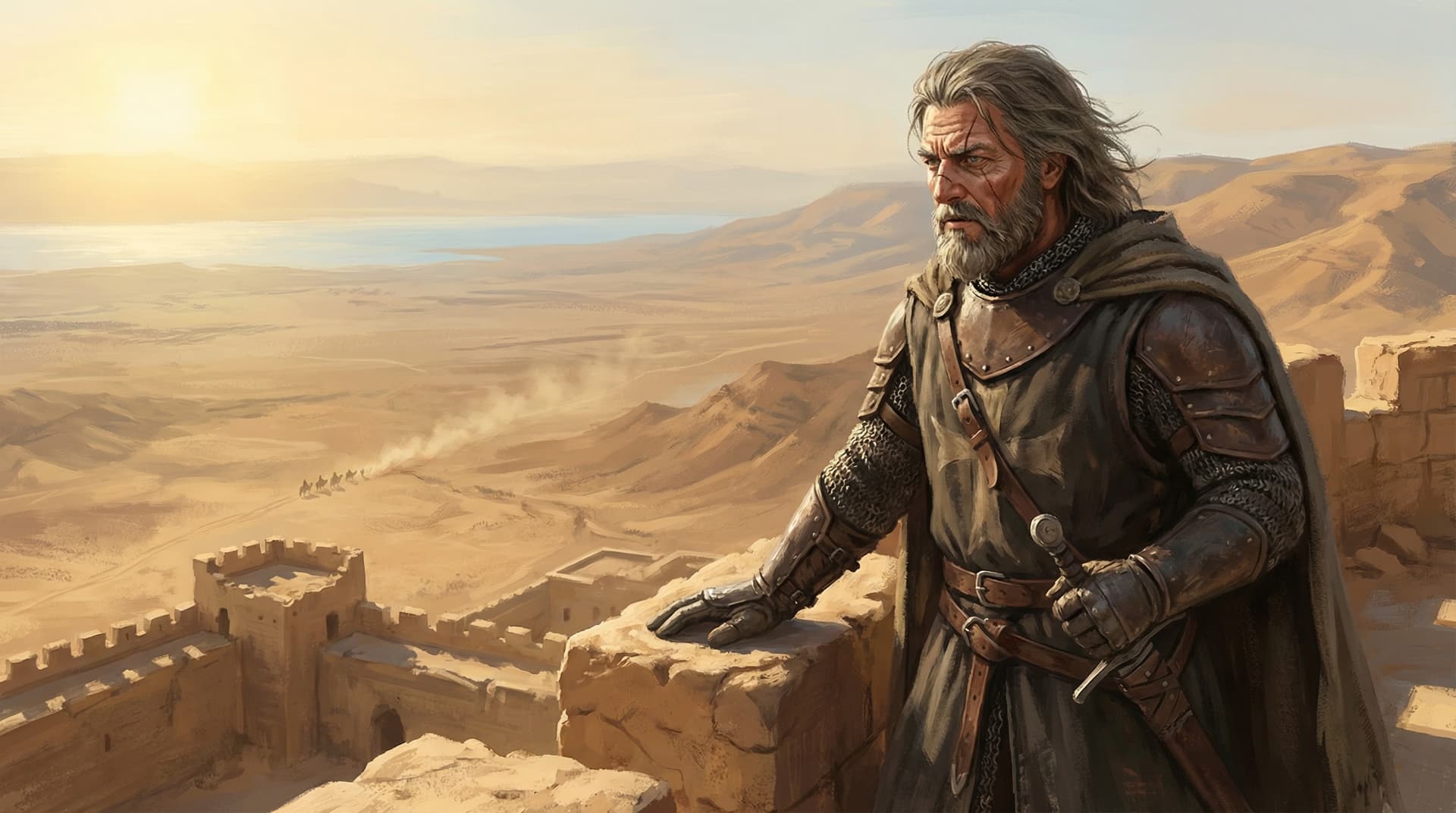
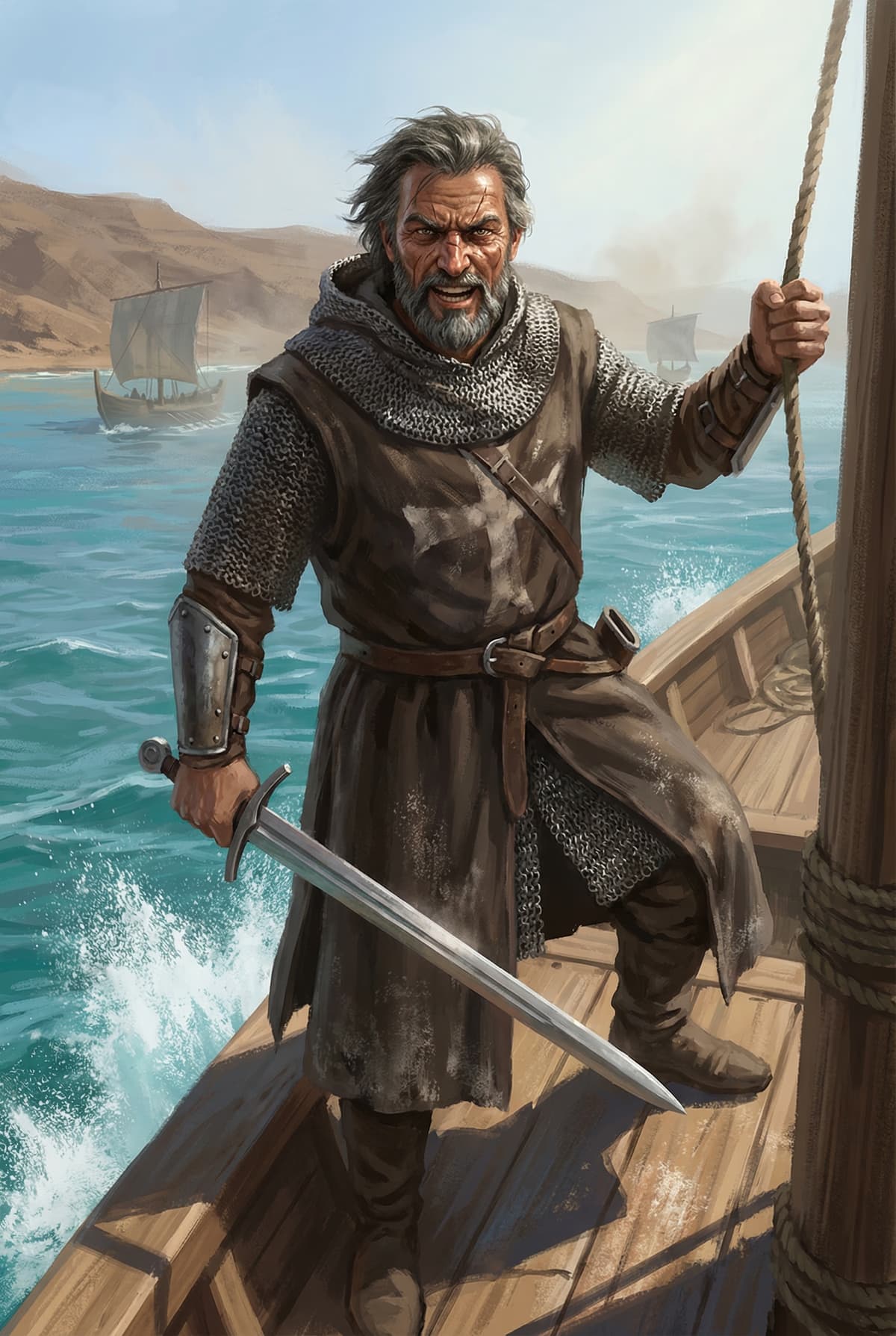
From Kerak, he commanded the overland trade routes between Egypt and Damascus. He raided them at will. He built ships, dismantled them, carried them overland to the Gulf of Aqaba, reassembled them, and launched a naval expedition down the Red Sea. His raiders reached within striking distance of Mecca and Medina. The entire Muslim world was outraged. Saladin swore to kill him personally.
Baldwin IV, the leper king, tried to control Raynald. Raymond III of Tripoli tried diplomacy. Truces were signed. Raynald ignored them. He attacked a massive Muslim caravan in late 1186 or early 1187, during a period of truce, seizing goods and prisoners. When told the truce forbade it, he reportedly sneered that the Franks could ask their Muhammad to save them. Saladin demanded the return of the prisoners and goods. Raynald refused. Saladin mobilized every soldier in his empire.
The result was Hattin. The result was the fall of Jerusalem. The result was the destruction of the Crusader kingdom. And the result was Raynald's head on the floor of Saladin's tent.
Personality & Motivations
Raynald was not stupid. He was not insane. He was a medieval warlord operating with perfect internal logic: take what you can, hold what you can, and never let anyone tell you what you cannot do. He had arrived in the East as a penniless adventurer and clawed his way to a principality through marriage and violence. Every lesson his life had taught him confirmed that aggression worked.
What he lacked was any capacity for restraint or strategic thinking beyond the next raid. He saw the Muslim caravans passing through his territory and saw only plunder. He saw the Red Sea and saw only an unguarded flank. The idea that his raids might unite the Muslim world against the kingdom, that his personal greed might trigger the extinction of everything the Crusaders had built. This calculation was either beyond him or beneath his concern.
There was also something personal in his war with Saladin. Sixteen years in a Muslim prison had not taught Raynald humility. It had taught him hatred. He emerged from captivity with an appetite for revenge that no treaty could satisfy. Every caravan he raided, every truce he broke, every provocation he hurled at the Muslim world was, at some level, Raynald settling a debt that could never be settled.
What Most People Get Wrong
Raynald is often portrayed as a simple brute, a thuggish knight too dumb to understand diplomacy. This misses the more uncomfortable truth. Raynald was intelligent, resourceful, and strategically creative. His Red Sea expedition was a logistical feat that required building a fleet from scratch, transporting it overland through desert, and projecting naval power into waters no Crusader had ever sailed. His control of the Kerak-Oultrejordain corridor gave him a chokehold on trade between Egypt and Syria that he exploited brilliantly.
The problem was not that Raynald lacked intelligence. It was that he applied his intelligence exclusively to personal enrichment and violence, with no concern for consequences beyond his own walls. He was not a fool who stumbled into catastrophe. He was a capable man who knowingly gambled the kingdom against his own profit and lost.
Key Moments
Antioch, 1153. Raynald marries Constance, Princess of Antioch, leapfrogging from landless knight to ruling prince in a single ceremony. The Crusader nobility is appalled. King Baldwin III of Jerusalem had suggested other candidates. Constance chose the fighter. Within three years, Raynald will invade Cyprus and torture the Patriarch, confirming every fear the nobility had.
Cyprus, 1156. Raynald invades the Christian island of Cyprus in retaliation for a delayed Byzantine payment. His troops loot every town, destroy churches, and mutilate the Greek clergy. He then forces the Patriarch of Antioch to sit on the castle roof with honey smeared on his head. The raid destroys any pretense that Raynald recognizes authority beyond his own.
Aleppo, 1160–1176. Captured during a raid, Raynald spends sixteen years in Muslim imprisonment. He is released in 1176, likely ransomed. He returns to find Antioch gone, his first wife dead, and the political landscape transformed. He adapts immediately, marrying Stephanie de Milly and acquiring the fortress of Kerak.
The Red Sea, 1182–1183. Raynald builds a fleet, hauls it overland to the Gulf of Aqaba, and launches raids down the Red Sea coast. His ships attack Muslim pilgrim routes and merchant vessels, and his raiders land near the ports serving Mecca and Medina. The expedition sends shockwaves through the Islamic world. Saladin's brother al-Adil destroys the fleet, but the provocation becomes Saladin's rallying cry for years.
Kerak, late 1186/early 1187. During a formal truce between Saladin and the Kingdom of Jerusalem, Raynald attacks a large Muslim caravan passing through his territory. He seizes the goods and imprisons the merchants. When King Guy demands he return the prisoners and honor the truce, Raynald refuses. Saladin masses his armies. The final war begins.
Hattin, July 4, 1187. Raynald is captured alongside King Guy after the catastrophic Crusader defeat. In Saladin's tent, the sultan personally strikes Raynald with his sword, fulfilling a vow sworn years earlier. The guards behead him. Saladin has killed the man who, more than anyone, made this war inevitable.
The Detail History Forgot
When Raynald launched his Red Sea fleet in 1182, his raiders did something that genuinely terrified the Muslim world: they attacked ships carrying Muslim pilgrims to Mecca. The idea that Christian soldiers might physically reach the holy cities of Islam was so shocking that it permanently altered Saladin's strategic calculus. Before Raynald's raid, Saladin could treat the Crusader states as a nuisance to be managed. After it, he could frame the war as an existential defense of Islam's holiest sites.
Saladin's brother al-Adil hunted down and destroyed Raynald's ships, and the captured raiders were taken to Mecca and publicly executed during the pilgrimage season. But the damage was done. Raynald had given Saladin the propaganda weapon he needed to unify the Muslim world behind the reconquest of Jerusalem. In a sense, the man who did more than anyone to destroy the Crusader kingdom also did more than anyone to create the coalition that destroyed it.
The Downfall
Raynald's downfall was not a single act but a pattern that finally caught up with him. He had spent decades raiding, breaking truces, and daring the Muslim world to stop him. For years, the Muslim world could not. It was too fragmented, too busy with internal wars, too divided to mount a unified response. Raynald had mistaken this fragmentation for permanent weakness.
Saladin changed the equation. By the mid-1180s, he had unified Egypt, Syria, and northern Mesopotamia under a single command. He had the manpower, the logistics, and the motive to destroy the Crusader states. All he needed was a pretext. Raynald handed him one by attacking the caravan during a formal truce.
The campaign that followed was methodical. Saladin massed every soldier he could find and advanced into Galilee. King Guy, pressured by Raynald and others to fight rather than wait, marched the Crusader army away from its water sources in the July heat. By the time they reached the Horns of Hattin, the army was dying of thirst. Saladin lit brush fires upwind. The infantry collapsed. The knights fought on foot until they were overwhelmed. The True Cross was captured. The kingdom's military power was annihilated in a single afternoon.
Raynald's death in Saladin's tent was the punctuation mark on a life that had been, from start to finish, a wager that force could solve every problem. It had worked for thirty-four years. He had married into power, raided his way to wealth, survived sixteen years of captivity, and terrorized an entire civilization from his desert fortress. But the one thing force could not do was make Saladin forget. The sultan had sworn an oath, and he kept it. Raynald of Chatillon died as he had lived, by the sword.