Intro

Somewhere right now, a copywriter who was making six figures two years ago is looking at her bank account and trying to figure out how her income dropped below ten thousand a year. Somewhere, a junior software engineer with a fresh computer science degree is sending out his ninety-seventh job application. Somewhere, an illustrator just opened an email from a client who has decided they will be using an AI to do what she did for them for the last decade. Somewhere, a Florida mother is staring at a credit card statement, trying to understand how she handed fifteen thousand dollars to a voice on the phone that sounded exactly like her daughter calling in tears after a car accident. None of these are predictions. They all happened in the last twelve months.
The people in charge have a phrase for what is happening. They use it in op-eds and earnings calls and commencement speeches. They call it the next industrial revolution. They mean it as a promise. The chief executive of Salesforce explained why he replaced four thousand customer service workers with software in five words. I need less heads. The chief executive of Anthropic called what is coming a white-collar bloodbath. The chief executive of OpenAI now tells investors he is delighted to be wrong about it, after spending two years telling everyone else the opposite. Seven out of ten Americans, in the most recent global trust survey, say their own chief executives are lying to them about AI taking their jobs.
And here is the thing about the people in charge calling this exciting. They are not, exactly, lying. For them, it is exciting. The cost of a revolution always lands somewhere. It rarely lands on the people making the speeches.
That phrase though, the next industrial revolution, keeps doing a particular kind of work. It is supposed to reassure you. The industrial revolution worked out. We have hospitals and cars and the weekend. So whatever this is, however bad it feels right now, sit back and let it cook.
I want to take that comparison seriously for a minute. Not the inspirational version. The actual one. Because the original industrial revolution, the one that built the modern world we are sitting inside right now, is one of the strongest arguments against the calm-down speech that has ever been written.
In Britain, in roughly the fifty years between 1790 and 1840, the country's productivity nearly doubled and ordinary people's wages barely moved. Whole trades that had supported families for generations vanished inside ten years. Children worked in factories sixteen hours a day. The cities that powered the entire economy had no voice in the government that ran it. Life expectancy in the industrial towns fell into the low thirties. Historians have a clinical word for that fifty-year stretch. They call it a pause. The people who lived inside it would have called it something else.
That is the comparison they are inviting. Five real moments from a country inside a revolution. I am going to take you inside each one. By the end of this video, you will understand why the people building the new one might be telling you the truth, and why that should land as a warning, not a promise.
Chapter 1: The Trades That Vanished
For centuries, in the villages of Lancashire and Yorkshire, weaving cloth on a handloom was a skilled trade.
A trained weaver could run his own loom in his own cottage. He set his own hours. He charged what his work was worth. The merchants came to him. It was a profession, the way that being a carpenter or a blacksmith was a profession, with apprenticeships and craft standards and a place in the social order of the village. Then, beginning in the 1810s, the power loom arrived. One mill, in one building, in one city, could out-produce hundreds of cottages. The price of cloth fell, and it kept falling, and there was no version of the old skill that was fast enough or cheap enough to compete with a machine that did not sleep.
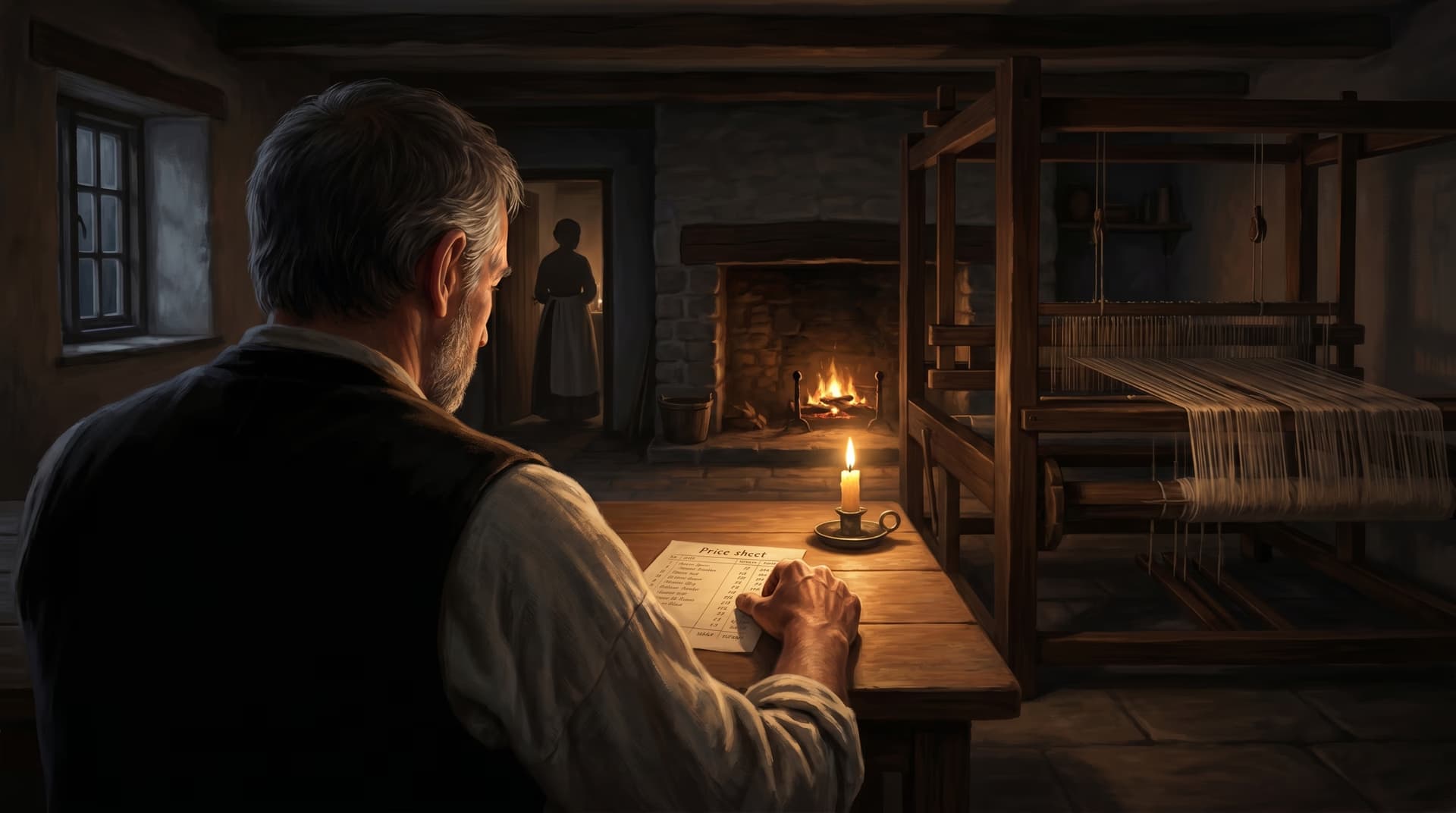
Tonight he is sitting at his kitchen table with the latest price sheet from Manchester in front of him. It is the autumn of 1826. He has been a weaver for twenty-three years. He learned the loom from his father, who learned it from his. The cloth he makes is good. The merchants who come to the village still tell him it is good. He runs the number on the page twice, by candle light, because he wants to be sure he has read it correctly. The price the mills are paying tonight, for the same cloth he has been weaving for two decades, is less than a quarter of what it was when he learned the trade. There is no version of his work, no length of his day, no fineness of his cloth, that lets him meet that number. He is still capable of doing what he has always done. There is no one who needs him to do it.
That weaver did not retire. He did not retrain in his fifties into a factory job that suited his skills. He went into the city, with his wife and his children, to look for whatever work the mills would give an adult man. A great many men like him died before the next generation found its footing. Within a single working lifetime, two hundred and forty thousand handloom weavers in England had become thirty thousand. The profession had been ended. The historians have a phrase for this kind of moment. They call it the destruction of traditional ways of life. The phrase sounds bloodless. The thing it describes was not.
If you have spent the last few years watching the publication you wrote for cut its staff. Or the trade you trained for fill with automated work. Or the assignment you used to get go instead to a system that cost the company a fraction of what they paid you. If you spent years acquiring a skill that was, until very recently, valuable, and you are watching that value evaporate in real time, the weaver in that cottage is not a stranger to you. The mechanism is identical. Only the loom is new.
But the displaced weaver, in one particular way, was lucky. Because he was an adult. The people running the new machines that put him out of business, the ones inside the factories now turning out cloth at twenty times the speed of his loom, were not.
One thing before I show you who they were. If you want more videos like this one, history that explains the news instead of just decorating it, subscribe so the next one finds you. Back to it.
This is the gate of one of those new mills. The lamps are still on. The figures walking through it are about to start a shift that will end well after dark. Some of them are not yet five feet tall. None of them get to decide whether to keep walking.
Subscribe to Nightfall History on YouTube
Join our community on YouTube for more historical deep dives and visual storytelling
Chapter 2: The Body That Pays First
A revolution is a story about machines. But the machines run on a body, and somebody has to be that body.
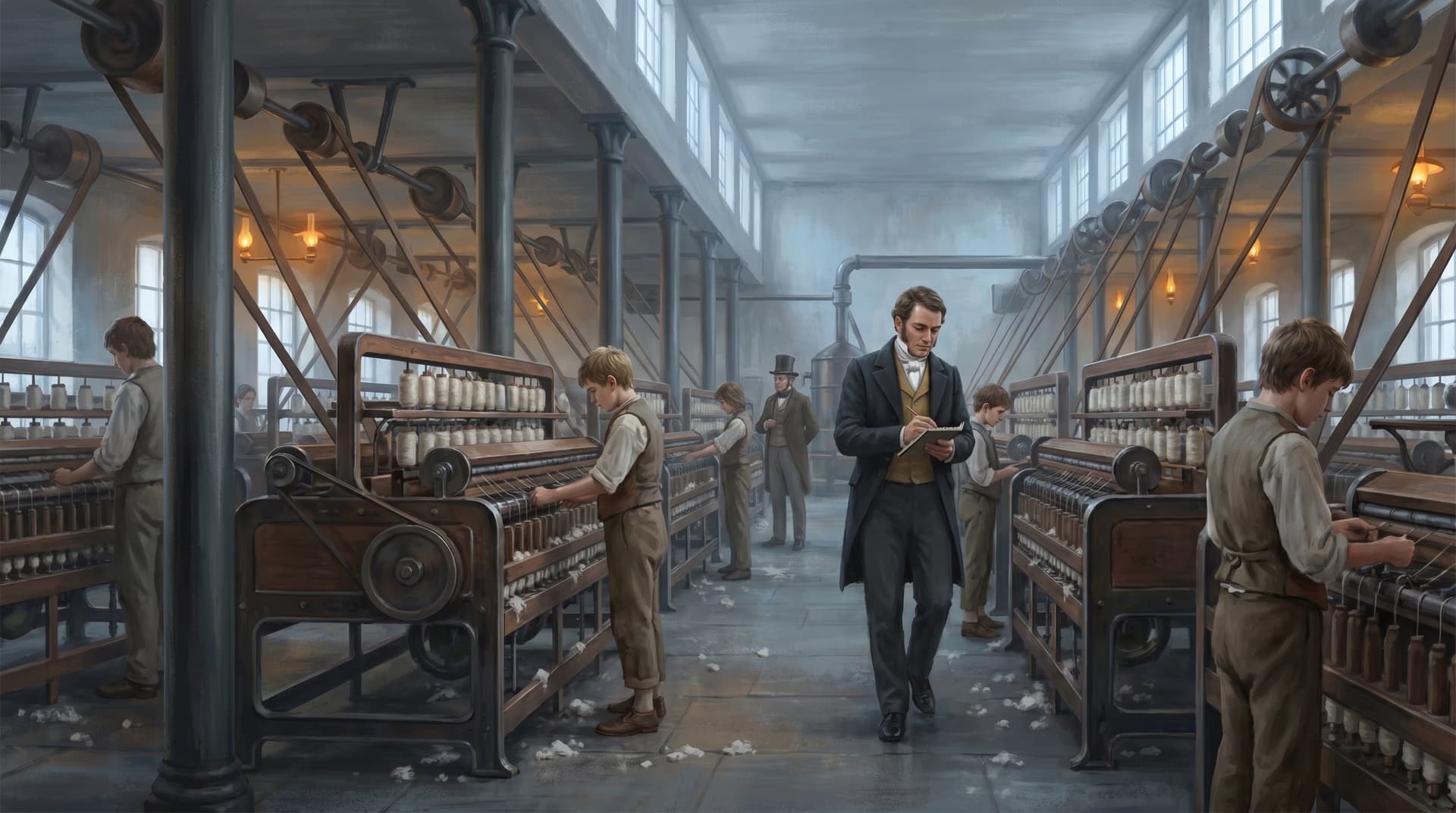
By the 1820s and 1830s, in Manchester and the cotton towns of Lancashire, mechanized factories produced cloth and iron and goods at scales no economy had ever seen. The people running the machines worked twelve to sixteen hour shifts, six days a week. They were paid wages that barely covered food. They worked without safety regulations, without rights, without any law on their side. And inside many factories, close to half the workforce was under fourteen.
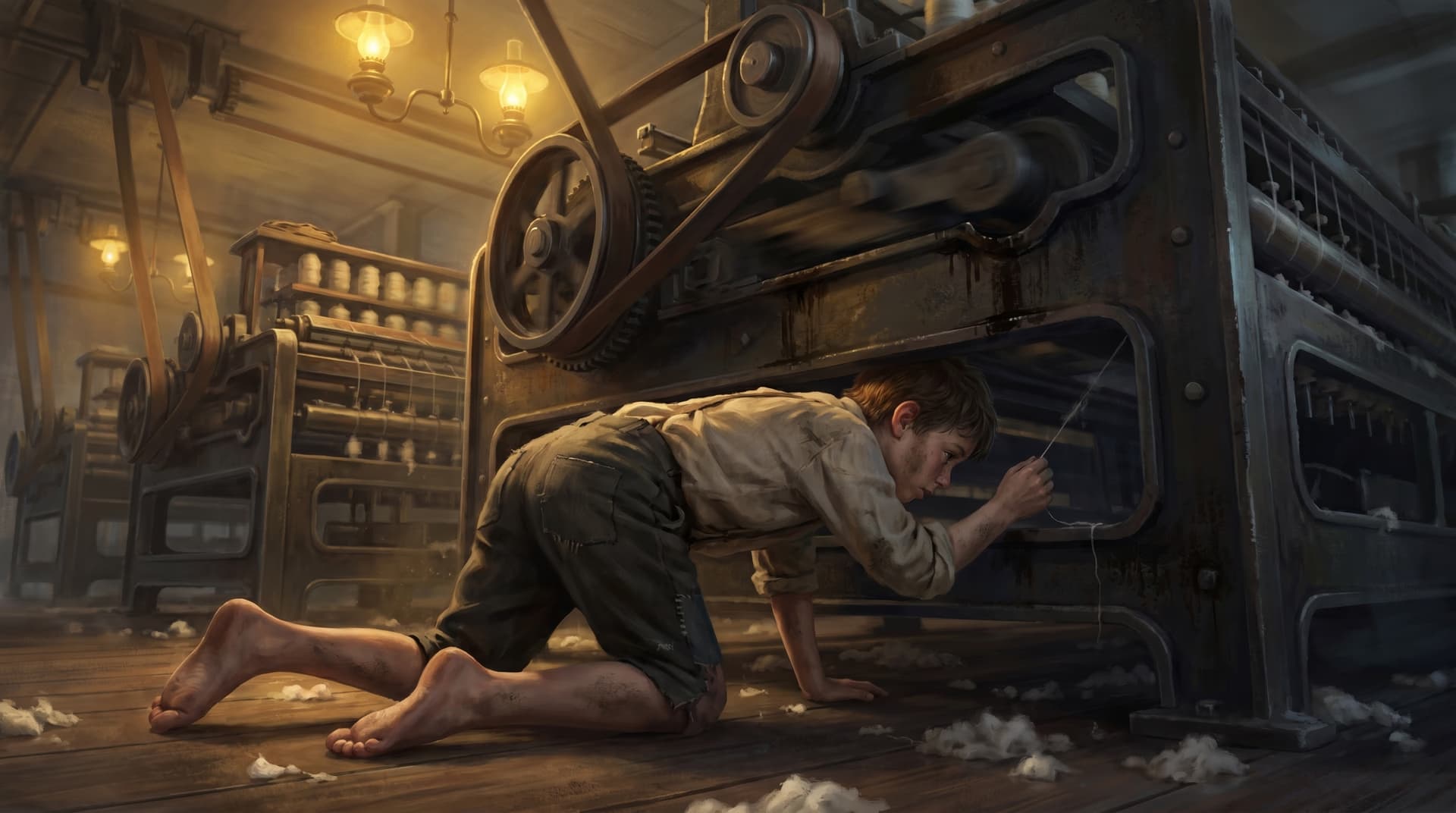
It is still dark when he leaves the house. He is nine years old, and the year is 1832. The mill where he works is a half mile through Manchester streets that are already filling with other children walking the same direction, lunch tins in their hands, eyes still half closed. His shift started an hour ago. By the middle of the day a thread will snap somewhere inside the spinning machine, and the floor manager will signal him. He will climb down between the moving parts, on his belly, into a space the size of an oven. He has done this hundreds of times. He knows the rhythm of the machine and the place to put his hands. What he does not know, today, is how long he will be under it before the manager waves the engineer to start it again.
Children were the preferred labor force for that work because they were small enough to fit under the machines. In some British coal pits, children as young as five were sent down to sit in total darkness for twelve-hour shifts, opening ventilation doors so the air kept moving. Older children, stripped to the waist, were harnessed by a belt and a chain to coal carts and made to crawl through passages as low as sixteen inches. Arriving late could mean a beating. Dozing off at a machine could cost an arm. None of this is metaphor. These are documented working conditions, in the early decades of a transformation we now teach in schools as the rise of the modern economy.
The factory owners did not stand at podiums and say this is what the new economy costs. They said it was the future. They said it was progress. And in the same sentence, they argued, fiercely, that any restriction on working hours would close their mills and ruin the country. That argument lasted decades. The children working those shifts ran out of time long before the laws caught up to them.
The men giving those speeches were not the ones losing fingers. Their children were not the ones walking to a mill in the dark. The cost of the new economy was real. It just was not theirs.
The displaced weavers in the villages and the children inside the new factories had something in common. They had no political voice. The system governing the country had been built for a country that no longer existed. And the people who benefited from keeping it that way were prepared to defend it with cavalry.
Chapter 3: The City With No Voice
Before 1832, the British parliament was elected through a patchwork of constituencies that had been drawn centuries earlier, when the country looked completely different.
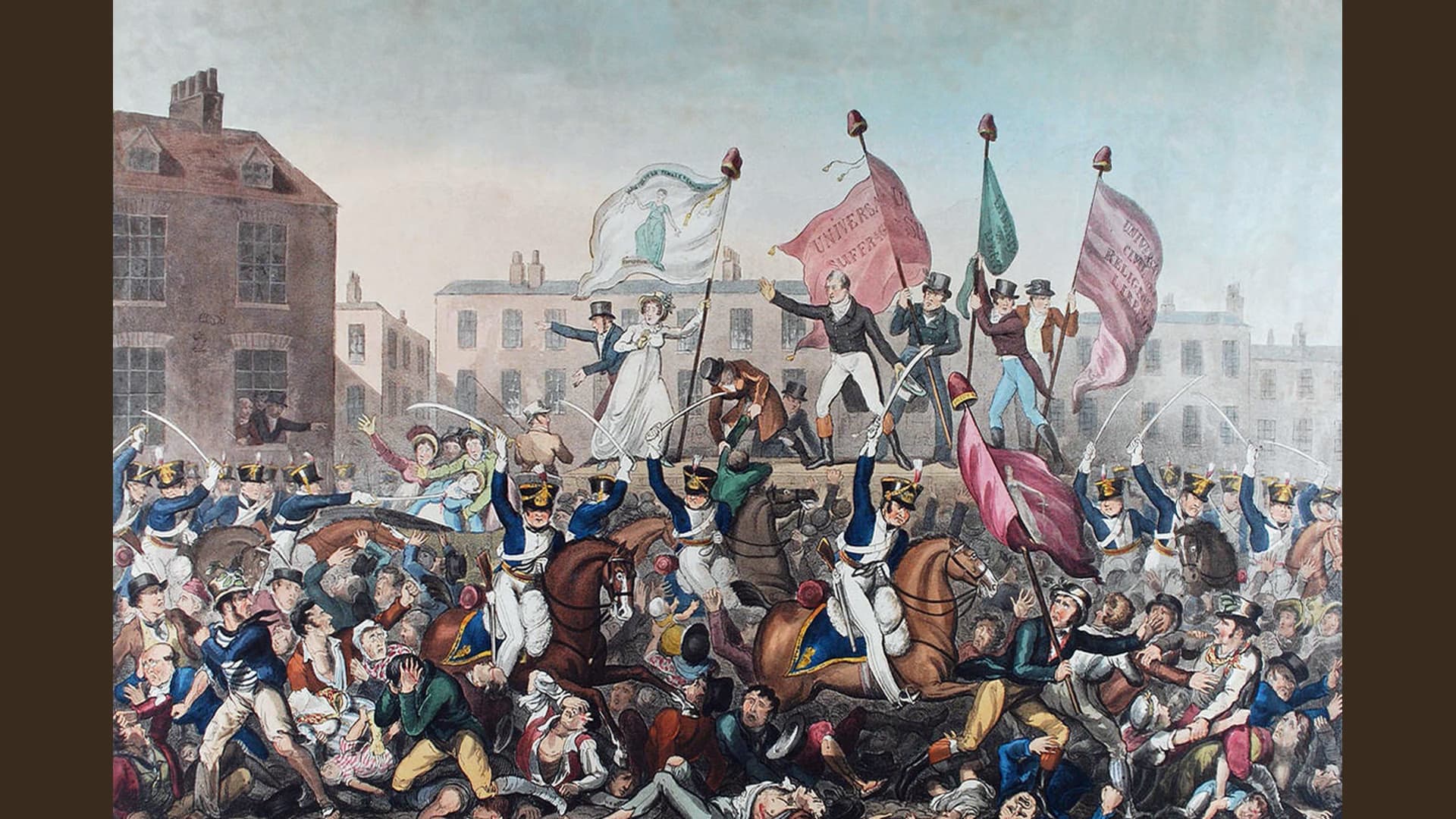
Some of those constituencies, called rotten boroughs, had once been real towns and had since shrunk to almost nothing. A constituency with twelve voters might still elect two members of parliament. The voters were usually selected, in practice, by whichever local landlord owned the place. Meanwhile, Manchester, the city that more than any other in the country powered the entire industrial revolution, the manufacturing heart of the British economy, had zero members of parliament. None. The city building the new world had no voice inside the government governing it.
It is the morning of August the sixteenth, 1819. A field on the edge of Manchester. The crowd is enormous, perhaps sixty thousand people, perhaps more. Working families have walked in from the surrounding mill towns, dressed in their good clothes. They have brought their children. There are picnics. The mood is calm. They are here to listen to a speaker named Henry Hunt, who has come up from London to argue that a city the size of theirs should have the right to elect a representative in parliament. Hunt has not finished his first sentence when the local magistrates, watching from a nearby window, decide the assembly is unlawful and order the cavalry to arrest him. The cavalry rides into the crowd with sabers drawn. They cannot reach Hunt without going through the people standing between them. By the time the field clears, eighteen people are dead, including a small child, and several hundred more are wounded. The newspapers will call it Peterloo.
It would take another thirteen years, and the Reform Crisis of 1832, a constitutional crisis that nearly broke the monarchy, before Manchester was given its first members of parliament. The argument the people in that field had been making turned out to be both correct and survivable. The country did not, in fact, collapse when working cities got the vote. The people who had insisted it would, who had said any reform would destroy the nation, were the people whose power the reform was about to reduce.
Now think about the communities, in Georgia and Maryland and Virginia, where data centers for the new revolution are being built without meaningful local consent. Where the residents who live next to those facilities can find out that their household electricity bills are subsidizing the rate the data centers pay for the same grid. Where the local water table is being drained on the strength of a permit nobody on the street had a chance to weigh in on. The rotten boroughs are not gone. They have new addresses.
Eventually, a lot of this did get better. The curve did bend. But it did not bend on its own. And the story of how it bent is the part of the inspirational version that almost never gets told.
Chapter 4: The Decades Before It Bent
The first factory act in Britain was passed in 1802. By historical consensus, it did almost nothing.
It set rules and assigned no inspectors. The factory owners ignored it. It took another thirty years of campaigns, parliamentary reports, sworn testimony, newspaper exposes, working-class meetings, and political pressure before the Factory Act of 1833 finally placed meaningful restrictions on child labor in textile mills. Every step of the way, the men who owned those mills said the same thing. They said any regulation on working hours would close their factories. They said the British economy depended on the conditions exactly as they were. They said the reformers did not understand industry.
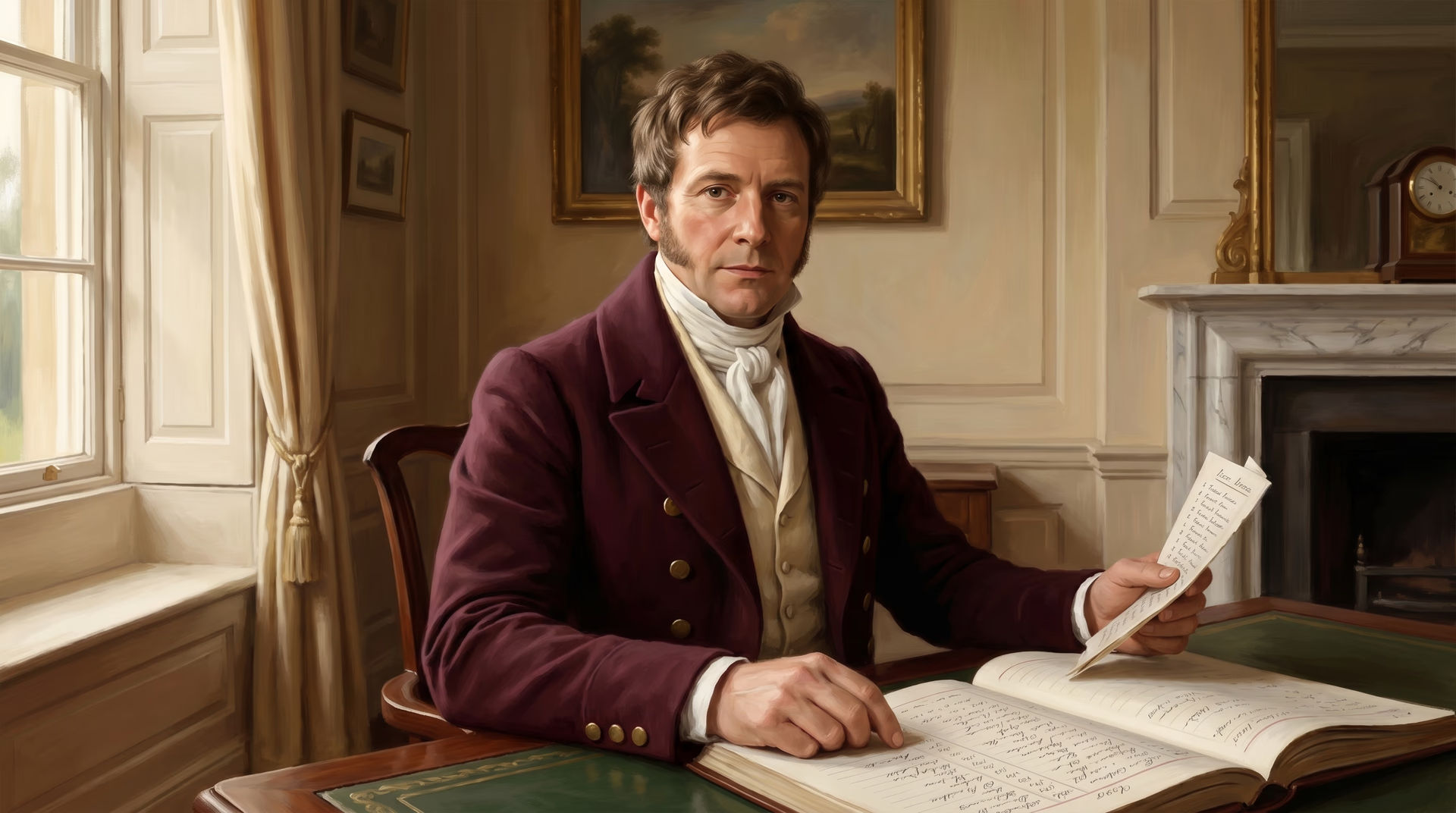
The young man at the table is twenty-two years old. He has been working in textile mills since he was a boy. The year is 1832. He is testifying before a committee chaired by a member of parliament named Michael Sadler, who has spent the last year collecting witnesses like this one and bringing them to London. The young man describes the hours he worked as a child. He describes the overseers, and the way they kept the children awake with a leather strap. He describes the morning a machine took the fingers of the girl who worked next to him, and what the floor manager said, and what happened to the girl afterward. He is describing all of it in a calm voice, because he has been describing it for a year, in newspapers, in pamphlets, in working-class meeting halls across the north. The Sadler Committee's findings will be published the following spring. They will be the document that finally forces parliament to take the question seriously.
The law that followed, the Factory Act of 1833, limited the working day for children under thirteen to nine hours, forbade the employment of children under nine in textile mills, and required factory inspectors paid by the government to enforce it. The mills did not close. The economy did not collapse. The predictions of disaster turned out to be wrong, in the way that predictions of that kind almost always turn out to be wrong. They were not analysis. They were a script.
A version of that same script is being read out loud, today, by the people building the new revolution. Any meaningful regulation on artificial intelligence, they say, will destroy American competitiveness. Will hand the future to China. Will cripple the economy. The factory owners said the same thing about the ten-hour day in 1832. The economy was fine. The economy was always going to be fine. The thing that was at risk was not the country. It was the part of the profit being kept upstream of any law.
Stay in the Loop
Get notified when new articles and videos drop. Unsubscribe anytime.
Chapter 5: Where You're Standing
Here is the piece of the story the inspirational version is built to leave out.
The benefits of the industrial revolution, the wealth, the medicine, the public schools, the democracy, the eight-hour day, the weekend, the pension, the safety inspector, every part of it the modern world quietly rests on, none of it arrived automatically. None of it was a feature of the technology. All of it was the work of people who were being ground up by the system, and who organized, and demonstrated, and testified, and lobbied, and voted, and struck, and pushed until the government caught up with the reality they were living in. The technology built the wealth. The fight built the share of it that reached ordinary people. Every generation since has lived inside both at once, and the inspirational version mostly remembers the wealth.
Which means the real question, when somebody tells you we are at the beginning of the next industrial revolution, is not whether they are right. The answer to that may very well be yes. The real question is the one they are not asking out loud. Which kind. Which version of this revolution are we living through.
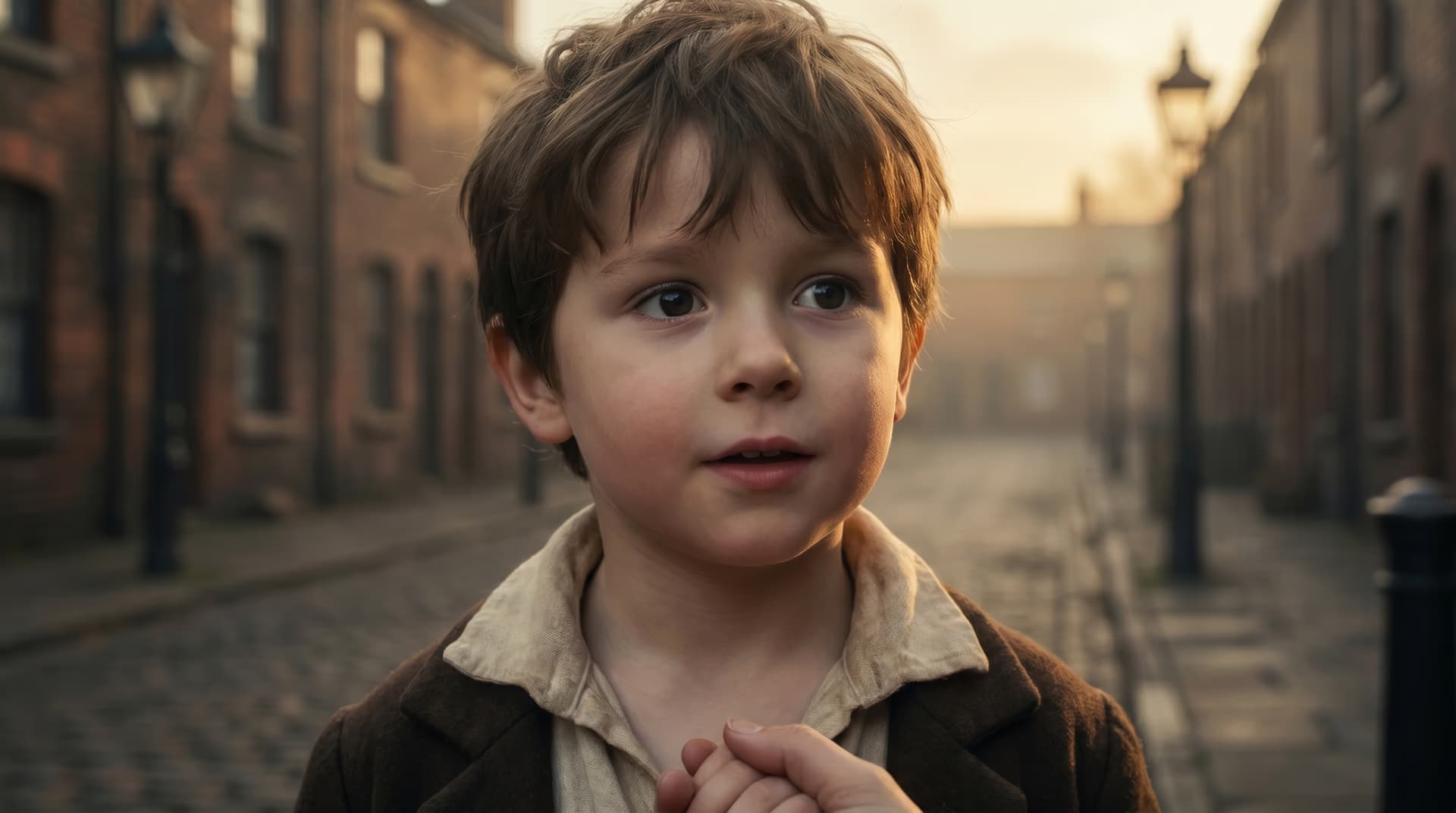
It is a morning in Manchester, in the autumn of 1833. A young mother is walking her two children along a row of brick terraces toward a school at the end of the street. The youngest is six years old. A year ago, the youngest would not have been going to school. He would have been going with her, before sunrise, to the mill where children his age sat at their machines from dawn until after dark. The Factory Act, passed earlier this year, forbade that, finally, for children under nine. He does not know that any of this has changed. He only knows that he is going to school, and that his sister is going with him, and that his mother is walking them there. Somewhere across the rooftops the factory bell starts in the distance. The mother does not turn toward it.
There is a version of artificial intelligence that ends the way that morning ends. The reforms that build it into something that serves the people who live inside it, not only the people who own it, arrive within years instead of decades. The cities and counties where its infrastructure is being installed get a meaningful seat at the table. The trades it displaces get rebuilt around it instead of buried under it. There is also a version where none of that happens, and the country gets a second look, in our lifetime, at what an unmanaged revolution does to the people on the wrong side of it. Both versions are open right now.
The graduates leaving an engineering school with a degree in machine learning, and the graduates leaving the same week, in the same city, with a degree in writing or design or journalism, are not living through the same technological moment. They are living through the same announcement of one. One of them is being told this is exciting because, for that one, it is. The other is being told the same thing in the same tone, and it lands as something between a dismissal and a threat. Both reactions are correct. They are not bipolar. They are accurate descriptions of the same revolution, from two different places inside it.
The people writing the inspirational version of this story are standing in roughly the same place the people writing the inspirational version of the last revolution stood. Which is to say, not on the factory floor. Not in the village where the trade is dying. Not in the kitchen where somebody is trying to figure out how to make rent on what is left. The cost is real. It is just not theirs. And costs that are not yours are easier to talk past.
The question, the one that history keeps handing back to us, is which way we want to answer it this time. And whether we are willing to do the part of the work that the inspirational version always edits out.
Outro

Nobody alive knows which version of this we end up in. The honest answer is that the upside is real, the downside is serious, and the uncertainty itself is the hard part. The people being told this is going to be exciting are not wrong to feel what they are feeling. The people writing the inspirational version are not wrong to feel hope. Both registers are correct. They are describing different parts of the same revolution from different places inside it. The one thing the history is clear on is that the gap between those two places is not closed by the technology. It is closed by the people on the wrong side of it being heard. That is the part nobody onstage tends to want to talk about. It is also the only part that has ever actually worked.
If this video was useful to you, the next one will be too. Subscribe so it finds you when it lands. I will see you in the next one.